Alfons G. Hoekstra – författare
Visar alla böcker från författaren Alfons G. Hoekstra. Handla med fri frakt och snabb leverans.
11 produkter
11 produkter
Häftad, Engelska, 2004
1 112 kr
Skickas inom 10-15 vardagar
"What joy to discern the minute in in?nity, the vast to perceive in the small, what divinity!" Jacob Bernoulli (1654-1705) in Ars Conjectandi (1713) We are proud to present to you the proceedings of the Sixth International C- ference on Cellular Automata for Research and Industry (ACRI 2004), held in Amsterdam, The Netherlands on October 25-27, 2004. Since the ?rst conference in Italy, ACRI, which is held biennially, has become the premier conference in the ?eld of cellular automata in Europe and beyond, and is still growing in quality and size. This year's theme was "From Individual to Collective Behavior", emphas- ing the capability of Cellular Automata to simulate macroscopic processes from individual, local interactions. Cellular Automata, in spite of their apparent s- plicity, represent a very powerful approach to studying spatio-temporal systems in which complex phenomena build up out of many simple local interactions. In thewordsofRichardFeynmanintheCharacterofPhysicalLaw(1982),"Nature uses only the longest threads to weave her patterns, so each small piece of her fabric reveals the organization of the entire tapestry".John von Neumann, who is recognized as the father of cellular automata, would have been 100 years old in 2004. ACRI 2004 wanted to commemorate this date by inviting researchers to submit contributions related to von Neumann's work or to the emergence of organization in systems in which collaboration between components wins over the individual behavior.
E-bok
PDF, Engelska, 20041 367 kr
Läs direkt efter köp
Häftad, Engelska, 2002
1 112 kr
Skickas inom 10-15 vardagar
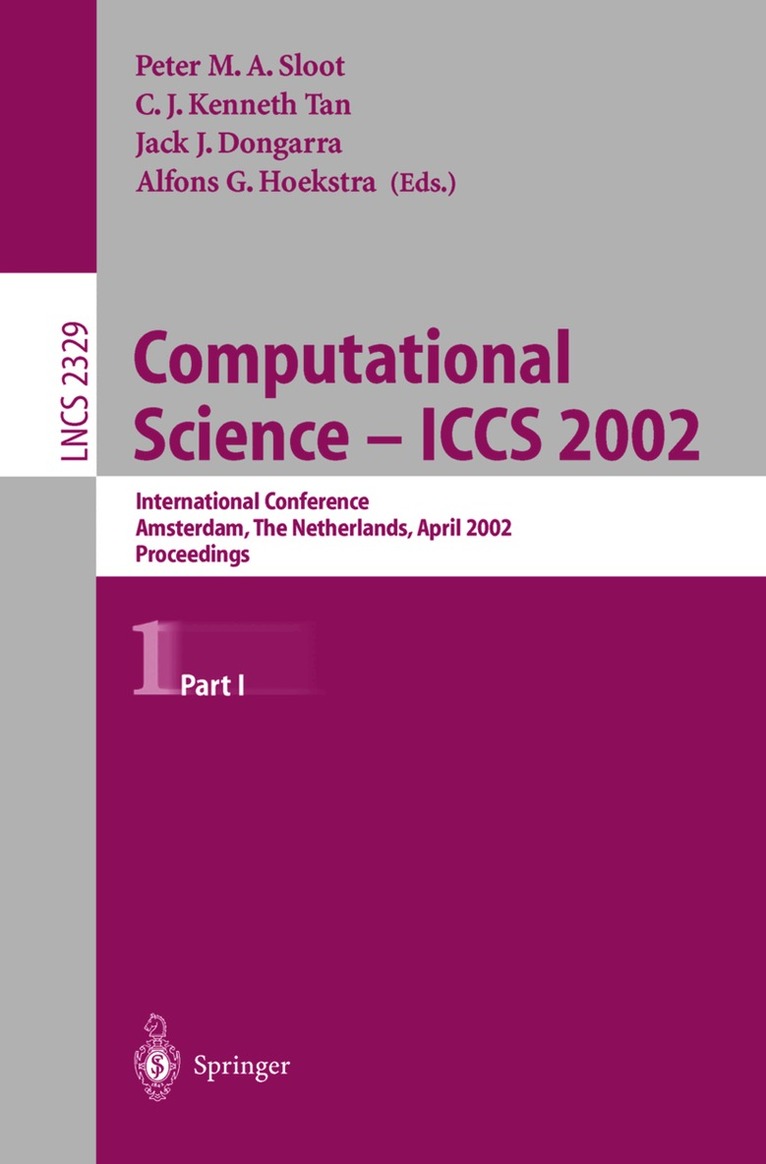
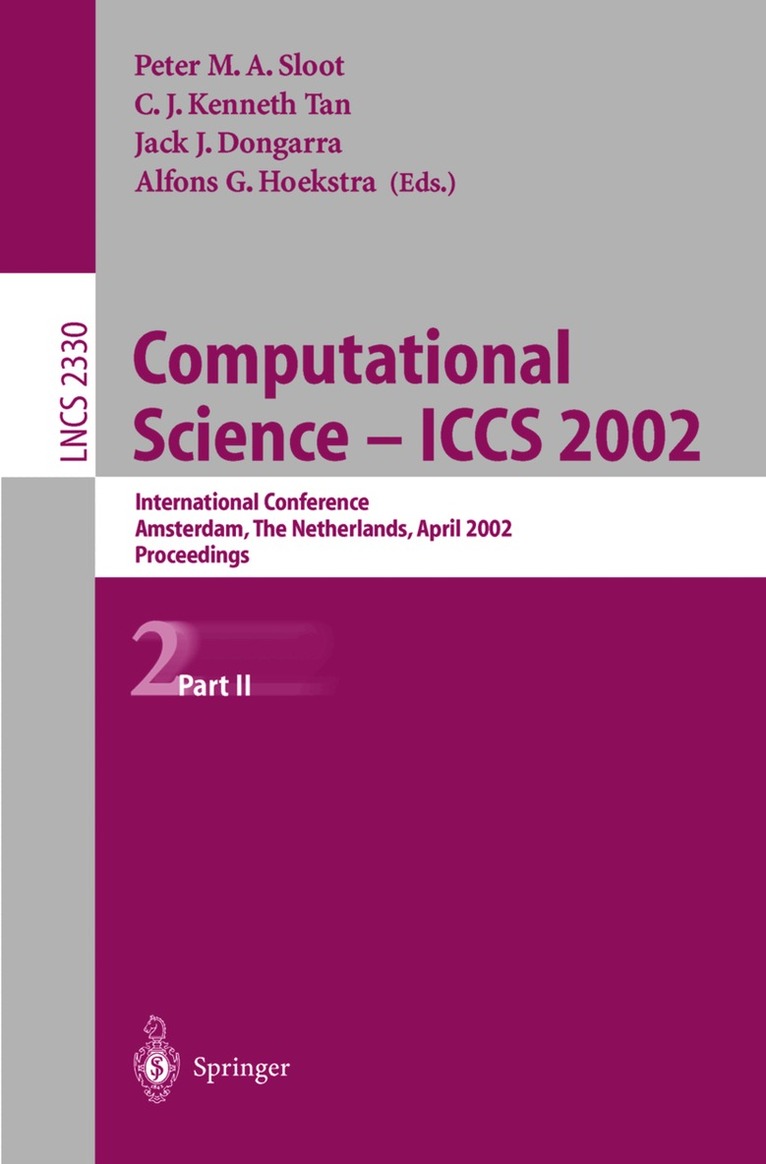
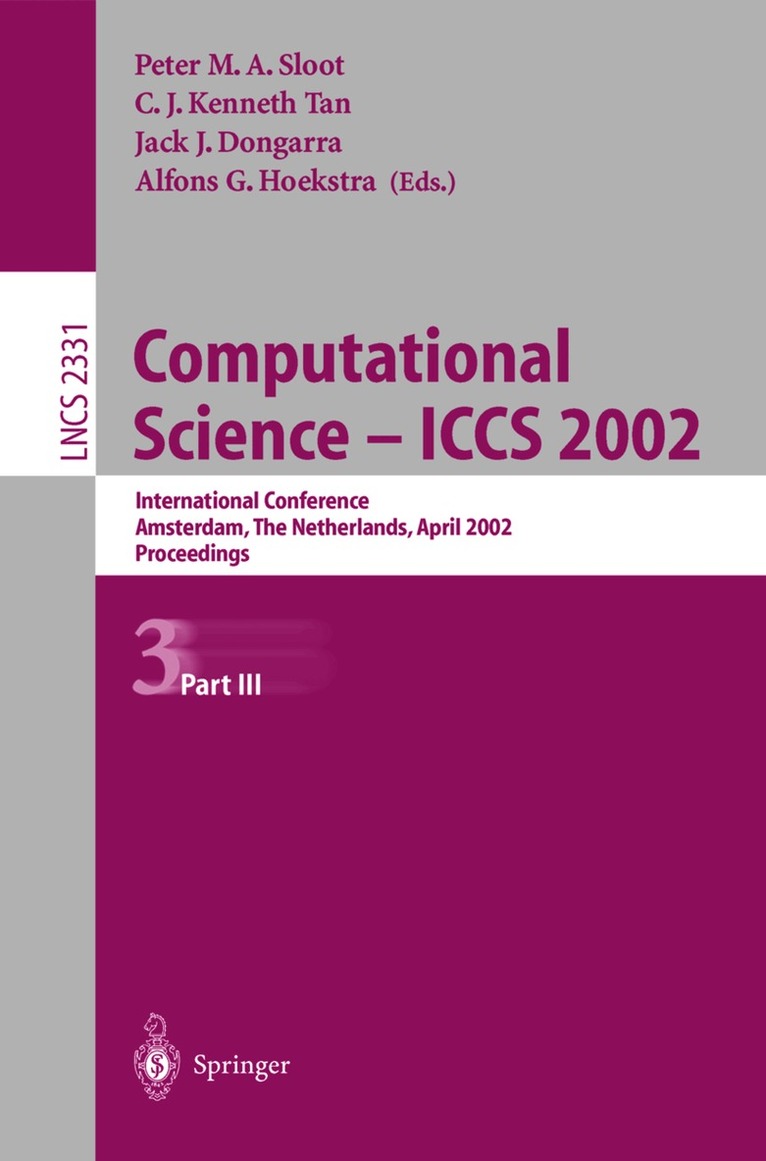
Computational Science is the scienti?c discipline that aims at the development and understanding of new computational methods and techniques to model and simulate complex systems. The area of application includes natural systems – such as biology, envir- mental and geo-sciences, physics, and chemistry – and synthetic systems such as electronics and ?nancial and economic systems. The discipline is a bridge b- ween ‘classical’ computer science – logic, complexity, architecture, algorithms – mathematics, and the use of computers in the aforementioned areas. The relevance for society stems from the numerous challenges that exist in the various science and engineering disciplines, which can be tackled by advances made in this ?eld. For instance new models and methods to study environmental issues like the quality of air, water, and soil, and weather and climate predictions through simulations, as well as the simulation-supported development of cars, airplanes, and medical and transport systems etc. Paraphrasing R. Kenway (R.D. Kenway, Contemporary Physics. 1994): ‘There is an important message to scientists, politicians, and industrialists: in the future science, the best industrial design and manufacture, the greatest medical progress, and the most accurate environmental monitoring and forecasting will be done by countries that most rapidly exploit the full potential ofcomputational science’. Nowadays we have access to high-end computer architectures and a large range of computing environments, mainly as a consequence of the enormous s- mulus from the various international programs on advanced computing, e.g.
Häftad, Engelska, 2002
559 kr
Skickas inom 10-15 vardagar
Computational Science is the scienti?c discipline that aims at the development and understanding of new computational methods and techniques to model and simulate complex systems. The area of application includes natural systems – such as biology, envir- mental and geo-sciences, physics, and chemistry – and synthetic systems such as electronics and ?nancial and economic systems. The discipline is a bridge b- ween ‘classical’ computer science – logic, complexity, architecture, algorithms – mathematics, and the use of computers in the aforementioned areas. The relevance for society stems from the numerous challenges that exist in the various science and engineering disciplines, which can be tackled by advances made in this ?eld. For instance new models and methods to study environmental issues like the quality of air, water, and soil, and weather and climate predictions through simulations, as well as the simulation-supported development of cars, airplanes, and medical and transport systems etc. Paraphrasing R. Kenway (R.D. Kenway, Contemporary Physics. 1994): ‘There is an important message to scientists, politicians, and industrialists: in the future science, the best industrial design and manufacture, the greatest medical progress, and the most accurate environmental monitoring and forecasting will be done by countries that most rapidly exploit the full potential ofcomputational science’. Nowadays we have access to high-end computer architectures and a large range of computing environments, mainly as a consequence of the enormous s- mulus from the various international programs on advanced computing, e.g.
660 kr
Skickas inom 10-15 vardagar
Computational Science is the scientific discipline that aims at the development and understanding of new computational methods and techniques to model and simulate complex systems. The area of application includes natural systems - such as biology environ mental and geo-sciences, physics, and chemistry - and synthetic systems such as electronics and financial and economic systems. The discipline is a bridge bet ween 'classical' computer science - logic, complexity, architecture, algorithm- mathematics, and the use of computers in the aforementioned areas. The relevance for society stems from the numerous challenges that exist in the various science and engineering disciplines, which can be tackled by advances made in this field. For instance new models and methods to study environmental issues like the quality of air, water, and soil, and weather and climate predictions through simulations, as well as the simulation-supported development of cars, airplanes, and medical and transportsystems etc. Paraphrasing R. Kenway (R.D. Kenway, Contemporary Physics. 1994): 'There is an important message to scientists, politicians, and industrialists: in the future science, the best industrial design and manufacture, the greatest medical progress, and the most accurate environmental monitoring and forecasting will be done by countries that most rapidly exploit the full potential of computational science'. Nowadays we have access to high-end computer architectures and a large range of computing environments, mainly as a consequence of the enormous sti mulus from the various international programs on advanced computing, e.g.
E-bok
PDF, Engelska, 20031 416 kr
Läs direkt efter köp
Computational Science is the scienti?c discipline that aims at the development and understanding of new computational methods and techniques to model and simulate complex systems. The area of application includes natural systems – such as biology, envir- mental and geo-sciences, physics, and chemistry – and synthetic systems such as electronics and ?nancial and economic systems. The discipline is a bridge b- ween ‘classical’ computer science – logic, complexity, architecture, algorithms – mathematics, and the use of computers in the aforementioned areas. The relevance for society stems from the numerous challenges that exist in the various science and engineering disciplines, which can be tackled by advances made in this ?eld. For instance new models and methods to study environmental issues like the quality of air, water, and soil, and weather and climate predictions through simulations, as well as the simulation-supported development of cars, airplanes, and medical and transport systems etc. Paraphrasing R. Kenway (R.D. Kenway, Contemporary Physics. 1994): ‘There is an important message to scientists, politicians, and industrialists: in the future science, the best industrial design and manufacture, the greatest medical progress, and the most accurate environmental monitoring and forecasting will be done by countries that most rapidly exploit the full potential ofcomputational science’. Nowadays we have access to high-end computer architectures and a large range of computing environments, mainly as a consequence of the enormous s- mulus from the various international programs on advanced computing, e.g.
E-bok
PDF, Engelska, 2003712 kr
Läs direkt efter köp
Computational Science is the scienti?c discipline that aims at the development and understanding of new computational methods and techniques to model and simulate complex systems. The area of application includes natural systems – such as biology, envir- mental and geo-sciences, physics, and chemistry – and synthetic systems such as electronics and ?nancial and economic systems. The discipline is a bridge b- ween ‘classical’ computer science – logic, complexity, architecture, algorithms – mathematics, and the use of computers in the aforementioned areas. The relevance for society stems from the numerous challenges that exist in the various science and engineering disciplines, which can be tackled by advances made in this ?eld. For instance new models and methods to study environmental issues like the quality of air, water, and soil, and weather and climate predictions through simulations, as well as the simulation-supported development of cars, airplanes, and medical and transport systems etc. Paraphrasing R. Kenway (R.D. Kenway, Contemporary Physics. 1994): ‘There is an important message to scientists, politicians, and industrialists: in the future science, the best industrial design and manufacture, the greatest medical progress, and the most accurate environmental monitoring and forecasting will be done by countries that most rapidly exploit the full potential ofcomputational science’. Nowadays we have access to high-end computer architectures and a large range of computing environments, mainly as a consequence of the enormous s- mulus from the various international programs on advanced computing, e.g.
E-bok
PDF, Engelska, 2003687 kr
Läs direkt efter köp
Computational Science is the scientific discipline that aims at the development and understanding of new computational methods and techniques to model and simulate complex systems. The area of application includes natural systems - such as biology environ mental and geo-sciences, physics, and chemistry - and synthetic systems such as electronics and financial and economic systems. The discipline is a bridge bet ween ''classical'' computer science - logic, complexity, architecture, algorithm- mathematics, and the use of computers in the aforementioned areas. The relevance for society stems from the numerous challenges that exist in the various science and engineering disciplines, which can be tackled by advances made in this field. For instance new models and methods to study environmental issues like the quality of air, water, and soil, and weather and climate predictions through simulations, as well as the simulation-supported development of cars, airplanes, and medical and transportsystems etc. Paraphrasing R. Kenway (R.D. Kenway, Contemporary Physics. 1994): ''There is an important message to scientists, politicians, and industrialists: in the future science, the best industrial design and manufacture, the greatest medical progress, and the most accurate environmental monitoring and forecasting will be done by countries that most rapidly exploit the full potential of computational science''. Nowadays we have access to high-end computer architectures and a large range of computing environments, mainly as a consequence of the enormous sti mulus from the various international programs on advanced computing, e.g.
Inbunden, Engelska, 2010
1 080 kr
Skickas inom 10-15 vardagar
Deeply rooted in fundamental research in Mathematics and Computer Science, Cellular Automata (CA) are recognized as an intuitive modeling paradigm for Complex Systems. Already very basic CA, with extremely simple micro dynamics such as the Game of Life, show an almost endless display of complex emergent behavior. Conversely, CA can also be designed to produce a desired emergent behavior, using either theoretical methodologies or evolutionary techniques. Meanwhile, beyond the original realm of applications - Physics, Computer Science, and Mathematics – CA have also become work horses in very different disciplines such as epidemiology, immunology, sociology, and finance. In this context of fast and impressive progress, spurred further by the enormous attraction these topics have on students, this book emerges as a welcome overview of the field for its practitioners, as well as a good starting point for detailed study on the graduate and post-graduate level. The book contains three parts, two major parts on theory and applications, and a smaller part on software. The theory part contains fundamental chapters on how to design and/or apply CA for many different areas. In the applications part a number of representative examples of really using CA in a broad range of disciplines is provided - this part will give the reader a good idea of the real strength of this kind of modeling as well as the incentive to apply CA in their own field of study. Finally, we included a smaller section on software, to highlight the important work that has been done to create high quality problem solving environments that allow to quickly and relatively easily implement a CA model and run simulations, both on the desktop and if needed, on High Performance Computing infrastructures.
E-bok
PDF, Engelska, 20101 367 kr
Läs direkt efter köp
Deeply rooted in fundamental research in Mathematics and Computer Science, Cellular Automata (CA) are recognized as an intuitive modeling paradigm for Complex Systems. Already very basic CA, with extremely simple micro dynamics such as the Game of Life, show an almost endless display of complex emergent behavior. Conversely, CA can also be designed to produce a desired emergent behavior, using either theoretical methodologies or evolutionary techniques. Meanwhile, beyond the original realm of applications - Physics, Computer Science, and Mathematics – CA have also become work horses in very different disciplines such as epidemiology, immunology, sociology, and finance. In this context of fast and impressive progress, spurred further by the enormous attraction these topics have on students, this book emerges as a welcome overview of the field for its practitioners, as well as a good starting point for detailed study on the graduate and post-graduate level. The book contains three parts, two major parts on theory and applications, and a smaller part on software. The theory part contains fundamental chapters on how to design and/or apply CA for many different areas. In the applications part a number of representative examples of really using CA in a broad range of disciplines is provided - this part will give the reader a good idea of the real strength of this kind of modeling as well as the incentive to apply CA in their own field of study. Finally, we included a smaller section on software, to highlight the important work that has been done to create high quality problem solving environments that allow to quickly and relatively easily implement a CA model and run simulations, both on the desktop and if needed, on High Performance Computing infrastructures.
Häftad, Engelska, 2012
1 080 kr
Skickas inom 10-15 vardagar
Deeply rooted in fundamental research in Mathematics and Computer Science, Cellular Automata (CA) are recognized as an intuitive modeling paradigm for Complex Systems. Already very basic CA, with extremely simple micro dynamics such as the Game of Life, show an almost endless display of complex emergent behavior. Conversely, CA can also be designed to produce a desired emergent behavior, using either theoretical methodologies or evolutionary techniques. Meanwhile, beyond the original realm of applications - Physics, Computer Science, and Mathematics – CA have also become work horses in very different disciplines such as epidemiology, immunology, sociology, and finance. In this context of fast and impressive progress, spurred further by the enormous attraction these topics have on students, this book emerges as a welcome overview of the field for its practitioners, as well as a good starting point for detailed study on the graduate and post-graduate level. The book contains three parts, two major parts on theory and applications, and a smaller part on software. The theory part contains fundamental chapters on how to design and/or apply CA for many different areas. In the applications part a number of representative examples of really using CA in a broad range of disciplines is provided - this part will give the reader a good idea of the real strength of this kind of modeling as well as the incentive to apply CA in their own field of study. Finally, we included a smaller section on software, to highlight the important work that has been done to create high quality problem solving environments that allow to quickly and relatively easily implement a CA model and run simulations, both on the desktop and if needed, on High Performance Computing infrastructures.