Alla P. Toropova – författare
Visar alla böcker från författaren Alla P. Toropova. Handla med fri frakt och snabb leverans.
4 produkter
4 produkter
Inbunden, Engelska, 2023
1 956 kr
Skickas inom 10-15 vardagar
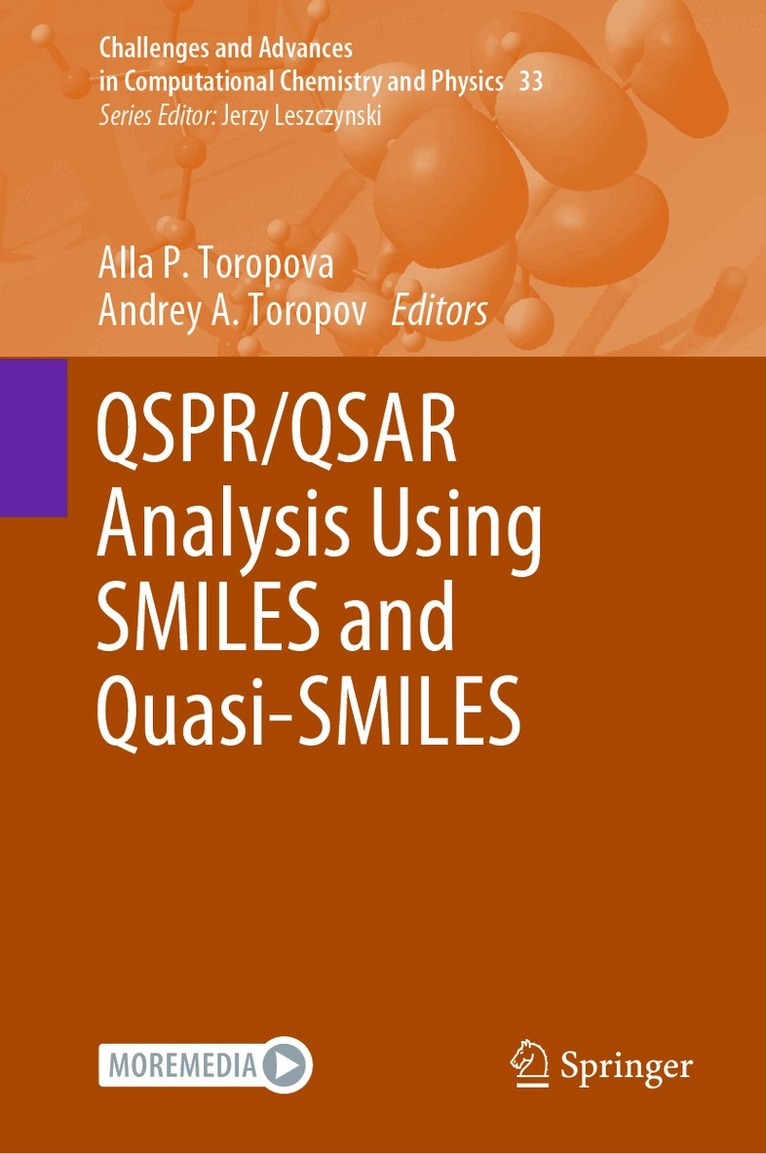
This contributed volume overviews recently presented approaches for carrying out QSPR/QSAR analysis by using a simplifying molecular input-line entry system (SMILES) to represent the molecular structure. In contrast to traditional SMILES, quasi-SMILES is a sequence of special symbols-codes that reflect molecular features and codes of experimental conditions. SMILES and quasi-SMILES serve as a basis to develop QSPR/QSAR as well Nano-QSPR/QSAR via the Monte Carlo calculation that provides the so-called optimal descriptors for QSPR/QSAR models. The book presents a reliable technology for developing Nano-QSPR/QSAR while it also includes the description of the algorithms of the Monte Carlo optimization. It discusses the theory and practice of the technique of variational authodecoders (VAEs) based on SMILES and analyses in detail the index of ideality of correlation (IIC) and the correlation intensity index (CII) which are new criteria for the predictive potential of the model. The mathematical apparatus used is simple so that students of relevant specializations can easily follow. This volume is a valuable contribution to the field and will be of great interest to developers of models of physicochemical properties and biological activity, chemical technologists, and toxicologists involved in the area of drug design.
E-bok
Engelska, 20232 435 kr
Läs direkt efter köp
This contributed volume overviews recently presented approaches for carrying out QSPR/QSAR analysis by using a simplifying molecular input-line entry system (SMILES) to represent the molecular structure. In contrast to traditional SMILES, quasi-SMILES is a sequence of special symbols-codes that reflect molecular features and codes of experimental conditions. SMILES and quasi-SMILES serve as a basis to develop QSPR/QSAR as well Nano-QSPR/QSAR via the Monte Carlo calculation that provides the so-called optimal descriptors for QSPR/QSAR models. The book presents a reliable technology for developing Nano-QSPR/QSAR while it also includes the description of the algorithms of the Monte Carlo optimization. It discusses the theory and practice of the technique of variational authodecoders (VAEs) based on SMILES and analyses in detail the index of ideality of correlation (IIC) and the correlation intensity index (CII) which are new criteria for the predictive potential of the model. The mathematical apparatus used is simple so that students of relevant specializations can easily follow. This volume is a valuable contribution to the field and will be of great interest to developers of models of physicochemical properties and biological activity, chemical technologists, and toxicologists involved in the area of drug design.
Engelska, 2023
625 kr
Skickas inom 5-8 vardagar
Häftad, Engelska, 2024
1 956 kr
Skickas inom 10-15 vardagar
This contributed volume overviews recently presented approaches for carrying out QSPR/QSAR analysis by using a simplifying molecular input-line entry system (SMILES) to represent the molecular structure. In contrast to traditional SMILES, quasi-SMILES is a sequence of special symbols-codes that reflect molecular features and codes of experimental conditions. SMILES and quasi-SMILES serve as a basis to develop QSPR/QSAR as well Nano-QSPR/QSAR via the Monte Carlo calculation that provides the so-called optimal descriptors for QSPR/QSAR models. The book presents a reliable technology for developing Nano-QSPR/QSAR while it also includes the description of the algorithms of the Monte Carlo optimization. It discusses the theory and practice of the technique of variational authodecoders (VAEs) based on SMILES and analyses in detail the index of ideality of correlation (IIC) and the correlation intensity index (CII) which are new criteria for the predictive potential of the model. The mathematical apparatus used is simple so that students of relevant specializations can easily follow. This volume is a valuable contribution to the field and will be of great interest to developers of models of physicochemical properties and biological activity, chemical technologists, and toxicologists involved in the area of drug design.