Allan Schore - Böcker
Visar alla böcker från författaren Allan Schore. Handla med fri frakt och snabb leverans.
9 produkter
9 produkter
591 kr
Skickas inom 7-10 vardagar
In 1994 Allan Schore published his groundbreaking book, Affect Regulation and the Origin of the Self, in which he integrated a large number of experimental and clinical studies from both the psychological and biological disciplines in order to construct an overarching model of social and emotional development. Since then he has expanded his regulation theory in more than two dozen articles and essays covering multiple disciplines, including neuroscience, psychiatry, psychoanalysis, developmental psychology, attachment, and trauma. Affect Dysregulation and Disorders of the Self contains writings on developmental affective neuroscience and developmental neuropsychiatry. It is absolutely essential reading for all clinicians, researchers, and general readers interested in normal and abnormal human development.
607 kr
Skickas inom 7-10 vardagar
In 1994 Allan Schore published his groundbreaking book, Affect Regulation and the Origin of the Self, in which he integrated a large number of experimental and clinical studies from both the psychological and biological disciplines in order to construct an overarching model of social and emotional development. Since then he has expanded his regulation theory in more than two dozen articles and essays covering multiple disciplines, including neuroscience, psychiatry, psychoanalysis, developmental psychology, attachment, and trauma. Affect Regulation and the Repair of the Self contains chapters on neuropsychoanalysis and developmentally oriented psychotherapy. It is absolutely essential reading for all clinicians, researchers, and general readers interested in normal and abnormal human development.
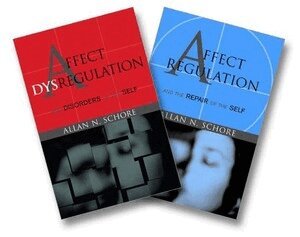
Affect Regulation and the Repair of the Self & Affect Dysregulation and Disorders of the Self Two-Book Set
Inbunden, Engelska, 2003
759 kr
Tillfälligt slut
In 1994 Allan Schore published his groundbreaking book, Affect Regulation and the Origin of the Self, in which he integrated a large number of experimental and clinical studies from both the psychological and biological disciplines in order to construct an overarching model of social and emotional development. Since then he has expanded his regulation theory in more than two dozen articles and essays covering multiple disciplines, including neuroscience, psychiatry, psychoanalysis, developmental psychology, attachment, and trauma. Affect Dysregulation and Disorders of the Self contains writings on developmental affective neuroscience and developmental neuropsychiatry. Affect Regulation and the Repair of the Self contains chapters on neuropsychoanalysis and developmentally oriented psychotherapy. Absolutely essential reading for all clinicians, researchers, and general readers interested in normal and abnormal human development.
650 kr
Skickas
Focusing on the hottest topics in psychotherapy—attachment, developmental neuroscience, trauma, the developing brain—this book provides a window into the ideas of one of the best-known writers on these topics. Following Allan Schore’s very successful books on affect regulation and dysregulation, also published by Norton, this is the third volume of the trilogy. It offers a representative collection of essential expansions and elaborations of regulation theory, all written since 2005.As in the first two volumes of this series, each chapter represents a further development of the theory at a particular point in time, presented in chronological order. Some of the earlier chapters have been re-edited: those more recent contain a good deal of new material that has not been previously published.The first part of the book, Affect Regulation Therapy and Clinical Neuropsychoanalysis, contains chapters on the art of the craft, offering interpersonal neurobiological models of the change mechanism in the treatment of all patients, but especially in patients with a history of early relational trauma. These chapters contain contributions on “modern attachment theory” and its focus on the essential nonverbal, unconscious affective mechanisms that lie beneath the words of the patient and therapist; on clinical neuropsychoanalytic models of working with relational trauma and pathological dissociation: and on the use of affect regulation therapy (ART) in the emotionally stressful, heightened affective moments of clinical enactments.The chapters in the second part of the book on Developmental Affective Neuroscience and Developmental Neuropsychiatry address the science that underlies regulation theory’s clinical models of development and psychopathogenesis. Although most mental health practitioners are actively involved in child, adolescent, and adult psychotherapeutic treatment, a major theme of the latter chapters is that the field now needs to more seriously attend to the problem of early intervention and prevention.Praise for Allan N. Schore:"Allan Schore reveals himself as a polymath, the depth and breadth of whose reading–bringing together neurobiology, developmental neurochemistry, behavioral neurology, evolutionary biology, developmental psychoanalysis, and infant psychiatry–is staggering." –British Journal of Psychiatry"Allan Schore's...work is leading to an integrated evidence-based dynamic theory of human development that will engender a rapproachement between psychiatry and neural sciences."–American Journal of Psychiatry"One cannot over-emphasize the significance of Schore's monumental creative labor...Oliver Sacks' work has made a great deal of difference to neurology, but Schore's is perhaps even more revolutionary and pivotal...His labors are Darwinian in scope and import."–Contemporary Psychoanalysis"Schore's model explicates in exemplary detail the precise mechanisms in which the infant brain might internalize and structuralize the affect-regulating functions of the mother, in circumscribed neural tissues, at specifiable points in it epigenetic history." –Journal of the American Psychoanalytic"Allan Schore has become a heroic figure among many psychotherapists for his massive reviews of neuroscience that center on the patient-therapist relationship." –Daniel Goleman, author of Social Intelligence
572 kr
Skickas inom 7-10 vardagar
An exploration into the adaptive functions of the emotional right brain, which describes not only affect and affect regulation within minds and brains, but also the communication and iterative regulation of affects between minds and brains. This book offers evidence that emotional interactions reflect right-brain-to-right-brain effective communication. Essential reading for those trying to understand one-person psychology as well as two-person psychology (relationships, whether clinical or otherwise).
521 kr
Skickas inom 7-10 vardagar
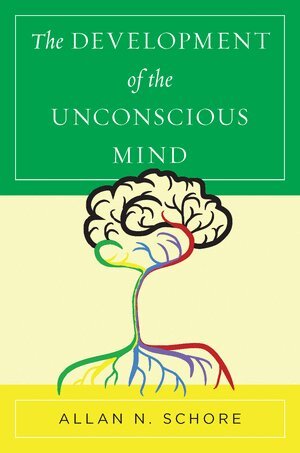
This book traces the evolution of the concept of the unconscious from an intangible, metapsychological abstraction to a psychoneurobiological function of a tangible brain. An integration of current findings in the neurobiological and developmental sciences offers a deeper understanding of the dynamic mechanisms of the unconscious. The relevance of this reformulation to clinical work is a central theme of Shore's other new book, Right Brain Psychotherapy.
The Development of the Unconscious Mind / Right Brain Psychotherapy Two-Book Set
Inbunden, Engelska, 2019
1 295 kr
Skickas inom 3-6 vardagar
446 kr
Skickas inom 7-10 vardagar
Books in the Norton Series on Interpersonal Neurobiology have collectively sold close to one million copies and contributed to a revolution in cutting-edge mental health care. An interpersonal neurobiology of human development enables us to understand that the structure and function of the mind and brain are shaped by experiences; especially those involving emotional relationships.Here, the three series editors have enlisted some of the most widely read IPNB authors to reflect on the impact of IPNB on their clinical practice and offer words of wisdom to the hundreds of thousands of IPNB-informed clinicians around the world. Topics include:Dan Hill on dysregulation and impaired states of consciousnessDeb Dana on the polyvagal perspectiveBonnie Badenoch on therapeutic presenceKathy Steele on motivational systems in complex trauma
556 kr
Skickas inom 7-10 vardagar
The culmination of three decades of Allan Schore’s groundbreaking work, this book details how the right brain—the psychobiological locus of Freud’s unconscious mind—plays a fundamental role in the early origin of human nature (the general characteristics and feelings attributed to human beings). The early developing right brain, not only grounds our bodily-based subjective experience of the world, but also allows us to make sense of it.This volume offers interdisciplinary and clinical evidence indicating that during human infancy, right brain intersubjectivity (the emotional communication between unconscious minds) and attachment (the subliminal interactive regulation of emotion) underlie the essential foundation of the human personality. Beneath conscious awareness, the early evolving right brain implicitly generates the emotional capacity for both love and hate, ecstasy and agony, good and evil, forgiveness and revenge, creativity and destructiveness—all products of the deeper stratum of human nature.