Alle-Jan van der Veen – författare
Visar alla böcker från författaren Alle-Jan van der Veen. Handla med fri frakt och snabb leverans.
5 produkter
5 produkter
Inbunden, Engelska, 1998
1 623 kr
Skickas inom 10-15 vardagar
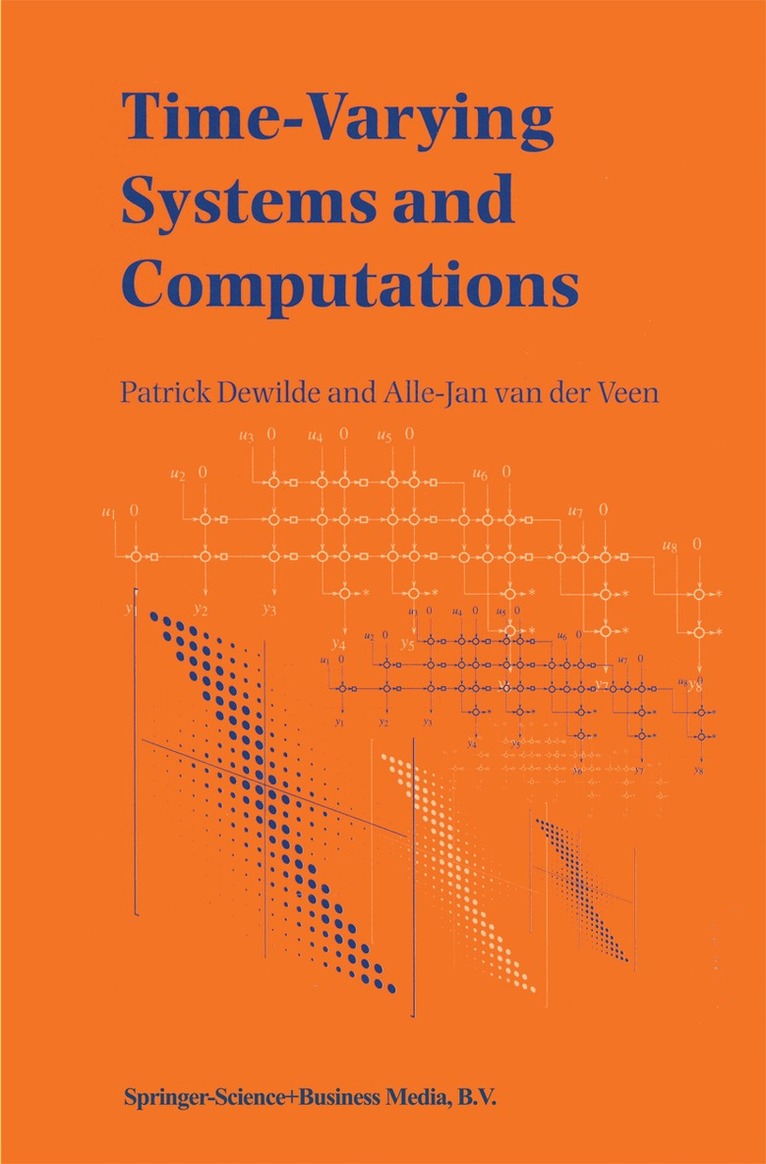
Complex function theory and linear algebra provide much of the basic mathematics needed by engineers engaged in numerical computations, signal processing or control. The transfer function of a linear time invariant system is a function of the complex vari able s or z and it is analytic in a large part of the complex plane. Many important prop erties of the system for which it is a transfer function are related to its analytic prop erties. On the other hand, engineers often encounter small and large matrices which describe (linear) maps between physically important quantities. In both cases similar mathematical and computational problems occur: operators, be they transfer functions or matrices, have to be simplified, approximated, decomposed and realized. Each field has developed theory and techniques to solve the main common problems encountered. Yet, there is a large, mysterious gap between complex function theory and numerical linear algebra. For example, complex function theory has solved the problem to find analytic functions of minimal complexity and minimal supremum norm that approxi e. g. , as optimal mate given values at strategic points in the complex plane. They serve approximants for a desired behavior of a system to be designed. No similar approxi mation theory for matrices existed until recently, except for the case where the matrix is (very) close to singular.
Inbunden, Engelska, 2024
971 kr
Skickas inom 7-10 vardagar
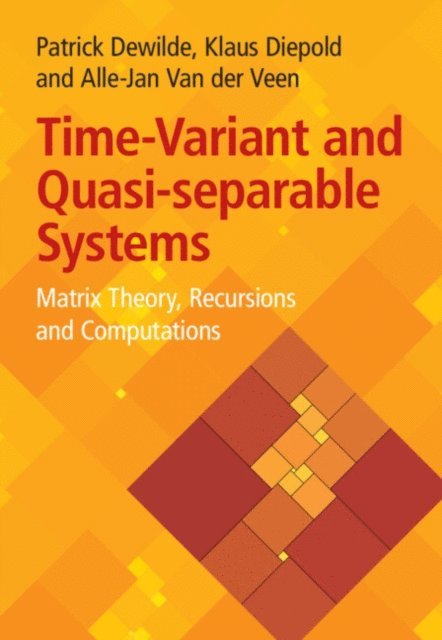
Matrix theory is the lingua franca of everyone who deals with dynamically evolving systems, and familiarity with efficient matrix computations is an essential part of the modern curriculum in dynamical systems and associated computation. This is a master's-level textbook on dynamical systems and computational matrix algebra. It is based on the remarkable identity of these two disciplines in the context of linear, time-variant, discrete-time systems and their algebraic equivalent, quasi-separable systems. The authors' approach provides a single, transparent framework that yields simple derivations of basic notions, as well as new and fundamental results such as constrained model reduction, matrix interpolation theory and scattering theory. This book outlines all the fundamental concepts that allow readers to develop the resulting recursive computational schemes needed to solve practical problems. An ideal treatment for graduate students and academics in electrical and computer engineering, computer science and applied mathematics.
E-bok
PDF, Engelska, 20241 187 kr
Läs direkt efter köp
Häftad, Engelska, 2010
1 623 kr
Skickas inom 10-15 vardagar
Complex function theory and linear algebra provide much of the basic mathematics needed by engineers engaged in numerical computations, signal processing or control. The transfer function of a linear time invariant system is a function of the complex vari able s or z and it is analytic in a large part of the complex plane. Many important prop erties of the system for which it is a transfer function are related to its analytic prop erties. On the other hand, engineers often encounter small and large matrices which describe (linear) maps between physically important quantities. In both cases similar mathematical and computational problems occur: operators, be they transfer functions or matrices, have to be simplified, approximated, decomposed and realized. Each field has developed theory and techniques to solve the main common problems encountered. Yet, there is a large, mysterious gap between complex function theory and numerical linear algebra. For example, complex function theory has solved the problem to find analytic functions of minimal complexity and minimal supremum norm that approxi e. g. , as optimal mate given values at strategic points in the complex plane. They serve approximants for a desired behavior of a system to be designed. No similar approxi mation theory for matrices existed until recently, except for the case where the matrix is (very) close to singular.
E-bok
PDF, Engelska, 20132 049 kr
Läs direkt efter köp
Complex function theory and linear algebra provide much of the basic mathematics needed by engineers engaged in numerical computations, signal processing or control. The transfer function of a linear time invariant system is a function of the complex vari able s or z and it is analytic in a large part of the complex plane. Many important prop erties of the system for which it is a transfer function are related to its analytic prop erties. On the other hand, engineers often encounter small and large matrices which describe (linear) maps between physically important quantities. In both cases similar mathematical and computational problems occur: operators, be they transfer functions or matrices, have to be simplified, approximated, decomposed and realized. Each field has developed theory and techniques to solve the main common problems encountered. Yet, there is a large, mysterious gap between complex function theory and numerical linear algebra. For example, complex function theory has solved the problem to find analytic functions of minimal complexity and minimal supremum norm that approxi e. g. , as optimal mate given values at strategic points in the complex plane. They serve approximants for a desired behavior of a system to be designed. No similar approxi mation theory for matrices existed until recently, except for the case where the matrix is (very) close to singular.