Allen G. Hunt - Böcker
Visar alla böcker från författaren Allen G. Hunt. Handla med fri frakt och snabb leverans.
10 produkter
10 produkter
698 kr
Skickas inom 10-15 vardagar
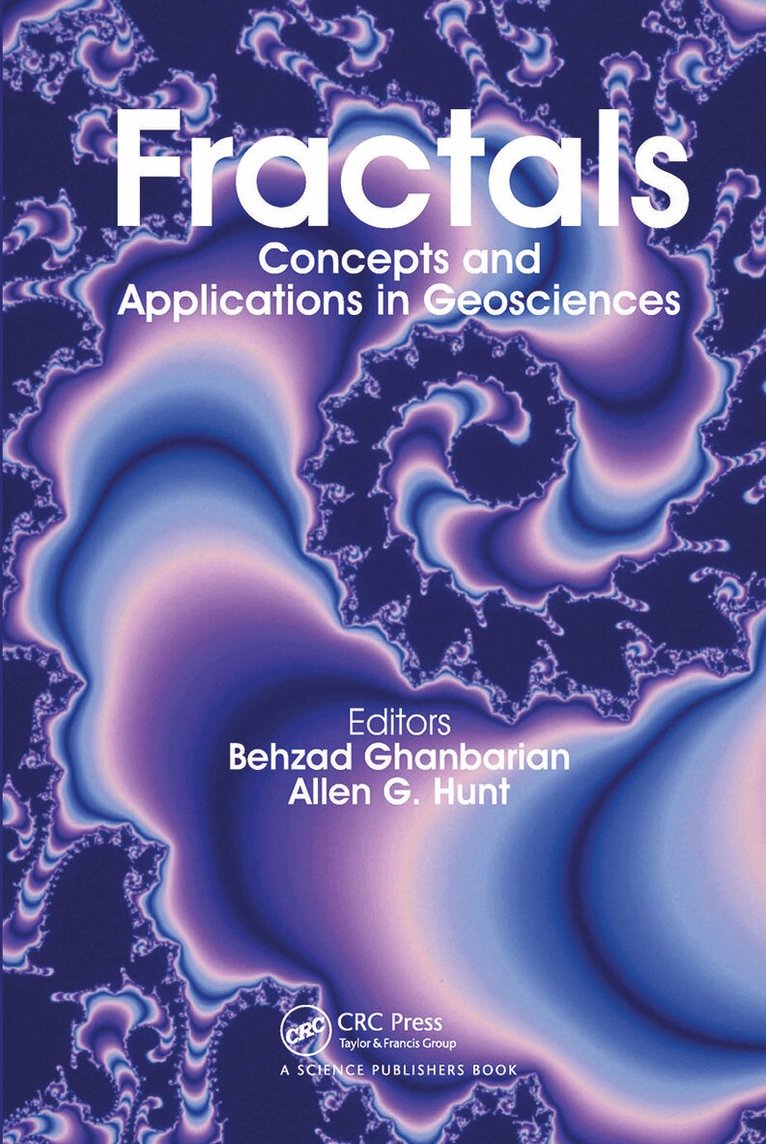
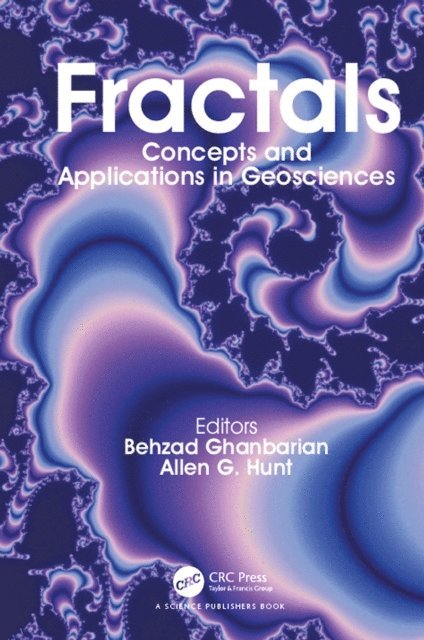
This book provides theoretical concepts and applications of fractals and multifractals to a broad range of audiences from various scientific communities, such as petroleum, chemical, civil and environmental engineering, atmospheric research, and hydrology. In the first chapter, we introduce fractals and multifractals from physics and math viewpoints. We then discuss theory and practical applications in detail. In what follows, in chapter 2, fragmentation process is modeled using fractals. Fragmentation is the breaking of aggregates into smaller pieces or fragments, a typical phenomenon in nature. In chapter 3, the advantages and disadvantages of two- and three-phase fractal models are discussed in detail. These two kinds of approach have been widely applied in the literature to model different characteristics of natural phenomena. In chapter 4, two- and three-phase fractal techniques are used to develop capillary pressure curve models, which characterize pore-size distribution of porous media. Percolation theory provides a theoretical framework to model flow and transport in disordered networks and systems. Therefore, following chapter 4, in chapter 5 the fractal basis of percolation theory and its applications in surface and subsurface hydrology are discussed. In chapter 6, fracture networks are shown to be modeled using fractal approaches. Chapter 7 provides different applications of fractals and multifractals to petrophysics and relevant area in petroleum engineering. In chapter 8, we introduce the practical advantages of fractals and multifractals in geostatistics at large scales, which have broad applications in stochastic hydrology and hydrogeology. Multifractals have been also widely applied to model atmospheric characteristics, such as precipitation, temperature, and cloud shape. In chapter 9, these kinds of properties are addressed using multifractals. At watershed scales, river networks have been shown to follow fractal behavior. Therefore, the applications of fractals are addressed in chapter 10. Time series analysis has been under investigations for several decades in physics, hydrology, atmospheric research, civil engineering, and water resources. In chapter 11, we therefore, provide fractal, multifractal, multifractal detrended fluctuation analyses, which can be used to study temporal characterization of a phenomenon, such as flow discharge at a specific location of a river. Chapter 12 addresses signals and again time series using a novel fractal Fourier analysis. In chapter 13, we discuss constructal theory, which has a perspective opposite to fractal theories, and is based on optimizationof diffusive exchange. In the case of river drainages, for example, the constructal approach begins at the divide and generates headwater streams first, rather than starting from the fundamental drainage pattern.
990 kr
Skickas inom 5-8 vardagar
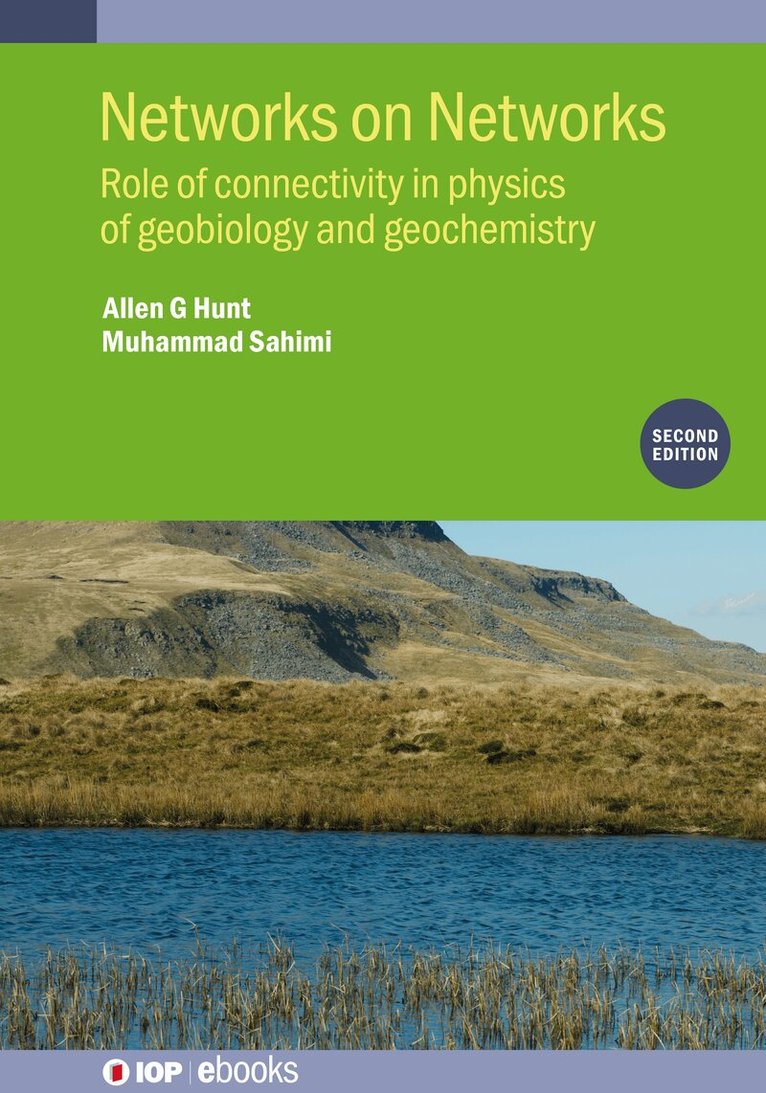
Networks on Networks (Second Edition)
Role of connectivity in physics of geobiology and geochemistry
Inbunden, Engelska, 2024
1 873 kr
Skickas inom 5-8 vardagar
Networks on Networks (Second Edition)
Role of connectivity in physics of geobiology and geochemistry
Häftad, Engelska, 2024
402 kr
Skickas inom 5-8 vardagar
3 946 kr
Skickas inom 10-15 vardagar
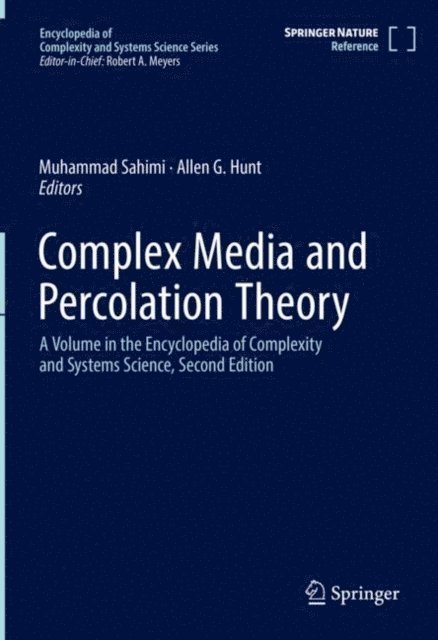
Percolation theory describes the effects of the connectivity of microscopic or small-scale elements of a complex medium to its macroscopic or large-scale properties. It also describes the conditions under which there may be a continuously connected path of local elements across the medium. The point at which the path is formed is called the percolation threshold. Percolation theory also predicts that many macroscopic properties of complex media follow universal power laws near the percolation threshold that are independent of many microscopic features of such media.There are many applications of percolation theory across the natural sciences, from porous materials, to composite solids, complex networks, and biological systems. This book presents the essential elements of percolation theory, covers the problem of calculating the exponents that characterize the power laws that the percolation quantities follow near the percolation threshold, provides a clear description of the geometry of percolation clusters of the connected paths, and addresses several variations of percolation theory. In particular, bootstrap percolation, explosive percolation, and invasion percolation are featured, which expand the range of natural systems to which percolation may be applicable. In addition, coverage includes several important applications of percolation theory to a range of phenomena, ranging from electrical conductivity, thermopower, the Hall effect, and photoconductivity of disordered semiconductors, to flow, transport and reaction in porous media, geochemistry, biology, and ecology.
13 284 kr
Kommande
Percolation theory describes the effects of the connectivity of microscopic or small-scale elements of a complex medium to its macroscopic or large-scale properties. It also describes the conditions under which there may be a continuously connected path of local elements across the medium. The point at which the path is formed is called the percolation threshold. Percolation theory also predicts that many macroscopic properties of complex media follow universal power laws near the percolation threshold that are independent of many microscopic features of such media.There are many applications of percolation theory across the natural sciences, from porous materials, to composite solids, complex networks, and biological systems. This book presents the essential elements of percolation theory, covers the problem of calculating the exponents that characterize the power laws that the percolation quantities follow near the percolation threshold, provides a clear description of the geometry of percolation clusters of the connected paths, and addresses several variations of percolation theory. In particular, bootstrap percolation, explosive percolation, and invasion percolation are featured, which expand the range of natural systems to which percolation may be applicable. In addition, coverage includes several important applications of percolation theory to a range of phenomena, ranging from electrical conductivity, thermopower, the Hall effect, and photoconductivity of disordered semiconductors, to flow, transport and reaction in porous media, geochemistry, biology, and ecology.
2 223 kr
Skickas inom 10-15 vardagar
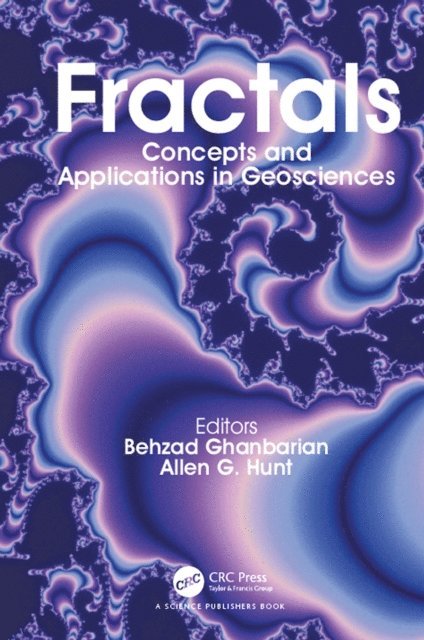
This book provides theoretical concepts and applications of fractals and multifractals to a broad range of audiences from various scientific communities, such as petroleum, chemical, civil and environmental engineering, atmospheric research, and hydrology. In the first chapter, we introduce fractals and multifractals from physics and math viewpoints. We then discuss theory and practical applications in detail. In what follows, in chapter 2, fragmentation process is modeled using fractals. Fragmentation is the breaking of aggregates into smaller pieces or fragments, a typical phenomenon in nature. In chapter 3, the advantages and disadvantages of two- and three-phase fractal models are discussed in detail. These two kinds of approach have been widely applied in the literature to model different characteristics of natural phenomena. In chapter 4, two- and three-phase fractal techniques are used to develop capillary pressure curve models, which characterize pore-size distribution of porous media. Percolation theory provides a theoretical framework to model flow and transport in disordered networks and systems. Therefore, following chapter 4, in chapter 5 the fractal basis of percolation theory and its applications in surface and subsurface hydrology are discussed. In chapter 6, fracture networks are shown to be modeled using fractal approaches. Chapter 7 provides different applications of fractals and multifractals to petrophysics and relevant area in petroleum engineering. In chapter 8, we introduce the practical advantages of fractals and multifractals in geostatistics at large scales, which have broad applications in stochastic hydrology and hydrogeology. Multifractals have been also widely applied to model atmospheric characteristics, such as precipitation, temperature, and cloud shape. In chapter 9, these kinds of properties are addressed using multifractals. At watershed scales, river networks have been shown to follow fractal behavior. Therefore, the applications of fractals are addressed in chapter 10. Time series analysis has been under investigations for several decades in physics, hydrology, atmospheric research, civil engineering, and water resources. In chapter 11, we therefore, provide fractal, multifractal, multifractal detrended fluctuation analyses, which can be used to study temporal characterization of a phenomenon, such as flow discharge at a specific location of a river. Chapter 12 addresses signals and again time series using a novel fractal Fourier analysis. In chapter 13, we discuss constructal theory, which has a perspective opposite to fractal theories, and is based on optimizationof diffusive exchange. In the case of river drainages, for example, the constructal approach begins at the divide and generates headwater streams first, rather than starting from the fundamental drainage pattern.
1 660 kr
Skickas inom 3-6 vardagar
1 198 kr
Skickas inom 3-6 vardagar
402 kr
Skickas inom 5-8 vardagar