
Amirsadegh Rezazadeh Nochehdehi – författare
2 686 kr
Skickas inom 10-15 vardagar
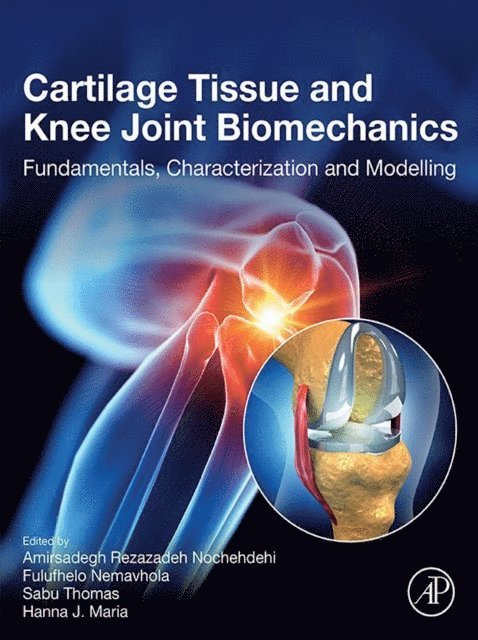
Cartilage, Tissue and Knee Joint Biomechanics: Fundamentals, Characterization and Modelling is a cutting-edge multidisciplinary book specifically focused on modeling, characterization and related clinical aspects. The book takes a comprehensive approach towards mechanics, fundamentals, morphology and properties of Cartilage Tissue and Knee Joints. Leading researchers from health science, medical technologists, engineers, academics, government, and private research institutions across the globe have contributed to this book. This book is a very valuable resource for graduates and postgraduates, engineers and research scholars. The content also includes comprehensive real-world applications.
As a reference for the total knee arthroplasty, this book focuses deeply on existing related theories (including: histology, design, manufacturing and clinical aspects) to assist readers in solving fundamental and applied problems in biomechanical and biomaterials characterization, modeling and simulation of human cartilages and cells. For biomedical engineers dealing with implants and biomaterials for knee joint injuries, this book will guide you in learning the knee anatomy, range of motion, surgical procedures, physiological loading and boundary conditions, biomechanics of connective soft tissues, type of injuries, and more.
Provides a comprehensive resource on the knee joint and its connective soft tissues; content included spans biomechanics, biomaterials, biology, anatomy, imaging and surgical procedure Covers ISO and FDA based regulatory control and compliance in the manufacturing process Includes discussions on the relationship between knee anatomical parameters and knee biomechanics3 693 kr
Läs direkt efter köp
9 593 kr
Skickas inom 10-15 vardagar
9 923 kr
Läs direkt efter köp
This comprehensive reference work satisfies the need for in-depth and multidisciplinary coverage of the current state of the art of magnetic hybrid nanoalloys (MHNAs) and their polymer and ceramic nanocomposites. MHNAs represent one of the most challenging research areas in modern science and technology. These materials are stiff and strong with remarkable electronic, mechanical, electrical, thermal and biocompatible properties, and a high potential for multifunctional applications ranging from industry to medicine. The peer-reviewed literature is already extensive, witnessing rapid progress in experimental and theoretical studies on fundamental properties as well as various advanced applications.
Part 1 covers theory, modelling, and synthesis (growth and alloying mechanisms) of MHNAs. Formation mechanisms of magneto-electric multiferroic materials, magnetic carbon nanotube (CNTs), and perovskite materials, which are a novel class of next-generation multifunctional nanomaterials, are discussed. The second part focuses on characterization techniques for electrical and dielectrical, rheological, biocompatibility, and other properties, as well as applications in the industrial, agricultural, environmental, and biomedical sectors. Finally, life cycle assessment is considered as essential to the development of nanomaterials and nanoproducts from MHNAs. Advanced undergraduate and graduate students, researchers, and other professionals in the fields of materials science and engineering, polymer science, surface science, bioengineering, and chemical engineering will find comprehensive and authoritative information for solving fundamental and applied problems in the characterization and use of these multifunctional nanomaterials.