Amos Omondi – författare
Visar alla böcker från författaren . Handla med fri frakt och snabb leverans.
5 produkter
5 produkter
E-bok
Engelska11 kr
Läs direkt efter köp
Inbunden, Engelska, 2015
2 193 kr
Skickas inom 5-8 vardagar
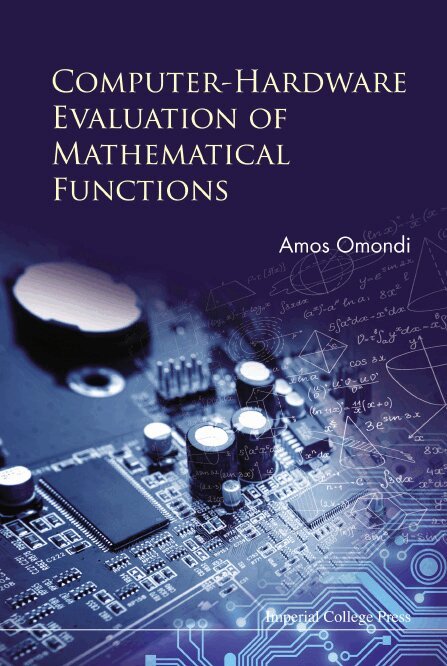
Computer-Hardware Evaluation of Mathematical Functions provides a thorough up-to-date understanding of the methods used in computer hardware for the evaluation of mathematical functions: reciprocals, square-roots, exponentials, logarithms, trigonometric functions, hyperbolic functions, etc. It discusses how the methods are derived, how they work, and how well they work. The methods are divided into four core themes: CORDIC, normalization, table look-up, and polynomial approximations. In each case, the author carefully considers the mathematical derivation and basis of the relevant methods, how effective they are (including mathematical errors analysis), and how they can be implemented in hardware.This book is an excellent resource for any student or researcher seeking a comprehensive, yet easily understandable, explanation of how computer chips evaluate mathematical functions.
Del 2 - ADVANCES IN COMPUTER SCIENCE AND ENGINEERING: TEXTS
RESIDUE NUMBER SYSTEMS: THEORY AND IMPLEMENTATION
Inbunden, Engelska, 2007
1 656 kr
Skickas inom 5-8 vardagar
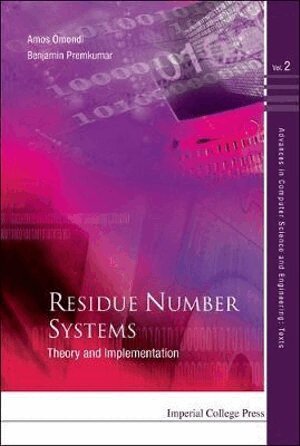
Residue number systems (RNSs) and arithmetic are useful for several reasons. First, a great deal of computing now takes place in embedded processors, such as those found in mobile devices, for which high speed and low-power consumption are critical; the absence of carry propagation facilitates the realization of high-speed, low-power arithmetic. Second, computer chips are now getting to be so dense that full testing will no longer be possible; so fault tolerance and the general area of computational integrity have become more important. RNSs are extremely good for applications such as digital signal processing, communications engineering, computer security (cryptography), image processing, speech processing, and transforms, all of which are extremely important in computing today.This book provides an up-to-date account of RNSs and arithmetic. It covers the underlying mathematical concepts of RNSs; the conversion between conventional number systems and RNSs; the implementation of arithmetic operations; various related applications are also introduced. In addition, numerous detailed examples and analysis of different implementations are provided.Sample Chapter(s)
Häftad, Engelska, 2003
559 kr
Skickas inom 10-15 vardagar
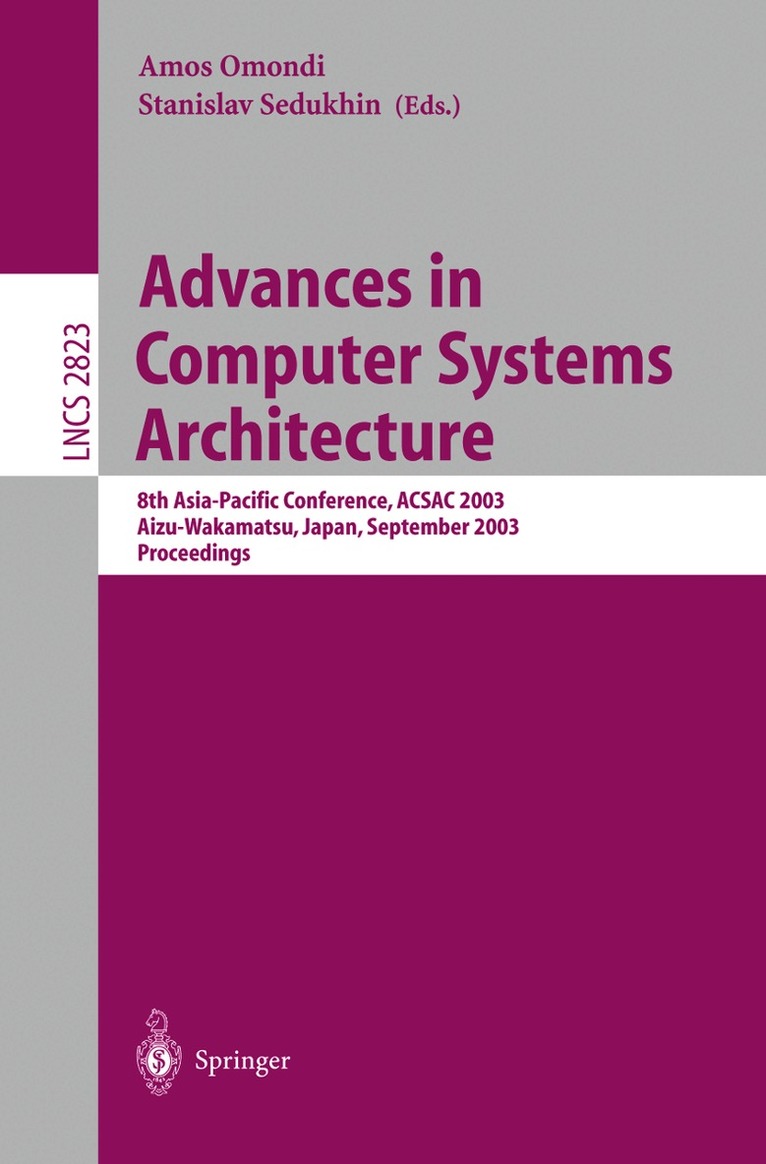
This conference marked the ?rst time that the Asia-Paci?c Computer Systems Architecture Conference was held outside Australasia (i. e. Australia and New Zealand), and was, we hope, the start of what will be a regular event. The conference started in 1992 as a workshop for computer architects in Australia and subsequently developed into a full-?edged conference covering Austra- sia. Two additional major changes led to the present conference. The ?rst was a change from “computer architecture” to “computer systems architecture”, a change that recognized the importance and close relationship to computer arc- tecture of certain levels of software (e. g. operating systems and compilers) and of other areas (e. g. computer networks). The second change, which re?ected the increasing number of papers being submitted from Asia, was the replacement of “Australasia” with “Asia-Paci?c”. This year’s event was therefore particularly signi?cant, in that it marked the beginning of a truly “Asia-Paci?c” conference. It is intended that in the future the conference venue will alternate between Asia and Australia/New Zealand and, although still small, we hope that in time the conference will develop into a major one that represents Asia to the same - tent as existing major computer-architecture conferences in North America and Europe represent those regions.
E-bok
PDF, Engelska, 2003734 kr
Läs direkt efter köp
This conference marked the ?rst time that the Asia-Paci?c Computer Systems Architecture Conference was held outside Australasia (i. e. Australia and New Zealand), and was, we hope, the start of what will be a regular event. The conference started in 1992 as a workshop for computer architects in Australia and subsequently developed into a full-?edged conference covering Austra- sia. Two additional major changes led to the present conference. The ?rst was a change from “computer architecture” to “computer systems architecture”, a change that recognized the importance and close relationship to computer arc- tecture of certain levels of software (e. g. operating systems and compilers) and of other areas (e. g. computer networks). The second change, which re?ected the increasing number of papers being submitted from Asia, was the replacement of “Australasia” with “Asia-Paci?c”. This year’s event was therefore particularly signi?cant, in that it marked the beginning of a truly “Asia-Paci?c” conference. It is intended that in the future the conference venue will alternate between Asia and Australia/New Zealand and, although still small, we hope that in time the conference will develop into a major one that represents Asia to the same - tent as existing major computer-architecture conferences in North America and Europe represent those regions.