Amy Perfors – författare
Visar alla böcker från författaren Amy Perfors. Handla med fri frakt och snabb leverans.
3 produkter
3 produkter
E-bok
PDF, Engelska, 2015501 kr
Läs direkt efter köp
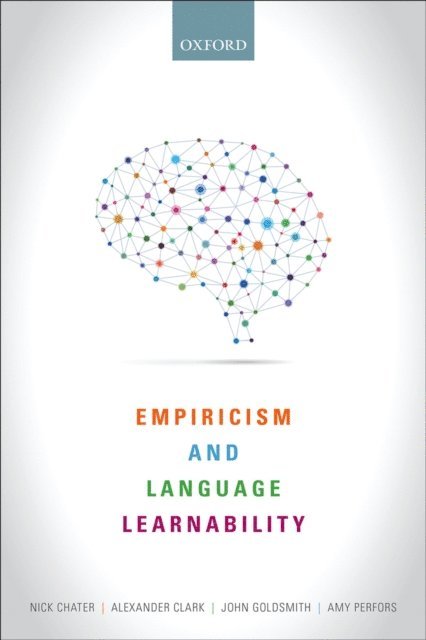
This interdisciplinary new work explores one of the central theoretical problems in linguistics: learnability. The authors, from different backgrounds—-linguistics, philosophy, computer science, psychology and cognitive science-explore the idea that language acquisition proceeds through general purpose learning mechanisms, an approach that is broadly empiricist both methodologically and psychologically.For many years, the empiricist approach has been taken to be unfeasible on practical and theoretical grounds. In the book, the authors present a variety of precisely specified mathematical and computational results that show that empiricist approaches can form a viable solution to the problem of language acquisition. It assumes limited technical background and explains the fundamental principles of probability, grammatical description and learning theory in an accessible and non-technical way.Different chapters address the problem of language acquisition using different assumptions: looking at the methodology of linguistic analysis using simplicity based criteria, using computational experiments on real corpora, using theoretical analysis using probabilistic learning theory, and lookingat the computational problems involved in learning richly structured grammars.Written by four researchers in the full range of relevant fields: linguistics (John Goldsmith), psychology (Nick Chater), computer science (Alex Clark), and cognitive science (Amy Perfors), the book sheds light on the central problems of learnability and language, and traces their implications for key questions of theoretical linguistics and the study of language acquisition.
E-bok
Engelska, 2015501 kr
Läs direkt efter köp
This interdisciplinary new work explores one of the central theoretical problems in linguistics: learnability. The authors, from different backgrounds—-linguistics, philosophy, computer science, psychology and cognitive science-explore the idea that language acquisition proceeds through general purpose learning mechanisms, an approach that is broadly empiricist both methodologically and psychologically.For many years, the empiricist approach has been taken to be unfeasible on practical and theoretical grounds. In the book, the authors present a variety of precisely specified mathematical and computational results that show that empiricist approaches can form a viable solution to the problem of language acquisition. It assumes limited technical background and explains the fundamental principles of probability, grammatical description and learning theory in an accessible and non-technical way.Different chapters address the problem of language acquisition using different assumptions: looking at the methodology of linguistic analysis using simplicity based criteria, using computational experiments on real corpora, using theoretical analysis using probabilistic learning theory, and lookingat the computational problems involved in learning richly structured grammars.Written by four researchers in the full range of relevant fields: linguistics (John Goldsmith), psychology (Nick Chater), computer science (Alex Clark), and cognitive science (Amy Perfors), the book sheds light on the central problems of learnability and language, and traces their implications for key questions of theoretical linguistics and the study of language acquisition.
Häftad, Engelska, 2015
867 kr
Skickas inom 7-10 vardagar
This interdisciplinary new work explores one of the central theoretical problems in linguistics: learnability. The authors, from different backgrounds---linguistics, philosophy, computer science, psychology and cognitive science-explore the idea that language acquisition proceeds through general purpose learning mechanisms, an approach that is broadly empiricist both methodologically and psychologically. For many years, the empiricist approach has been taken to be unfeasible on practical and theoretical grounds. In the book, the authors present a variety of precisely specified mathematical and computational results that show that empiricist approaches can form a viable solution to the problem of language acquisition. It assumes limited technical background and explains the fundamental principles of probability, grammatical description and learning theory in an accessible and non-technical way. Different chapters address the problem of language acquisition using different assumptions: looking at the methodology of linguistic analysis using simplicity based criteria, using computational experiments on real corpora, using theoretical analysis using probabilistic learning theory, and looking at the computational problems involved in learning richly structured grammars.Written by four researchers in the full range of relevant fields: linguistics (John Goldsmith), psychology (Nick Chater), computer science (Alex Clark), and cognitive science (Amy Perfors), the book sheds light on the central problems of learnability and language, and traces their implications for key questions of theoretical linguistics and the study of language acquisition.