André Raymond – författare
Visar alla böcker från författaren André Raymond. Handla med fri frakt och snabb leverans.
5 produkter
5 produkter
Häftad, Engelska, 2002
362 kr
Skickas inom 10-15 vardagar
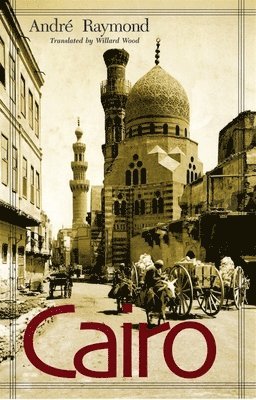
Gaze toward the Nile from the desert hills of Mukattam, and the vast city of Cairo unfolds before you, with its monumental architecture, teeming populace, and thousands of years of rich history. The extraordinary tapestry of Cairo's past and present comes vividly to life in this magisterial study by André Raymond, arguably the premier social historian of the Arab world. The most deeply observed and historically nuanced account ever given of the greatest Arab city of northern Africa, this book shows us Cairo from the glimmer of its beginnings in the Arab conquest of Egypt in 640 through its transformation into the modern center of Middle Eastern life today.Here are the Fatimids, the Mamluks, and the Ottomans, the invasions, dynastic changes, and religious conflicts that one after another altered and shaped Cairo's destiny. And here, alongside rulers and religious leaders, are the merchants and artisans who have given Cairene life its distinctive character over time. Raymond depicts life in Cairo through the centuries, chronicling the coming of European influence, the vagaries of social evolution, and the development of economic structure and urban design. His work reflects all facets of Cairo's historical and social reality, weaving commerce, politics, religion, and culture into a finely worked portrait of the foremost Arab city on the continent of Africa. With its splendid illustrations and maps and its meticulous attention to the topography and archaeology of the city, this book will prove as valuable to the serious traveler as to observers of Middle Eastern history and society. It stands as the definitive work on Cairo, unparalleled in scope, depth, and detail.
Inbunden, Engelska, 2002
2 027 kr
Skickas inom 10-15 vardagar
Professor Raymond deals here with the evolution of the great Arab cities of the Ottoman period (1516-1800) - with questions of organisation, social life and the built space - looking in particular at Aleppo, Algiers, Constantine and, above all, at Cairo. These studies form part of a movement, in which the author’s work has played a significant role, aiming to re-examine the traditional Orientalist view of ’Muslim cities’. Contrary to the negative perception one so often finds, of decadent and chaotic towns, it can be seen that they had a coherent internal structure and that, far from being in decline, they enjoyed renewed prosperity in the Ottoman era, benefiting from the strength of the empire and flourishing Mediterranean trade. This in turn was reflected in the important and original architectural activity of the period.
E-bok
PDF, Engelska, 2024936 kr
Läs direkt efter köp
Professor Raymond deals here with the evolution of the great Arab cities of the Ottoman period (1516-1800) - with questions of organisation, social life and the built space - looking in particular at Aleppo, Algiers, Constantine and, above all, at Cairo. These studies form part of a movement, in which the author’s work has played a significant role, aiming to re-examine the traditional Orientalist view of ’Muslim cities’. Contrary to the negative perception one so often finds, of decadent and chaotic towns, it can be seen that they had a coherent internal structure and that, far from being in decline, they enjoyed renewed prosperity in the Ottoman era, benefiting from the strength of the empire and flourishing Mediterranean trade. This in turn was reflected in the important and original architectural activity of the period.
E-bok
Engelska, 2024936 kr
Läs direkt efter köp
Professor Raymond deals here with the evolution of the great Arab cities of the Ottoman period (1516-1800) - with questions of organisation, social life and the built space - looking in particular at Aleppo, Algiers, Constantine and, above all, at Cairo. These studies form part of a movement, in which the author’s work has played a significant role, aiming to re-examine the traditional Orientalist view of ’Muslim cities’. Contrary to the negative perception one so often finds, of decadent and chaotic towns, it can be seen that they had a coherent internal structure and that, far from being in decline, they enjoyed renewed prosperity in the Ottoman era, benefiting from the strength of the empire and flourishing Mediterranean trade. This in turn was reflected in the important and original architectural activity of the period.
E-bok
PDF, Engelska, 20089 176 kr
Läs direkt efter köp
The purpose of this book is to draw attention to the sites of life, politics and culture where current and past generations of the Islamic world have made their mark. Unlike many previous volumes dealing with the city in the Islamic world, this one has been expanded not only to include snapshots of historical fabric, but also to deal with the transformation of this fabric into modern and contemporary urban entities. Salma Khadra Jayyusi was awarded Cultural Personality of the Year by the Sheikh Zayed Book Award for her profound contribution to Arabic literature and culture in 2020. The paperback edition of The City in the Islamic World was published to celebrate the occasion.