Andrea Bianco – författare
Visar alla böcker från författaren Andrea Bianco. Handla med fri frakt och snabb leverans.
8 produkter
8 produkter
E-bok
PDF, Engelska, 20131 416 kr
Läs direkt efter köp
Optical networks are leaving the labs and becoming a reality. Despite the current crisis of the telecom industry, our everyday life increasingly depends on communication networks for information exchange, medicine, education, data transfer, commerce, and many other endeavours. High capacity links are required by the large futemet traffic demand, and optical networks remain one of the most promising technologies for meeting these needs. WDM systems are today widely deployed, thanks to low-cost at extreme data rates and high reliability of optical components, such as optical amplifiers and fixed/tunable filters and transceivers. Access and metropolitan area networks are increasingly based on optical technologies to overcome the electronic bottleneck at the network edge. Traditional multi-layer architectures, such as the widely deployed IP/ATM/SDH protocol stack, are increasingly based on WDM transport; further efforts are sought to move at the optical layer more of the functionalities available today in higher protocol layers. New components and subsystems for very high speed optical networks offer new design opportunities to network operators and designers. The trends towards dynamically configurable all-optical network infrastructures open up a wide range of new network engineering and design choices, which must face issues such as interoperability and unified control and management.
Inbunden, Italienska, 2025
345 kr
Skickas inom 5-8 vardagar
200 kr
Skickas inom 5-8 vardagar
Inbunden, Engelska, 2003
1 112 kr
Skickas inom 10-15 vardagar
Optical networks are leaving the labs and becoming a reality. Despite the crisis of the telecom industry, the dependence of society on communication networks for information exchange, medicine, education, data transfer, commerce, and many other endeavours dominates our everyday life. High capacity links are required by the large Internet traffic demand, and optical networks remain one of the most promising technologies for meeting these needs. WDM systems are widely deployed, thanks to low-cost at extreme data rates and high reliability of optical components, such as optical amplifiers and fixed/tunable filters and transceivers. Access and metropolitan area networks are increasingly based on optical technologies to overcome the electronic bottleneck at the network edge. Traditional multi-layer architectures, such as the widely deployed IP/ATM/SDH protocol stack, are increasingly based on WDM transport; further efforts are sought to move at the optical layer more of the functionalities available today in higher protocol layers. New components and subsystems for very high-speed optical networks offer new design opportunities to network operators and designers.The trends towards dynamically configurable all-optical network infrastructures open up a wide range of new network engineering and design choices, which must face issues such as interoperability and unified control and management. This title contains the papers presented at the Sixth Working Conference on Optical Network Design and Modelling, which was sponsored by the International Federation for Information Processing (IFIP) and held in February 2002 at Politecnico di Torino, Italy. With contributions from researchers, network operators and manufacturers from Europe, America and Asia, this volume provides a comprehensive snapshot of the state of the art in optical networking.
648 kr
Skickas inom 5-8 vardagar
Häftad, Engelska, 2013
1 086 kr
Skickas inom 10-15 vardagar
Optical networks are leaving the labs and becoming a reality. Despite the current crisis of the telecom industry, our everyday life increasingly depends on communication networks for information exchange, medicine, education, data transfer, commerce, and many other endeavours. High capacity links are required by the large futemet traffic demand, and optical networks remain one of the most promising technologies for meeting these needs. WDM systems are today widely deployed, thanks to low-cost at extreme data rates and high reliability of optical components, such as optical amplifiers and fixed/tunable filters and transceivers. Access and metropolitan area networks are increasingly based on optical technologies to overcome the electronic bottleneck at the network edge. Traditional multi-layer architectures, such as the widely deployed IP/ATM/SDH protocol stack, are increasingly based on WDM transport; further efforts are sought to move at the optical layer more of the functionalities available today in higher protocol layers. New components and subsystems for very high speed optical networks offer new design opportunities to network operators and designers. The trends towards dynamically configurable all-optical network infrastructures open up a wide range of new network engineering and design choices, which must face issues such as interoperability and unified control and management.
Häftad, Engelska, 2001
565 kr
Skickas inom 10-15 vardagar
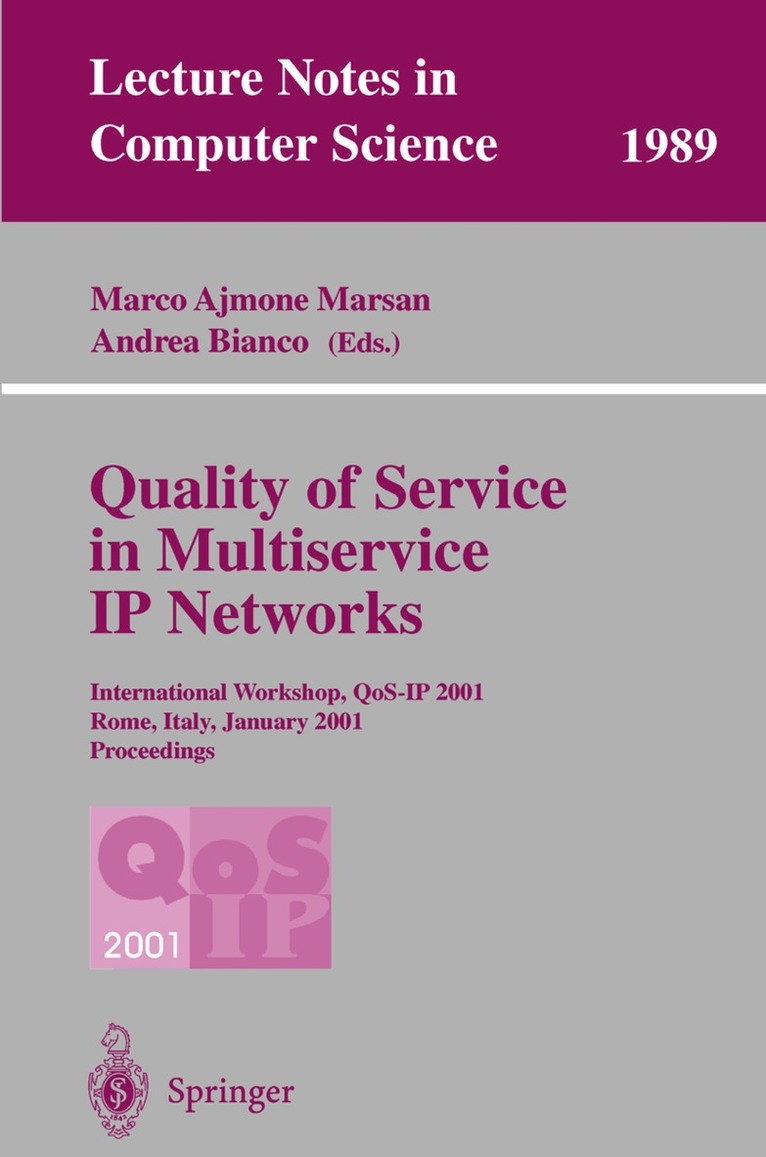
IP is clearly emerging as the networking paradigm for the integration of the tr- ?c ?ows generated by a variety of new applications (IP telephony, multimedia multicasting, e-business, ...), whose performance requirements may be extremely di?erent. This situation has generated a great interest in the development of te- niques for the provision of quality of service (QoS) guarantees in IP networks. Two proposals have already emerged from the IETF groups IntServ and Di?- Serv, but research and experiments are continuing, in order to identify the most e?ective architectures and protocols. The Italian Ministry for University and Scienti?c Research has been funding a research program on these topics, named “Techniques for quality of service guarantees in multiservice telecommunication networks” or MQOS for short, in the years 1999 and 2000. At the end of its activity, the MQOS program has organized in Rome (Italy) in January 2001 the International Workshop on QoS in Multiserevice IP N- works (QoS-IP 2001), for the presentation of high-quality recent research results on QoS in IP networks, and the dissemination of the most relevant research results obtained within the MQOS program.
E-bok
PDF, Engelska, 2003734 kr
Läs direkt efter köp
IP is clearly emerging as the networking paradigm for the integration of the tr- ?c ?ows generated by a variety of new applications (IP telephony, multimedia multicasting, e-business, ...), whose performance requirements may be extremely di?erent. This situation has generated a great interest in the development of te- niques for the provision of quality of service (QoS) guarantees in IP networks. Two proposals have already emerged from the IETF groups IntServ and Di?- Serv, but research and experiments are continuing, in order to identify the most e?ective architectures and protocols. The Italian Ministry for University and Scienti?c Research has been funding a research program on these topics, named “Techniques for quality of service guarantees in multiservice telecommunication networks” or MQOS for short, in the years 1999 and 2000. At the end of its activity, the MQOS program has organized in Rome (Italy) in January 2001 the International Workshop on QoS in Multiserevice IP N- works (QoS-IP 2001), for the presentation of high-quality recent research results on QoS in IP networks, and the dissemination of the most relevant research results obtained within the MQOS program.