Andrea Consiglio – författare
962 kr
Läs direkt efter köp
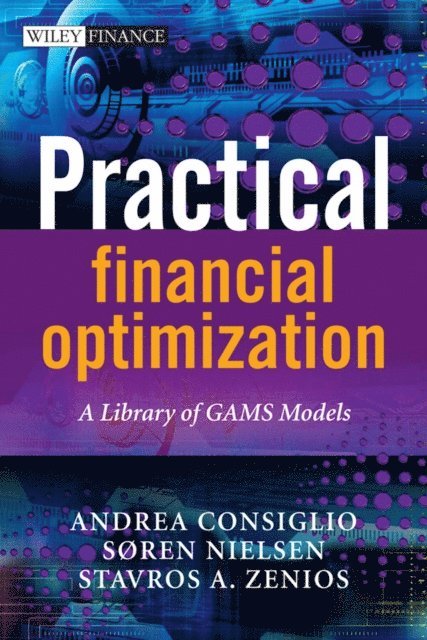
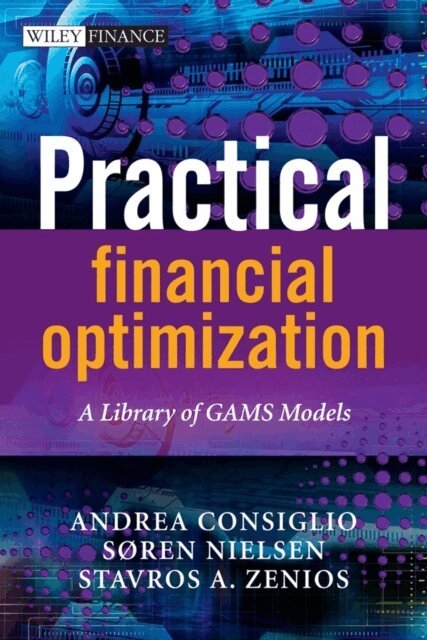
In Practical Financial Optimization: A Library of GAMS Models, the authors provide a diverse set of models for portfolio optimization, based on the General Algebraic Modelling System. ''GAMS'' consists of a language which allows a high-level, algebraic representation of mathematical models and a set of solvers – numerical algorithms – to solve them. The system was developed in response to the need for powerful and flexible front-end tools to manage large, real-life models.
The work begins with an overview of the structure of the GAMS language, and discusses issues relating to the management of data in GAMS models. The authors provide models for mean-variance portfolio optimization which address the question of trading off the portfolio expected return against its risk. Fixed income portfolio optimization models perform standard calculations and allow the user to bootstrap a yield curve from bond prices. Dedication models allow for standard portfolio dedication with borrowing and re-investment decisions, and are extended to deal with maximisation of horizon return and to incorporate various practical considerations on the portfolio tradeability. Immunization models provide for the factor immunization of portfolios of treasury and corporate bonds.
The scenario-based portfolio optimization problem is addressed with mean absolute deviation models, tracking models, regret models, conditional VaR models, expected utility maximization models and put/call efficient frontier models. The authors employ stochastic programming for dynamic portfolio optimization, developing stochastic dedication models as stochastic extensions of the fixed income models discussed in chapter 4. Two-stage and multi-stage stochastic programs extend the scenario models analysed in Chapter 5 to allow dynamic rebalancing of portfolios as time evolves and new information becomes known. Models for structuring index funds and hedging interest rate risk on international portfolios are also provided.
The final chapter provides a set of ''case studies'': models for large-scale applications of portfolio optimization, which can be used as the basis for the development of business support systems to suit any special requirements, including models for the management of participating insurance policies and personal asset allocation.
The title will be a valuable guide for quantitative developers and analysts, portfolio and asset managers, investment strategists and advanced students of finance.
962 kr
Läs direkt efter köp
In Practical Financial Optimization: A Library of GAMS Models, the authors provide a diverse set of models for portfolio optimization, based on the General Algebraic Modelling System. ''GAMS'' consists of a language which allows a high-level, algebraic representation of mathematical models and a set of solvers – numerical algorithms – to solve them. The system was developed in response to the need for powerful and flexible front-end tools to manage large, real-life models.
The work begins with an overview of the structure of the GAMS language, and discusses issues relating to the management of data in GAMS models. The authors provide models for mean-variance portfolio optimization which address the question of trading off the portfolio expected return against its risk. Fixed income portfolio optimization models perform standard calculations and allow the user to bootstrap a yield curve from bond prices. Dedication models allow for standard portfolio dedication with borrowing and re-investment decisions, and are extended to deal with maximisation of horizon return and to incorporate various practical considerations on the portfolio tradeability. Immunization models provide for the factor immunization of portfolios of treasury and corporate bonds.
The scenario-based portfolio optimization problem is addressed with mean absolute deviation models, tracking models, regret models, conditional VaR models, expected utility maximization models and put/call efficient frontier models. The authors employ stochastic programming for dynamic portfolio optimization, developing stochastic dedication models as stochastic extensions of the fixed income models discussed in chapter 4. Two-stage and multi-stage stochastic programs extend the scenario models analysed in Chapter 5 to allow dynamic rebalancing of portfolios as time evolves and new information becomes known. Models for structuring index funds and hedging interest rate risk on international portfolios are also provided.
The final chapter provides a set of ''case studies'': models for large-scale applications of portfolio optimization, which can be used as the basis for the development of business support systems to suit any special requirements, including models for the management of participating insurance policies and personal asset allocation.
The title will be a valuable guide for quantitative developers and analysts, portfolio and asset managers, investment strategists and advanced students of finance.
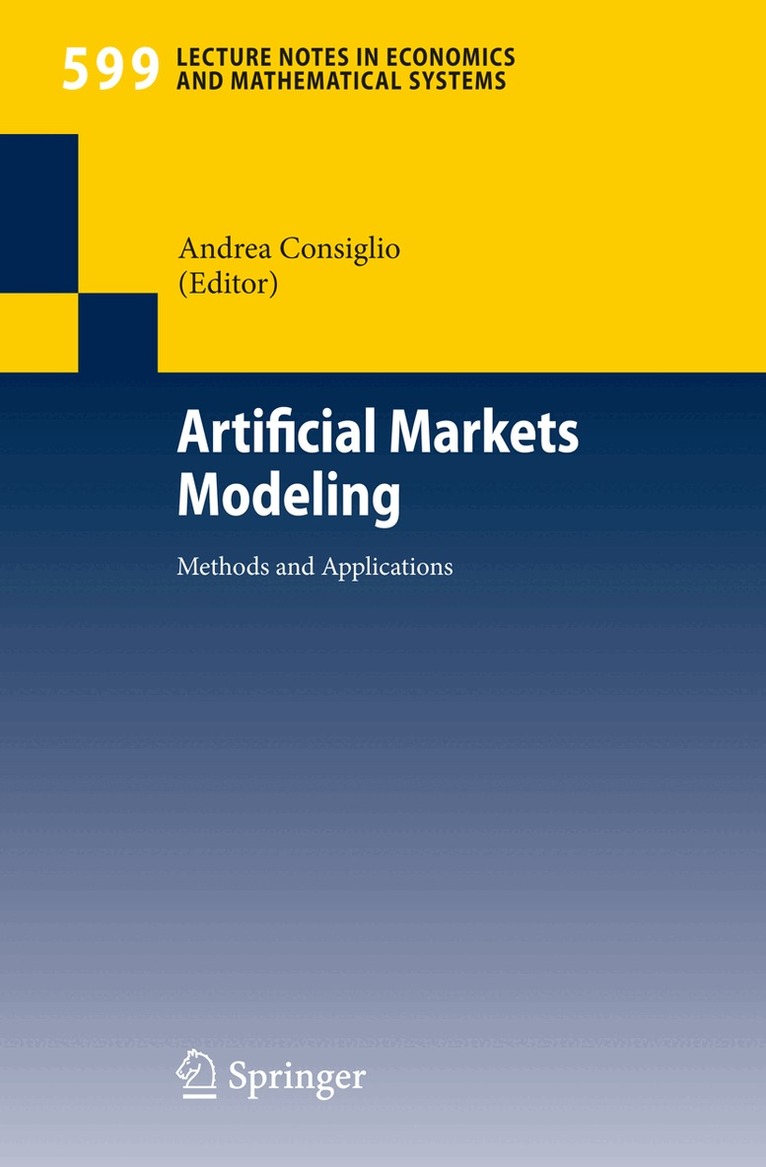
Artificial Markets Modeling
Methods and Applications
550 kr
Skickas inom 10-15 vardagar
687 kr
Läs direkt efter köp
Agent-based computational modeling with its intrinsic multidisciplinary approach is gaining increasing recognition in the social sciences, particularly in economics, business and finance. The methodology is now widely used to compute analytical models numerically and test them for departures from theoretical assumptions, and to provide stand-alone simulation models for problems that are analytically intractable.This volume is devoted to recent contributions to the field from both the social sciences and computer sciences. It presents applications of agent-based computational methodologies and tools in the social sciences, focusing strongly on the uses, requirements and constraints of agent-based models employed by social scientists. Topics include agent-based macroeconomics, the emergence of norms and conventions, the dynamics of social and economic networks, and behavioral models in financial markets.