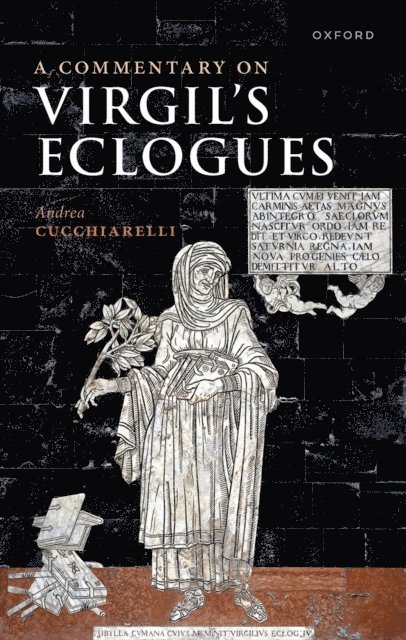
Virgil''s Eclogues are a fundamental text of Western literature that served as a model for the nascent poetry of the Augustan and later of the Imperial Age. Inspired by the bucolic poetry of Theocritus, the work uses the apparent simplicity of rural settings to explore complex elements of poetic, literary, philosophical, and even figurative culture, and to express the drama of civil war and expropriations. In this commentary, accompanied by a detailed introduction, Andrea Cucchiarelli analyses the Eclogues in depth, establishing comparisons with both Greek and Roman poetic models, with philosophical texts, and with significant later texts from the Roman poetic tradition. The commentary is the first to offer a systematic account of the poem in its historical context, between the end of the Republic and the Age of Augustus: particular attention is also paid to the language of the figurative arts, which for Roman readers constituted an important complement to literary knowledge of myths and stories. The volume offers the reader a reliable and concise interpretation of the text, which is systematically lemmatized and annotated throughout; each eclogue is additionally accompanied by an introductory overview and a detailed bibliography to direct further reading.
Virgil's Eclogues are a fundamental text of Western literature that served as a model for the nascent poetry of the Augustan and later of the Imperial Age. Inspired by the bucolic poetry of Theocritus, the work uses the apparent simplicity of rural settings to explore complex elements of poetic, literary, philosophical, and even figurative culture, and to express the drama of civil war and expropriations. In this commentary, accompanied by a detailed introduction, Andrea Cucchiarelli analyses the Eclogues in depth, establishing comparisons with both Greek and Roman poetic models, with philosophical texts, and with significant later texts from the Roman poetic tradition. The commentary is the first to offer a systematic account of the poem in its historical context, between the end of the Republic and the Age of Augustus: particular attention is also paid to the language of the figurative arts, which for Roman readers constituted an important complement to literary knowledge of myths and stories. The volume offers the reader a reliable and concise interpretation of the text, which is systematically lemmatized and annotated throughout; each eclogue is additionally accompanied by an introductory overview and a detailed bibliography to direct further reading.
Landscape is a central topic in the humanities, particularly in the study of Latin literature, which has likewise been deeply affected by the so-called “spatial turn.” Given the breadth of the subject, the volume does not aim at encyclopaedic completeness, but rather seeks to establish a methodological framework while offering concrete case studies on specific contexts and authors. The book follows a clear chronological structure, providing a concise, substantial, and up-to-date analysis of most major Latin authors from the Augustan age—understood as a decisive moment in the definition of landscape representation in Roman literature—through to Late Antiquity. At the same time, an extensive introduction and numerous internal cross-references allow readers to pursue parallel paths, for instance by following themes or literary genres. Alongside literary analysis, the volume includes contributions that build bridges to the Greek world (such as on Italy as seen by Strabo), to archaeology and ancient art history, and to the history of landscape. The volume thus constitutes a timely and valuable resource for a broad academic audience, offering both a methodological tool and a reference work for teaching and research in classical studies.
Virgil''s Eclogues are a fundamental text of Western literature that served as a model for the nascent poetry of the Augustan and later of the Imperial Age. Inspired by the bucolic poetry of Theocritus, the work uses the apparent simplicity of rural settings to explore complex elements of poetic, literary, philosophical, and even figurative culture, and to express the drama of civil war and expropriations. In this commentary, accompanied by a detailed introduction, Andrea Cucchiarelli analyses the Eclogues in depth, establishing comparisons with both Greek and Roman poetic models, with philosophical texts, and with significant later texts from the Roman poetic tradition. The commentary is the first to offer a systematic account of the poem in its historical context, between the end of the Republic and the Age of Augustus: particular attention is also paid to the language of the figurative arts, which for Roman readers constituted an important complement to literary knowledge of myths and stories. The volume offers the reader a reliable and concise interpretation of the text, which is systematically lemmatized and annotated throughout; each eclogue is additionally accompanied by an introductory overview and a detailed bibliography to direct further reading.
Virgil's Eclogues are a fundamental text of Western literature that served as a model for the nascent poetry of the Augustan and later of the Imperial Age. Inspired by the bucolic poetry of Theocritus, the work uses the apparent simplicity of rural settings to explore complex elements of poetic, literary, philosophical, and even figurative culture, and to express the drama of civil war and expropriations. In this commentary, accompanied by a detailed introduction, Andrea Cucchiarelli analyses the Eclogues in depth, establishing comparisons with both Greek and Roman poetic models, with philosophical texts, and with significant later texts from the Roman poetic tradition. The commentary is the first to offer a systematic account of the poem in its historical context, between the end of the Republic and the Age of Augustus: particular attention is also paid to the language of the figurative arts, which for Roman readers constituted an important complement to literary knowledge of myths and stories. The volume offers the reader a reliable and concise interpretation of the text, which is systematically lemmatized and annotated throughout; each eclogue is additionally accompanied by an introductory overview and a detailed bibliography to direct further reading.
Landscape is a central topic in the humanities, particularly in the study of Latin literature, which has likewise been deeply affected by the so-called “spatial turn.” Given the breadth of the subject, the volume does not aim at encyclopaedic completeness, but rather seeks to establish a methodological framework while offering concrete case studies on specific contexts and authors. The book follows a clear chronological structure, providing a concise, substantial, and up-to-date analysis of most major Latin authors from the Augustan age—understood as a decisive moment in the definition of landscape representation in Roman literature—through to Late Antiquity. At the same time, an extensive introduction and numerous internal cross-references allow readers to pursue parallel paths, for instance by following themes or literary genres. Alongside literary analysis, the volume includes contributions that build bridges to the Greek world (such as on Italy as seen by Strabo), to archaeology and ancient art history, and to the history of landscape. The volume thus constitutes a timely and valuable resource for a broad academic audience, offering both a methodological tool and a reference work for teaching and research in classical studies.