Andrea D. Sims – författare
Visar alla böcker från författaren Andrea D. Sims. Handla med fri frakt och snabb leverans.
7 produkter
Inflectional Defectiveness
Inbunden, 2015
1761 kr
Lägg i varukorg
Paradigmatic gaps ('missing' inflected forms) have traditionally been considered to be the random detritus of a language's history and marginal exceptions to the normal functioning of its inflectional system. Arguing that this is a misperception, Inflectional Defectiveness demonstrates that …
Inflectional Defectiveness
Häftad, 2019
586 kr
Lägg i varukorg
Paradigmatic gaps ('missing' inflected forms) have traditionally been considered to be the random detritus of a language's history and marginal exceptions to the normal functioning of its inflectional system. Arguing that this is a misperception, Inflectional Defectiveness demonstrates that …
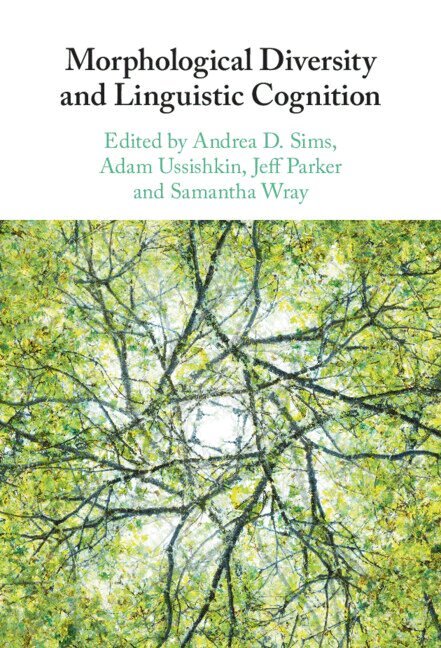
Morphological Diversity and Linguistic Cognition
Av Andrea D. Sims, Adam Ussishkin m. fl.
Inbunden, 2022
1761 kr
Lägg i varukorg
Morphological structures interact dynamically with lexical processing and storage, with the parameters of morphological typology being partly dependent on cognitive pathways for processing, storage and generalization of word structure, and vice versa. Bringing together a team of well-known …
Morphological Diversity and Linguistic Cognition
Av Andrea D. Sims, Adam Ussishkin m. fl.
Häftad, 2025
451 kr
Lägg i varukorg
Morphological structures interact dynamically with lexical processing and storage, with the parameters of morphological typology being partly dependent on cognitive pathways for processing, storage and generalization of word structure, and vice versa. Bringing together a team of well-known …
Morphological Diversity and Linguistic Cognition
Av Samantha Wray, Jeff Parker m. fl.
E-bok, 2022
427 kr
Lägg i varukorg
Morphological structures interact dynamically with lexical processing and storage, with the parameters of morphological typology being partly dependent on cognitive pathways for processing, storage and generalization of word structure, and vice versa. Bringing together a team of well-known …
Morphological Diversity and Linguistic Cognition
Av Samantha Wray, Jeff Parker m. fl.
E-bok, 2022
427 kr
Lägg i varukorg
Morphological structures interact dynamically with lexical processing and storage, with the parameters of morphological typology being partly dependent on cognitive pathways for processing, storage and generalization of word structure, and vice versa. Bringing together a team of well-known …