Andreas Frommer – författare
Visar alla böcker från författaren Andreas Frommer. Handla med fri frakt och snabb leverans.
9 produkter
9 produkter
E-bok
PDF, Tyska, 2013603 kr
Läs direkt efter köp
Häftad, Tyska, 1990
582 kr
Skickas inom 10-15 vardagar
Häftad, Engelska, 2005
1 092 kr
Skickas inom 10-15 vardagar
The Third International Workshop on Numerical Analysis and Lattice QCD tookplaceattheUniversityofEdinburgh fromJune30th toJuly4th,2003. It continued a sequence which started in 1995 at the University of Kentucky and continuedin1999withaworkshopattheUniversityofWuppertal.Theaimof these workshops is to bring together applied mathematicians and theoretical physicists to stimulate the exchange of ideas between leading experts in the ?elds of lattice QCD and numerical analysis. Indeed, the last ten years have seen quite a substantial increase in cooperation between the two scienti?c communities, and particularly so between numerical linear algebra and lattice QCD. The workshop was organised jointly by the University of Edinburgh and the UK National e-Science Centre. It promoted scienti?c progress in lattice QCD as an e-Science activity that encourages close collaboration between the core sciences of physics, mathematics, and computer science. In order to achieve more realistic computations in lattice quantum ?eld theory substantial progress is required in the exploitation of numerical me- ods.Recently,therehasbeenmuchprogressintheformulationoflatticechiral symmetry satisfying the Ginsparg-Wilson relation.Methods for impleme- ing such chiral fermions e?ciently were the principal subject of this meeting, which, in addition, featured several tutorial talks aiming at introducing the important concepts of one ?eld to colleagues from the other. These proce- ings re?ect this, being organised in three parts: part I contains introductory surveypapers,whereaspartsIIandIIIcontainlatestresearchresultsinlattice QCD and in computational methods.
Häftad, Engelska, 2004
566 kr
Skickas inom 10-15 vardagar
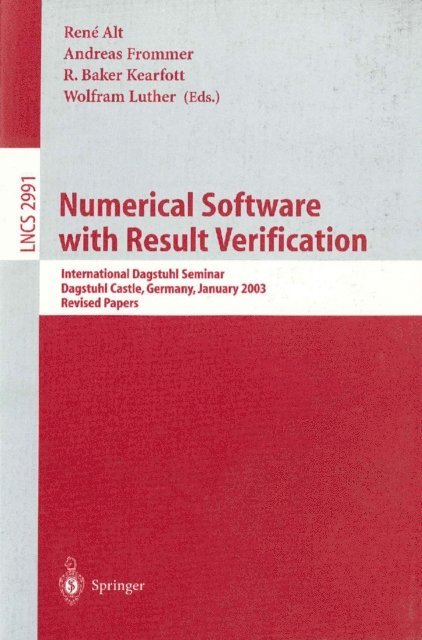
Reliable computing techniques are essential if the validity of the output of a - merical algorithm is to be guaranteed to be correct. Our society relies more and more on computer systems. Usually, our systems appear to work successfully, but there are sometimes serious, and often minor, errors. Validated computing is one essential technology to achieve increased software reliability. Formal - gor in the de?nition of data types, the computer arithmetic, in algorithm design, and in program execution allows us to guarantee that the stated problem has (or does not have) a solution in an enclosing interval we compute. If the enclosure is narrow, we are certain that the result can be used. Otherwise, we have a clear warning that the uncertainty of input values might be large and the algorithm and the model have to be improved. The use of interval data types and al- rithms with controlled rounding and result veri?cation capture uncertainty in modeling and problem formulation, in model parameter estimation, in algorithm truncation, in operation round-o?, and in model interpretation. The techniques of validated computing have proven their merits in many scienti?c and engineering applications. They are based on solid and interesting theoretical studies in mathematics and computer science. Contributions from ?elds including real, complex and functional analysis, semigroups, probability, statistics,fuzzyintervalanalysis,fuzzylogic,automaticdi?erentiation,computer hardware, operating systems, compiler construction, programming languages, object-oriented modeling, parallel processing, and software engineering are all essential.
E-bok
PDF, Engelska, 2004712 kr
Läs direkt efter köp
Reliable computing techniques are essential if the validity of the output of a - merical algorithm is to be guaranteed to be correct. Our society relies more and more on computer systems. Usually, our systems appear to work successfully, but there are sometimes serious, and often minor, errors. Validated computing is one essential technology to achieve increased software reliability. Formal - gor in the de?nition of data types, the computer arithmetic, in algorithm design, and in program execution allows us to guarantee that the stated problem has (or does not have) a solution in an enclosing interval we compute. If the enclosure is narrow, we are certain that the result can be used. Otherwise, we have a clear warning that the uncertainty of input values might be large and the algorithm and the model have to be improved. The use of interval data types and al- rithms with controlled rounding and result veri?cation capture uncertainty in modeling and problem formulation, in model parameter estimation, in algorithm truncation, in operation round-o?, and in model interpretation. The techniques of validated computing have proven their merits in many scienti?c and engineering applications. They are based on solid and interesting theoretical studies in mathematics and computer science. Contributions from ?elds including real, complex and functional analysis, semigroups, probability, statistics,fuzzyintervalanalysis,fuzzylogic,automaticdi?erentiation,computer hardware, operating systems, compiler construction, programming languages, object-oriented modeling, parallel processing, and software engineering are all essential.
E-bok
PDF, Engelska, 20051 416 kr
Läs direkt efter köp
1 092 kr
Skickas inom 10-15 vardagar
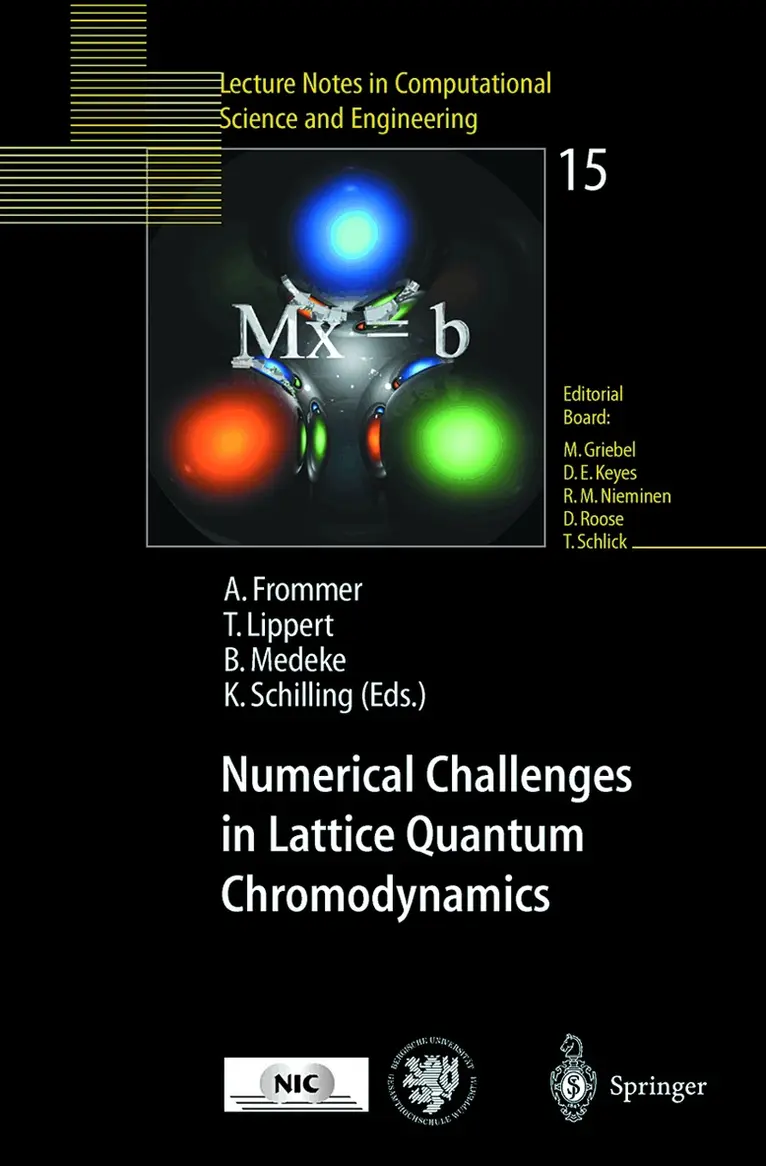
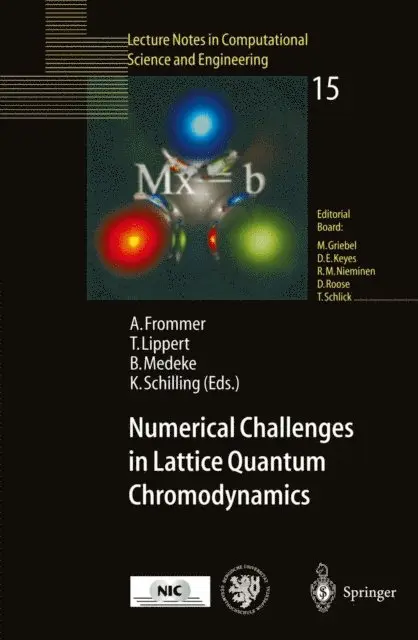
The book with contributions from the joint interdisciplinary workshop covers important numerical bottleneck problems from lattice quantum chromodynamics: 1) The computation of Green's functions from huge sparse linear systems and the determination of flavor-singlet observables by stochastic estimates of matrix traces can both profit from novel preconditioning techniques and algebraic multi-level algorithms. 2) The exciting overlap fermion formulation requires the solution of linear systems including a matrix sign function, an extremely demanding numerical task that is tackled by Lanczos/projection methods. 3) Realistic simulations of QCD must include three light dynamical quark flavors with non-degenerate masses. Algorithms using polynomial approximations of the matrix determinant can deal with this situation. The volume aims at stimulating synergism and creating new links between lattice quantum and numerical analysis.
Häftad, Tyska, 2013
464 kr
Skickas inom 10-15 vardagar
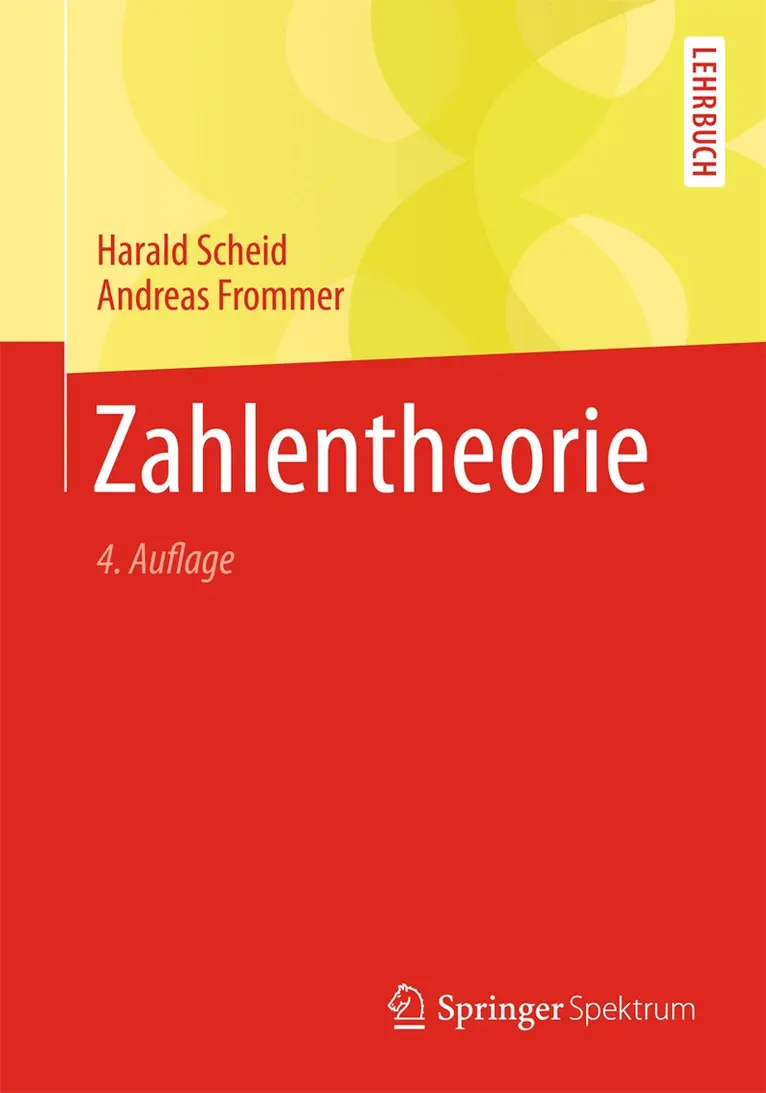
Die Zahlentheorie beschäftigt sich mit den Eigenschaften der natürlichen Zahlen 1, 2, 3, ... Viele ihrer Problemstellungen, wie z. B. das Primzahlzwillingsproblem oder die berühmte Fermat'sche Vermutung, lassen sich in allgemeinverständlicher Form angeben, zu ihrer Behandlung benötigt man aber meistens anspruchsvolle Methoden der Algebra und der Analysis. Diese Zweige der Mathematik verdanken ihre Entwicklung nicht zuletzt der Faszination, welche die Zahlentheorie zu allen Zeiten ausgeübt hat. Die "Königin der Mathematik", wie Gauß die Zahlentheorie genannt hat, sah man lange als zwar schönstes, aber auch nutzlosestes Gebiet der Mathematik an. In jüngster Zeit hat sich diese Einschätzung, bedingt durch die Verfügbarkeit schneller Computer, stark geändert. Insbesondere benötigt man heute zahlentheoretische Methoden in der Kodierungstheorie und in der Kryptographie. Das Buch setzt einige Kenntnisse aus einem Grundstudium der Mathematik voraus. Es bietet zahlreiche Anwendungsbeispiele sowie eine umfangreiche Sammlung von Aufgaben mit Lösungshinweisen. Die vorliegende stark überarbeitete und erweiterte 4. Auflage enthält ein zusätzliches Kapitel über zahlentheoretische Algorithmen.
E-bok
PDF, Engelska, 20121 416 kr
Läs direkt efter köp
Lattice gauge theory is a fairly young research area in Theoretical Particle Physics. It is of great promise as it offers the framework for an ab-initio treatment of the nonperturbative features of strong interactions. Ever since its adolescence the simulation of quantum chromodynamics has attracted the interest of numerical analysts and there is growing interdisciplinary engage ment between theoretical physicists and applied mathematicians to meet the grand challenges of this approach. This volume contains contributions of the interdisciplinary workshop "Nu merical Challenges in Lattice Quantum Chromo dynamics" that the Institute of Applied Computer Science (IAI) at Wuppertal University together with the Von-Neumann-Institute-for-Computing (NIC) organized in August 1999. The purpose of the workshop was to offer a platform for the exchange of key ideas between lattice QCD and numerical analysis communities. In this spirit leading experts from both fields have put emphasis to transcend the barriers between the disciplines. The meetings was focused on the following numerical bottleneck problems: A standard topic from the infancy of lattice QCD is the computation of Green''s functions, the inverse of the Dirac operator. One has to solve huge sparse linear systems in the limit of small quark masses, corresponding to high condition numbers of the Dirac matrix. Closely related is the determination of flavor-singlet observables which came into focus during the last years.