Andreas Schäffer – författare
Visar alla böcker från författaren Andreas Schäffer. Handla med fri frakt och snabb leverans.
8 produkter
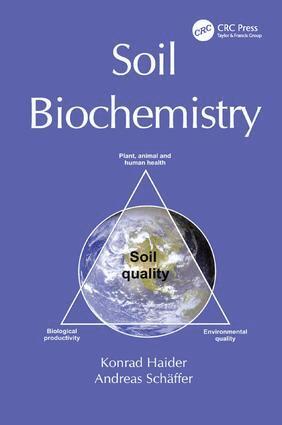
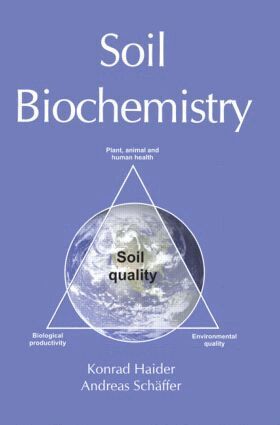
Soil Biochemistry
Häftad, 2017
1284 kr
Lägg i varukorg
Soils play a central role in the conversion of organic matter and element fluxes because of the large number of microorganisms present in the soil. In this book the more important processes that are driven by microbiological activity are discussed. It will be of interest to students of chemistry, …
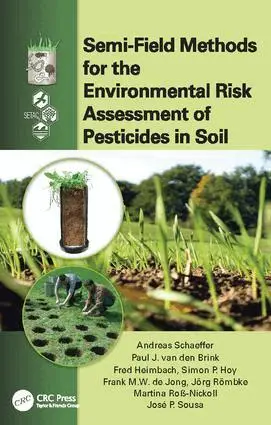
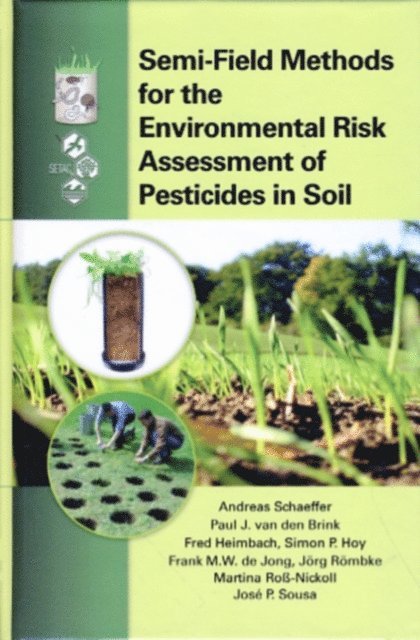
Semi-Field Methods for the Environmental Risk Assessment of Pesticides in Soil
Av Andreas Schaeffer, Paul J. van den Brink m. fl.
Häftad, 2017
1241 kr
Lägg i varukorg
Based on discussions at the 2007 SETAC Europe PERAS Workshop in Coimbra, Semi-Field Methods for the Environmental Risk Assessment of Pesticides in Soil presents a timely summary of state-of-the-art higher-tier terrestrial risk assessment of plant protection products (PPPs). Influential regulators, …
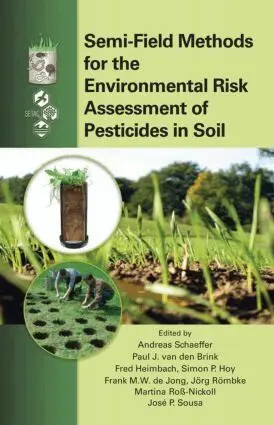
Semi-Field Methods for the Environmental Risk Assessment of Pesticides in Soil
Av Andreas Schaeffer, Paul J. van den Brink m. fl.
Inbunden, 2010
3370 kr
Lägg i varukorg
Based on discussions at the 2007 SETAC Europe PERAS Workshop in Coimbra, Semi-Field Methods for the Environmental Risk Assessment of Pesticides in Soil presents a timely summary of state-of-the-art higher-tier terrestrial risk assessment of plant protection products (PPPs). Influential regulators, …
Semi-Field Methods for the Environmental Risk Assessment of Pesticides in Soil
Av Jose P. Sousa, Martina Ro-Nickoll m. fl.
E-bok, 2010
1440 kr
Lägg i varukorg
Based on discussions at the 2007 SETAC Europe PERAS Workshop in Coimbra, Semi-Field Methods for the Environmental Risk Assessment of Pesticides in Soil presents a timely summary of state-of-the-art higher-tier terrestrial risk assessment of plant protection products (PPPs). Influential regulators, …
Semi-Field Methods for the Environmental Risk Assessment of Pesticides in Soil
Av Jose P. Sousa, Martina Ro-Nickoll m. fl.
E-bok, 2010
1440 kr
Lägg i varukorg
Based on discussions at the 2007 SETAC Europe PERAS Workshop in Coimbra, Semi-Field Methods for the Environmental Risk Assessment of Pesticides in Soil presents a timely summary of state-of-the-art higher-tier terrestrial risk assessment of plant protection products (PPPs). Influential regulators, …
Soil Biochemistry
Inbunden, 2009
3418 kr
Lägg i varukorg
Soils play a central role in the conversion of organic matter and element fluxes because of the large number of microorganisms present in the soil. In this book the more important processes that are driven by microbiological activity are discussed. It will be of interest to students of chemistry, …
Organic Trace Analysis
Av Reinhard Nießner, Andreas Schäffer
Häftad, 2017
869 kr
Lägg i varukorg
"Organic Trace Analysis" presents the basics of trace analysis, from sample preparation to the measurement: Students are introduced to statistical evaluation, quality control technologies, sampling and preparation of organic traces, as well as to enrichment and separation of samples. Spectroscopic …
Organic Trace Analysis
Av Reinhard Nießner, Andreas Schäffer
Häftad, 2024
961 kr
Lägg i varukorg
Organic contaminants even in very low concentrations can have toxic and ecotoxic effects on exposed organisms. Detection and quantification of such trace amounts in diverging matrices (e.g., water, air, soil, food, tissue, organisms) is challenging and great carefulness and strategic thinking is …