Andreas Schedler - Böcker
Visar alla böcker från författaren Andreas Schedler. Handla med fri frakt och snabb leverans.
3 produkter
3 produkter
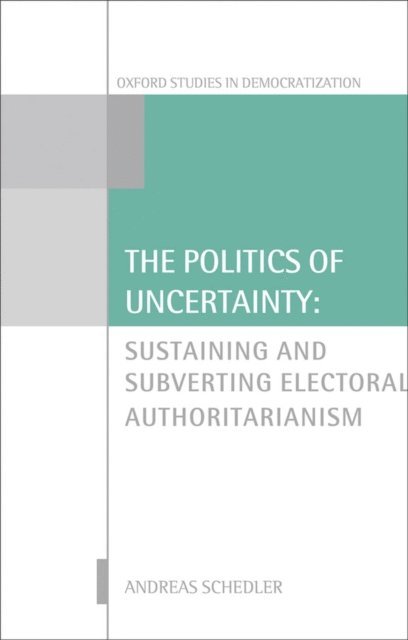
The Politics of Uncertainty
Sustaining and Subverting Electoral Authoritarianism
Häftad, Engelska, 2015
690 kr
Skickas
Dictatorship is not what it was once. Military and single-party regimes have been withering away. Today, most dictators organize multiparty elections. The Politics of Uncertainty presents an analytical framework and empirical data that allow us to understand the distinctive political dynamics of these new electoral authoritarian regimes. It argues that all autocracies suffer from institutional uncertainties: their hold on power is never secure. They also suffer from informational uncertainties: they can never know for sure how secure they are. The author identifies these uncertainties as the central axes of regimes conflicts under dictatorship. The "politics of uncertainty" comprises the struggle between rulers and dissidents over these twin uncertainties. In electoral autocracies, it unfolds primarily as competition over electoral uncertainty. The study of electoral authoritarianism is a vibrant growth industry in political science and this book is required reading for all students of elections, authoritarianism, and democratization. Oxford Studies in Democratization is a series for scholars and students of comparative politics and related disciplines. Volumes concentrate on the comparative study of the democratization process that accompanied the decline and termination of the cold war. The geographical focus of the series is primarily Latin America, the Caribbean, Southern and Eastern Europe, and relevant experiences in Africa and Asia. The series editor is Laurence Whitehead, Senior Research Fellow, Nuffield College, University of Oxford.
The Politics of Uncertainty
Sustaining and Subverting Electoral Authoritarianism
Inbunden, Engelska, 2013
2 372 kr
Skickas inom 3-6 vardagar
Dictatorship is not what it was once. Military and single-party regimes have been withering away. Today, most dictators organize multiparty elections. The Politics of Uncertainty presents an analytical framework and empirical data that allow us to understand the distinctive political dynamics of these new electoral authoritarian regimes. It argues that all autocracies suffer from institutional uncertainties: their hold on power is never secure. They also suffer from informational uncertainties: they can never know for sure how secure they are. The author identifies these uncertainties as the central axes of regimes conflicts under dictatorship. The Politics of Uncertainty comprises the struggle between rulers and dissidents over these twin uncertainties. In electoral autocracies, it unfolds primarily as competition over electoral uncertainty. The study of electoral authoritarianism is a vibrant growth industry in political science and this book is required reading for all students of elections, authoritarianism, and democratization.Oxford Studies in Democratization is a series for scholars and students of comparative politics and related disciplines. Volumes concentrate on the comparative study of the democratization process that accompanied the decline and termination of the cold war. The geographical focus of the series is primarily Latin America, the Caribbean, Southern and Eastern Europe, and relevant experiences in Africa and Asia. The series editor is Laurence Whitehead, Official Fellow, Nuffield College, University of Oxford.
727 kr
Skickas inom 5-8 vardagar
Since communism collapsed we have witnessed the emergence of numerous political actors - neopopulists, neoliberals, fundamentalists, nationalists, and others - who share one ideological leitmotif: their deep contempt for modern democratic politics. The book asks an old question: What is politics? And it adds a new one to the agenda of social sciences: What is antipolitics? Some authors trace antipolitical traditions in Western political thought, while others analyze the rhetoric of contemporary antipolitical actors in the US, the former Soviet Union, and South America. The book contains contributions from Charles H. Fairbanks Jr, Barry Hindess, Erwin A. Jaffe, Norbert Lechner, Jose Nun, Louis Pauly, Andreas Schedler, and Gershon Weiler.