Andrei A. Agrachev - Böcker
Visar alla böcker från författaren Andrei A. Agrachev. Handla med fri frakt och snabb leverans.
3 produkter
3 produkter
Del 87 - Encyclopaedia of Mathematical Sciences
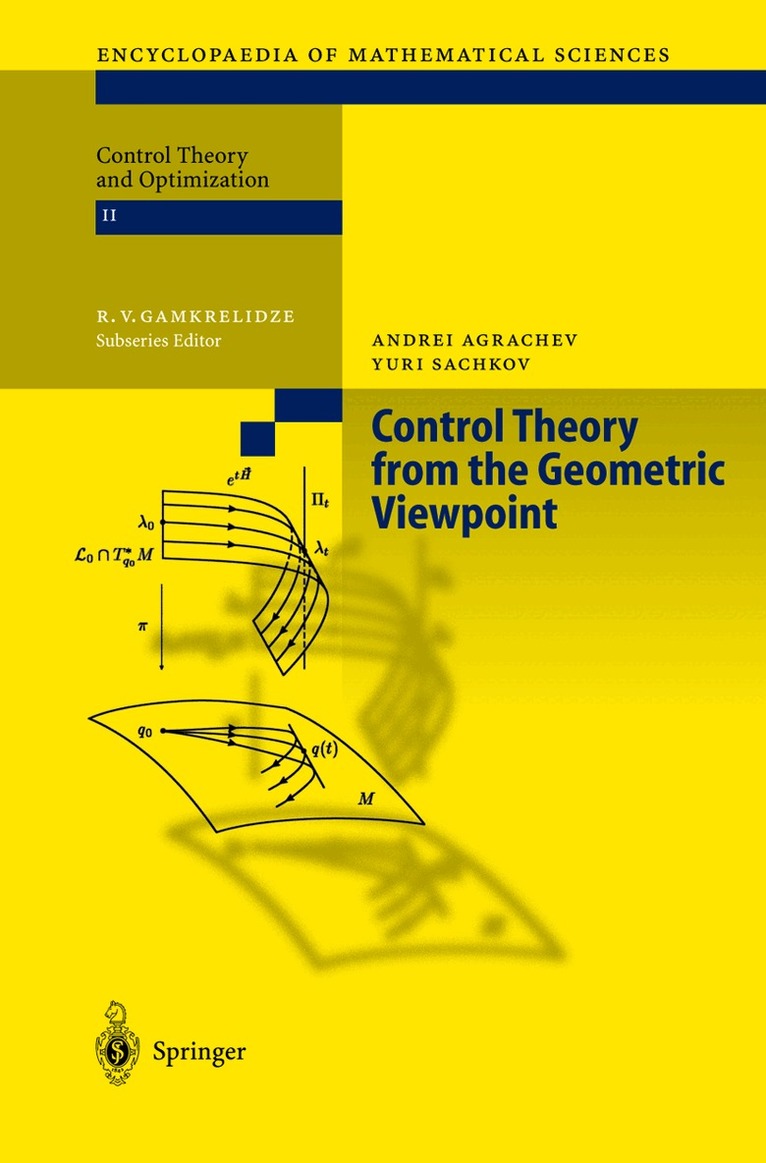
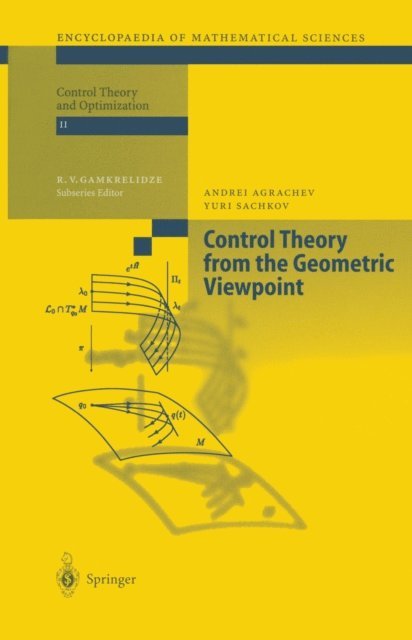
Control Theory from the Geometric Viewpoint
Inbunden, Engelska, 2004
1 682 kr
Skickas inom 10-15 vardagar
This book presents some facts and methods of Mathematical Control Theory treated from the geometric viewpoint. It is devoted to finite-dimensional deterministic control systems governed by smooth ordinary differential equations. The problems of controllability, state and feedback equivalence, and optimal control are studied. Some of the topics treated by the authors are covered in monographic or textbook literature for the first time while others are presented in a more general and flexible setting than elsewhere. Although being fundamentally written for mathematicians, the authors make an attempt to reach both the practitioner and the theoretician by blending the theory with applications. They maintain a good balance between the mathematical integrity of the text and the conceptual simplicity that might be required by engineers. It can be used as a text for graduate courses and will become most valuable as a reference work for graduate students and researchers.
Del 1932 - Lecture Notes in Mathematics
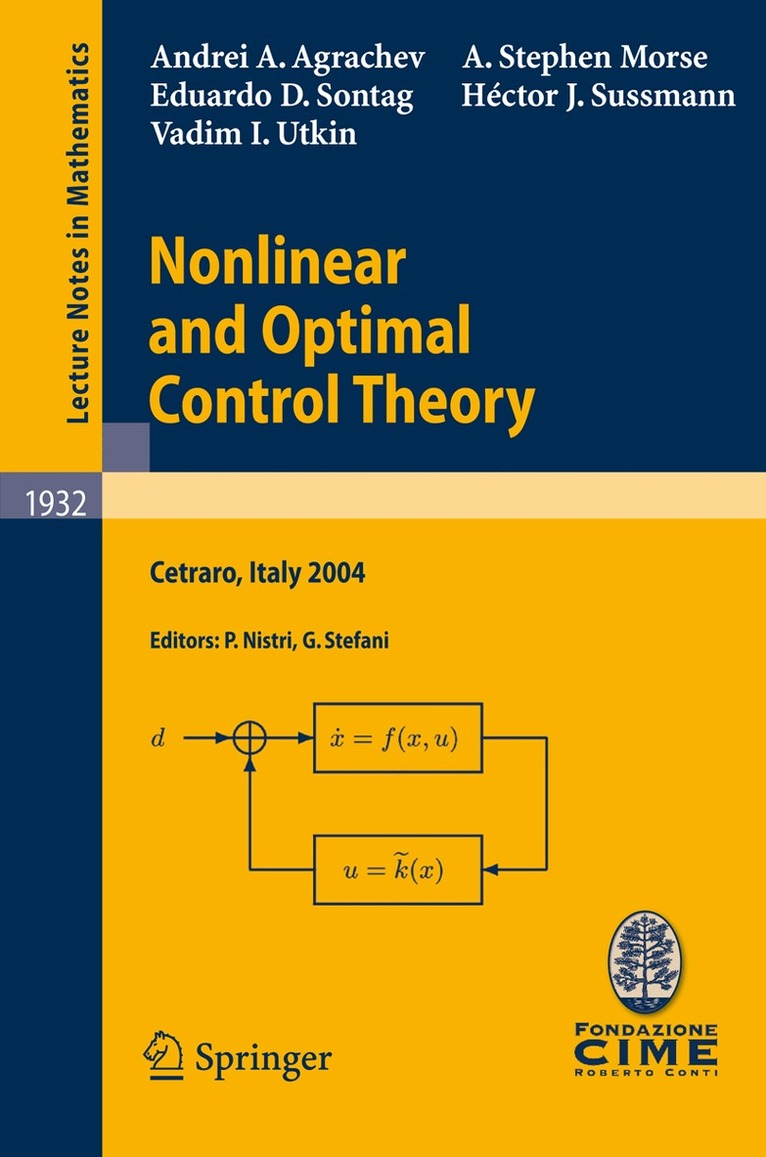
Nonlinear and Optimal Control Theory
Lectures given at the C.I.M.E. Summer School held in Cetraro, Italy, June 19-29, 2004
Häftad, Engelska, 2008
694 kr
Skickas inom 10-15 vardagar
Mathematical Control Theory is a branch of Mathematics having as one of its main aims the establishment of a sound mathematical foundation for the c- trol techniques employed in several di?erent ?elds of applications, including engineering,economy,biologyandsoforth. Thesystemsarisingfromthese- plied Sciences are modeled using di?erent types of mathematical formalism, primarily involving Ordinary Di?erential Equations, or Partial Di?erential Equations or Functional Di?erential Equations. These equations depend on oneormoreparameters thatcanbevaried,andthusconstitute thecontrol - pect of the problem. The parameters are to be chosen soas to obtain a desired behavior for the system. From the many di?erent problems arising in Control Theory, the C. I. M. E. school focused on some aspects of the control and op- mization ofnonlinear, notnecessarilysmooth, dynamical systems. Two points of view were presented: Geometric Control Theory and Nonlinear Control Theory. The C. I. M. E. session was arranged in ?ve six-hours courses delivered by Professors A. A. Agrachev (SISSA-ISAS, Trieste and Steklov Mathematical Institute, Moscow), A. S. Morse (Yale University, USA), E. D.Sontag (Rutgers University, NJ, USA), H. J. Sussmann (Rutgers University, NJ, USA) and V. I. Utkin (Ohio State University Columbus, OH, USA). We now brie?y describe the presentations. Agrachev's contribution began with the investigation of second order - formation in smooth optimal control problems as a means of explaining the variational and dynamical nature of powerful concepts and results such as Jacobi ?elds, Morse's index formula, Levi-Civita connection, Riemannian c- vature.
Del 87 - Encyclopaedia of Mathematical Sciences
Control Theory from the Geometric Viewpoint
Häftad, Engelska, 2010
1 658 kr
Skickas inom 10-15 vardagar
This book presents some facts and methods of Mathematical Control Theory treated from the geometric viewpoint. It is devoted to finite-dimensional deterministic control systems governed by smooth ordinary differential equations. The problems of controllability, state and feedback equivalence, and optimal control are studied. Some of the topics treated by the authors are covered in monographic or textbook literature for the first time while others are presented in a more general and flexible setting than elsewhere. Although being fundamentally written for mathematicians, the authors make an attempt to reach both the practitioner and the theoretician by blending the theory with applications. They maintain a good balance between the mathematical integrity of the text and the conceptual simplicity that might be required by engineers. It can be used as a text for graduate courses and will become most valuable as a reference work for graduate students and researchers.