Andrej Michalsen – författare
Visar alla böcker från författaren Andrej Michalsen. Handla med fri frakt och snabb leverans.
11 produkter
Compelling Ethical Challenges in Critical Care and Emergency Medicine
Av Andrej Michalsen, Nicholas Sadovnikoff
Inbunden, 2020
1464 kr
Lägg i varukorg
This book addresses the ethical problems that physicians have to face every day while caring for critically ill patients. Advances in medical technology, ageing societies worldwide, and their increased demands on health care systems have, on the one hand, led to better care and remarkable longevity …
Compelling Ethical Challenges in Critical Care and Emergency Medicine
Av Nicholas Sadovnikoff, Andrej Michalsen
E-bok, 2020
1335 kr
Lägg i varukorg
This book addresses the ethical problems that physicians have to face every day while caring for critically ill patients. Advances in medical technology, ageing societies worldwide, and their increased demands on health care systems have, on the one hand, led to better care and remarkable longevity …
Compelling Ethical Challenges in Critical Care and Emergency Medicine
Av Andrej Michalsen, Nicholas Sadovnikoff
Häftad, 2021
1016 kr
Lägg i varukorg
This book addresses the ethical problems that physicians have to face every day while caring for critically ill patients. Advances in medical technology, ageing societies worldwide, and their increased demands on health care systems have, on the one hand, led to better care and remarkable longevity …
Ethics in Intensive Care Medicine
Av Andrej Michalsen, Nicholas Sadovnikoff m. fl.
Inbunden, 2023
736 kr
Lägg i varukorg
In this book, part of the European Society of Intensive Care Medicine (ESICM) textbook series, experts in the field of clinical ethics describe basic principles of clinical ethics and ethical reasoning, the fundamental pillars of intensive care medicine as well as the decision-making processes …
Ethics in Intensive Care Medicine
Av Jozef Kesecioglu, Nicholas Sadovnikoff m. fl.
E-bok, 2023
755 kr
Lägg i varukorg
In this book, part of the European Society of Intensive Care Medicine (ESICM) textbook series, experts in the field of clinical ethics describe basic principles of clinical ethics and ethical reasoning, the fundamental pillars of intensive care medicine as well as the decision-making processes …
Ethics in Intensive Care Medicine
Av Andrej Michalsen, Nicholas Sadovnikoff m. fl.
Häftad, 2024
567 kr
Lägg i varukorg
In this book, part of the European Society of Intensive Care Medicine (ESICM) textbook series, experts in the field of clinical ethics describe basic principles of clinical ethics and ethical reasoning, the fundamental pillars of intensive care medicine as well as the decision-making processes …
End-of-Life Care in der Intensivmedizin
Av Andrej Michalsen, Christiane S. Hartog
Inbunden, 2013
353 kr
Lägg i varukorg
Der medizinisch-technische Fortschritt führt verbunden mit der demographischen Entwicklung dazu, dass immer mehr, und v.a. ältere und vorerkrankte Menschen intensivmedizinisch behandelt werden. Die Vorhersage des Behandlungsergebnisses bleibt dabei häufig schwierig. Im Verlauf einer …
End-of-Life Care in der Intensivmedizin
Av Christiane S. Hartog, Andrej Michalsen
E-bok, 2013
370 kr
Lägg i varukorg
Der medizinisch-technische Fortschritt führt verbunden mit der demographischen Entwicklung dazu, dass immer mehr, und v.a. ältere und vorerkrankte Menschen intensivmedizinisch behandelt werden. Die Vorhersage des Behandlungsergebnisses bleibt dabei häufig schwierig. Im Verlauf einer …
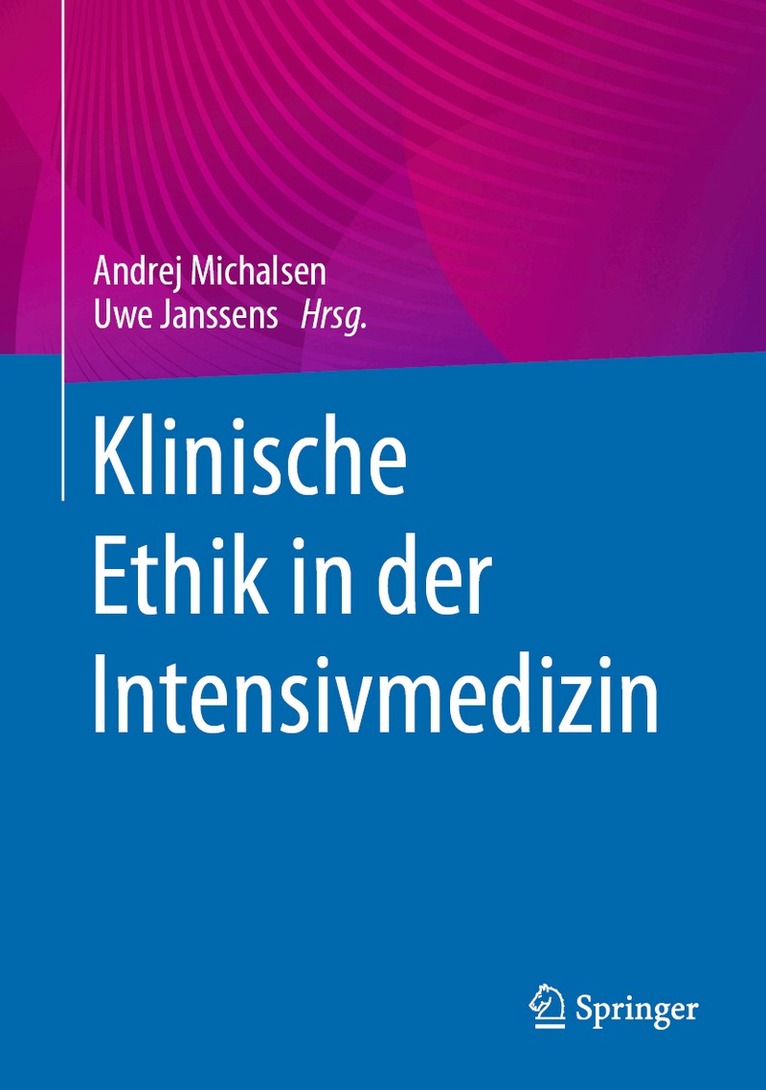
Klinische Ethik in der Intensivmedizin
Av Andrej Michalsen, Uwe Janssens
Inbunden, 2026
531 kr
Lägg i varukorg
Der medizinisch-technische Fortschritt und die demographische Entwicklung sowie die Erwartungen und Anspruchshaltungen in der Bevölkerung haben in den letzten Jahren zu einer erheblichen Ausweitung intensivmedizinischer Maßnahmen geführt. Die Festlegung eines individuell angemessenen Therapieziels …
Klinische Ethik in der Intensivmedizin
Av Uwe Janssens, Andrej Michalsen
E-bok, 2026
537 kr
Lägg i varukorg
Der medizinisch-technische Fortschritt und die demographische Entwicklung sowie die Erwartungen und Anspruchshaltungen in der Bevölkerung haben in den letzten Jahren zu einer erheblichen Ausweitung intensivmedizinischer Maßnahmen geführt. Die Festlegung eines individuell angemessenen Therapieziels …