Andrew E. Yagle - Böcker
Visar alla böcker från författaren Andrew E. Yagle. Handla med fri frakt och snabb leverans.
2 produkter
2 produkter
1 010 kr
Skickas inom 7-10 vardagar
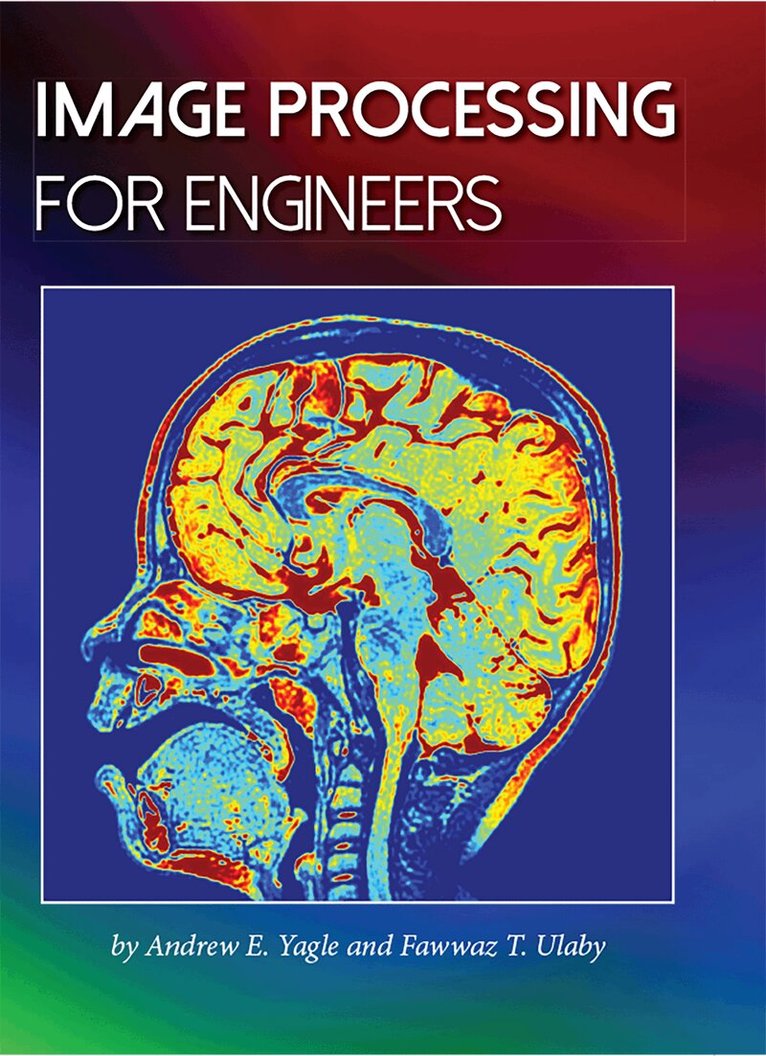
[from the Preface] Designed for a course on image processing (IP) aimed at both graduate students as well as undergraduates in their senior year, in any field of engineering, this book starts with an overview in Chapter 1 of how imaging sensors—from cameras to radars to MRIs and CAT—form images, and then proceeds to cover a wide array of image processing topics. The IP topics include: image interpolation, magnification, thumbnails, and sharpening, edge detection, noise filtering, de-blurring of blurred images, supervised and unsupervised learning, and image segmentation, among many others. As a prelude to the chapters focused on image processing (Chapters 3–12), the book offers in Chapter 2 a review of 1-D signals and systems, borrowed from our 2018 book Signals and Systems: Theory and Applications, by Ulaby and Yagle.
1 109 kr
Skickas inom 7-10 vardagar
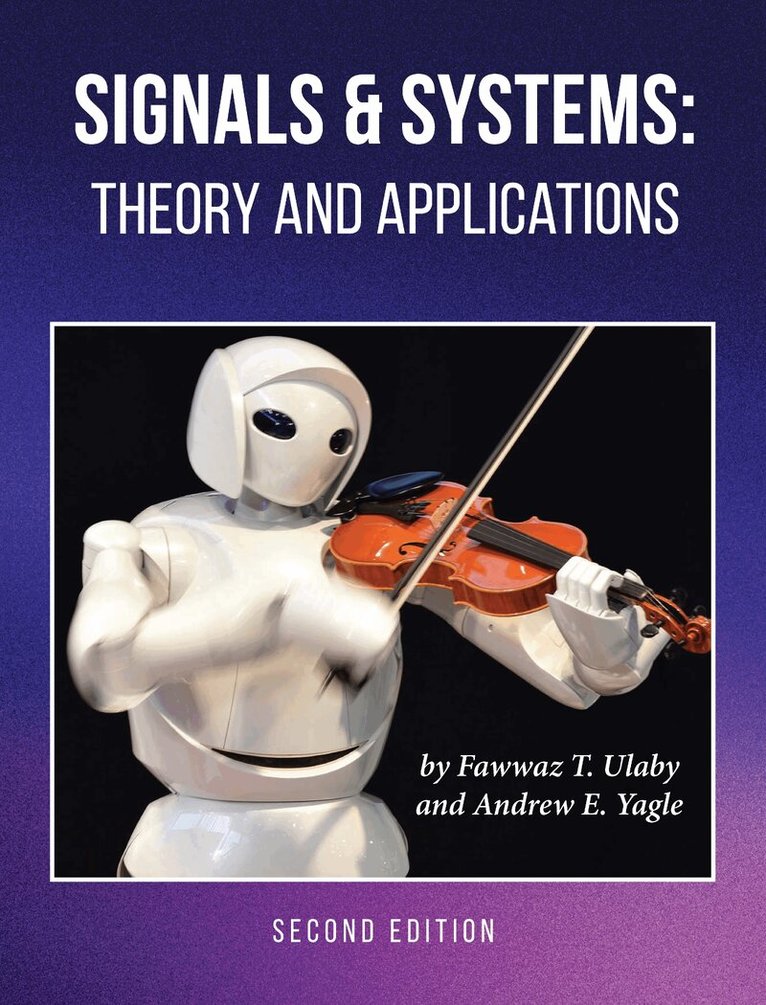
[From the Preface] This is a signals and systems textbook with a difference: Engineering applications of signals and systems are integrated into the presentation as equal partners with concepts and mathematical models, instead of just presenting the concepts and models and leaving the student to wonder how it all relates to engineering.The first six chapters of this textbook cover the usual basic concepts of continuous-time signals and systems, including the Laplace and Fourier transforms. Chapters 7 and 8 present the discrete-time version of Chapters 1–6, emphasizing the similarities and analogies, and often using continuous-time results to derive discrete-time results. The two chapters serve to introduce the reader to the world of discrete-time signals and systems. Concepts highlighted in Chapters 1–8 include: compensator feedback configuration (Ch. 4); energy spectral density, group delay, expanded coverage of exponential Fourier series (Ch. 5); filtering of images, Hilbert transform, single-sideband (SSB), zero and first-order hold interpolation (Ch. 6); the Cooley-Tukey FFT (Ch. 7); bilateral z-transform and use for non-minimum-phase deconvolution (Ch. 8). Chapter 9 covers the usual concepts of discrete-time signal processing, including data windows, FIR and IIR filter design, multirate signal processing, and auto-correlation and crosscorrelation. It also includes some nontraditional concepts, including spectrograms, application of multirate signal processing, and the musical circle of fifths to audio signal processing, and some biomedical applications of autocorrelation and cross-correlation. Chapter 10 covers image processing, discrete-time wavelets (including the Smith-Barnwell condition and the Haar and Daubechies discrete-time wavelet expansions), and an introduction to compressed sensing. This is the first sophomore-junior level textbook the authors are aware of that allows students to apply compressed sensing concepts. Applications include: image denoising using 2-D filtering; image denoising using thresholding and shrinkage of image wavelet transforms; image deconvolution using Wiener filters; “valid” image deconvolution using ISTA; image inpainting; tomography and the projection-slice theorem, and image reconstruction from partial knowledge of 2-D DFT values. Problems allow students to apply these techniques to actual images and learn by doing, not by only reading.