Andrew F.G. Bourke - Böcker
Visar alla böcker från författaren Andrew F.G. Bourke. Handla med fri frakt och snabb leverans.
3 produkter
3 produkter
2 292 kr
Skickas inom 7-10 vardagar
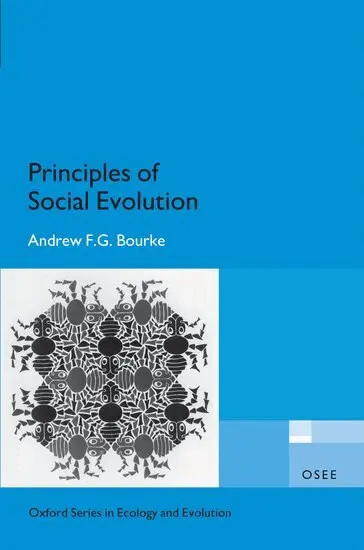
Living things are organized in a hierarchy of levels. Genes group together in cells, cells group together in organisms, and organisms group together in societies. Even different species form mutualistic partnerships. Throughout the history of life, previously independent units have formed groups that, in time, have come to resemble individuals in their own right. Evolutionary biologists term such events "the major transitions". The process common to them all is social evolution. Each transition occurs only if natural selection favours one unit joining with another in a new kind of group. This book presents a fresh synthesis of the principles of social evolution that underlie the major transitions, explaining how the basic theory underpinning social evolution - inclusive fitness theory - is central to understanding each event. The book defines the key stages in a major transition, then highlights the shared principles operating at each stage across the transitions as a whole. It addresses in new ways the question of how, once they have arisen, organisms and societies become more individualistic.
987 kr
Skickas inom 7-10 vardagar
Living things are organized in a hierarchy of levels. Genes group together in cells, cells group together in organisms, and organisms group together in societies. Even different species form mutualistic partnerships. Throughout the history of life, previously independent units have formed groups that, in time, have come to resemble individuals in their own right. Evolutionary biologists term such events "the major transitions". The process common to them all is social evolution. Each transition occurs only if natural selection favours one unit joining with another in a new kind of group. This book presents a fresh synthesis of the principles of social evolution that underlie the major transitions, explaining how the basic theory underpinning social evolution - inclusive fitness theory - is central to understanding each event. The book defines the key stages in a major transition, then highlights the shared principles operating at each stage across the transitions as a whole. It addresses in new ways the question of how, once they have arisen, organisms and societies become more individualistic.
1 331 kr
Skickas inom 3-6 vardagar
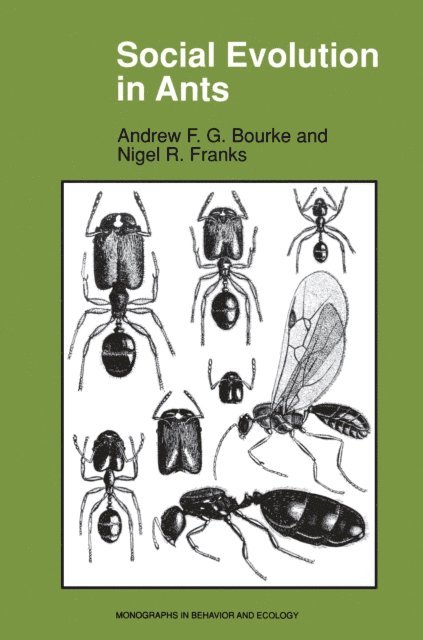
Biologists since Darwin have been intrigued and confounded by the complex issues involved in the evolution and ecology of the social behavior of insects. The self-sacrifice of sterile workers in ant colonies has been particularly difficult for evolutionary biologists to explain. In this important new book, Andrew Bourke and Nigel Franks not only present a detailed overview of the current state of scientific knowledge about social evolution in ants, but also show how studies on ants have contributed to an understanding of many fundamental topics in behavioral ecology and evolutionary biology. One of the substantial contributions of Social Evolution in Ants is its clear explanation of kin selection theory and sex ratio theory and their applications to social evolution in insects. Working to dispel lingering skepticism about the validity of kin selection and, more broadly, of "selfish gene" theory, Bourke and Franks show how these ideas underpin the evolution of both cooperation and conflict within ant societies. In addition, using simple algebra, they provide detailed explanations of key mathematical models.Finally, the authors discuss two relatively little-known topics in ant social biology: life history strategy and mating systems. This comprehensive, up-to-date, and well-referenced work will appeal to all researchers in social insect biology and to scholars and students in the fields of entomology, behavioral ecology, and evolution.