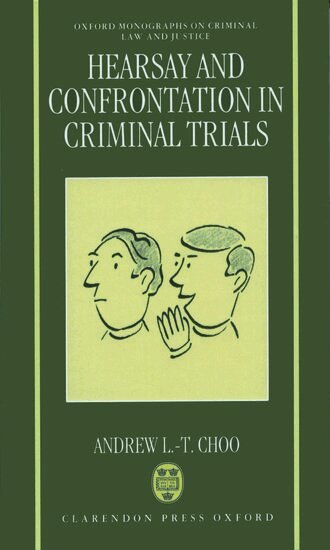
The law of Criminal Hearsay is one of the most controversial and topical areas of English law today. Following closely on the heels of the publication of the Law Commission's consultation paper on Criminal Hearsay, this timely book takes a critical look at the operation of the Hearsay rule in criminal trials on indictment in England. In addition, an examination of the legal position in a number of other jurisdictions (especially Canada, Australia, and the United States) is undertaken at appropriate points in the text. The author examines possible rationale for the Hearsay rule, challenging traditional notions that the rule in criminal proceedings exists simply to safeguard the reliability of evidence. A critical review of some of the relevant psychological research is also undertaken. Included in the book, too, is a discussion of some possible options for reform, including the suggestions made by the Law Commission in its consultation papers.
The criminal courts have a power to stop a prosecution from proceeding altogether where it would be inappropriate for it to continue. This power to stay proceedings which constitute an abuse of the process of the court has assumed great practical significance and is potentially applicable in many situations. There is at least one consideration of the abuse of process doctrine in virtually every major criminal trial today.This fully updated second edition of Abuse of Process and Judicial Stays of Criminal Proceedings blends doctrinal discussion with a thorough consideration of the underlying theory to provide a searching analysis of the theory and practice of abuse of process in England and Wales, with comparative examinations of many other jurisdictions including The USA, Canada, Australia, and New Zealand. This edition focuses in particular upon the profound impact of the European Convention on Human Rights in this area.
The law of Criminal Hearsay is one of the most controversial and topical areas of English law today. Following closely on the heels of the publication of the Law Commission's consultation paper on Criminal Hearsay, this timely book takes a critical look at the operation of the Hearsay rule in criminal trials on indictment in England. In addition, an examination of the legal position in a number of other jurisdictions (especially Canada, Australia, and the United States) is undertaken at appropriate points in the text. The author examines possible rationale for the Hearsay rule, challenging traditional notions that the rule in criminal proceedings exists simply to safeguard the reliability of evidence. A critical review of some of the relevant psychological research is also undertaken. Included in the book, too, is a discussion of some possible options for reform, including the suggestions made by the Law Commission in its consultation papers.
The criminal courts have a power to stop a prosecution from proceeding altogether where it would be inappropriate for it to continue. This power to stay proceedings which constitute an abuse of the process of the court has assumed great practical significance and is potentially applicable in many situations. There is at least one consideration of the abuse of process doctrine in virtually every major criminal trial today.This fully updated second edition of Abuse of Process and Judicial Stays of Criminal Proceedings blends doctrinal discussion with a thorough consideration of the underlying theory to provide a searching analysis of the theory and practice of abuse of process in England and Wales, with comparative examinations of many other jurisdictions including The USA, Canada, Australia, and New Zealand. This edition focuses in particular upon the profound impact of the European Convention on Human Rights in this area.