Andrew Pratt – författare
Visar alla böcker från författaren Andrew Pratt. Handla med fri frakt och snabb leverans.
7 produkter
7 produkter
Häftad, Engelska, 2010
320 kr
Skickas inom 5-8 vardagar
The SCM Studyguide: Practical Skills for Ministry offers a practical introduction for those who are training for ministry, both lay and ordained, within the church. The book answers the questions asked by those preparing for ministry and by those who have recently started and found gaps in the way they have been prepared. The author uses real examples drawn from his experience of over 20 years of pastoral ministry, together with work in chaplaincy and broadcasting and the shared experience of others. The book covers all those aspects of ministry required within the more practical contextual areas of the course of preparation for ministry in use by mainstream denominations, such as baptisms, weddings, working with others, communication, meetings and funerals. It provides practical guidance which is soundly theologically and pastorally based.
E-bok
Engelska, 2013287 kr
Läs direkt efter köp
The SCM Studyguide: Practical Skills for Ministry offers a practical introduction for those who are training for ministry, both lay and ordained, within the church. The book answers the questions asked by those preparing for ministry and by those who have recently started and found gaps in the way they have been prepared. The author uses real examples drawn from his experience of over 20 years of pastoral ministry, together with work in chaplaincy and broadcasting and the shared experience of others. The book covers all those aspects of ministry required within the more practical contextual areas of the course of preparation for ministry in use by mainstream denominations, such as baptisms, weddings, working with others, communication, meetings and funerals. It provides practical guidance which is soundly theologically and pastorally based.
Häftad, Engelska, 2021
111 kr
Skickas
Del 2 - Honza
Head to Head - Honza Book 2
Häftad, Engelska, 2022
157 kr
Skickas
Häftad, Engelska, 2023
156 kr
Skickas
E-bok
PDF, Engelska, 2017287 kr
Läs direkt efter köp
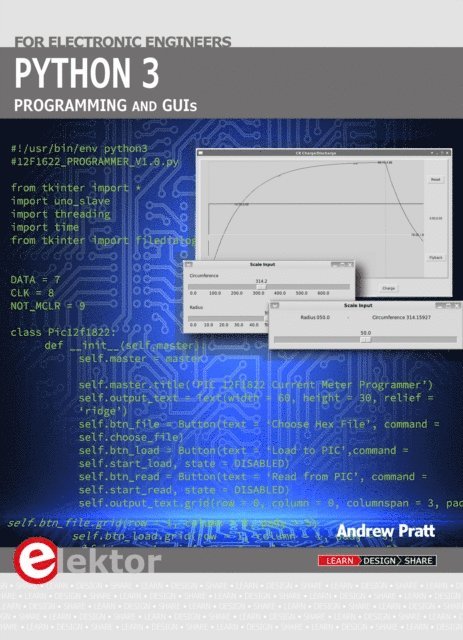
This is the second edition of a book aimed at engineers, scientists and hobbyists who want to interface PCs with hardware projects using graphical user interfaces. Desktop and web based applications are covered. The programming language used is Python 3 which is one of the most popular languages around: speed of programming being a key feature. The book has been revised and updated with emphasis on getting the user to produce practical designs with ease - a text editor is all that is required to produce Python programs. Hardware interfacing is achieved using an Arduino Uno as a remote slave. A full description and source code of the communication interface is given in the book. The slave provides digital and analogue input and outputs. Multiple Unos can be included in one project with all control code written in Python and running on a PC. One project involves a PIC microcontroller with code provided that can be loaded into the PIC using the Uno. The web applications and server are all implemented in Python allowing you to access your electronic hardware over the Internet. The Raspberry Pi computer can be used as your web server. An introductory chapter is provided to get you started with using Linux. The book is written for use with Debian or variations including Mint or Ubuntu. All of the programs in the book are freely available, ready to use and experiment with by way of a download from Elektor.
E-bok
PDF, Engelska, 2020317 kr
Läs direkt efter köp
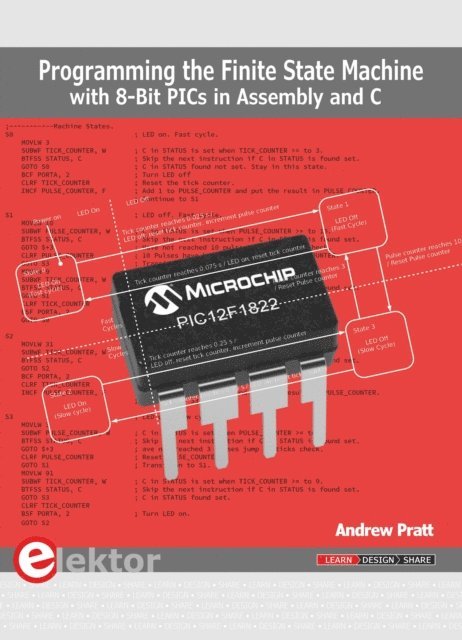
This practical guide is aimed at electronics students and hobbyists. It is intended to be a valuable aid in writing programs using Finite State Machines (FSMs) in assembly language using 8-bit PIC microcontrollers. The last two chapters introduce the use of the C programming language and make a direct comparison with development in Assembly. An FSM is a way of writing a program to make it easier to produce and modify. The machine is abstract in that it is just the structure of the program. This abstract machine can be represented by drawing a diagram on paper. The diagram is independent of the programming language used. The FSM chart gives a complete description of what the program does. It can then be implemented as source code. The book should appeal to those with an interest in the combination of electronics and software and have an interest in how things work. The book will describe writing code for two particular microcontrollers: The 12F1822 and 16F1823. Both are mid-range and inexpensive. To read and write the programs to and from the PICs, all that is required is an FTDI TTL level USB lead (TTL-232R-5V-WE) in addition to two programs that are both available for free download as executable files and source code from Elektor. Microsoft Windows or Linux can be used. The PIC programs are written in assembly language. This goes against the conventional wisdom of using a higher-level language such as C. One reason for this is that assembly is a good way of learning what is happening at the lowest level. This is important as microcontroller programming requires an understanding of the chip. Another reason for using the finite state machine approach is that it makes assembly programs surprisingly easy to follow. One of the main obstacles in the way of getting started with embedded programming is the installation and learning of new software tools. The emphasis of this book is on making things straightforward with as little complication as possible. Therefore you can concentrate on understanding the code. Real projects aren''t just about coding: our software has to do something real. As a consequence, a chapter deals with a method of circuit board construction.All coding is done in a text editor of your choosing. The command line is used for running programs. If you are a Windows user, you might look at this as old fashioned. This is actually an efficient way of doing things: simple scripts for repetitive tasks save lots of mouse clicks. The last two chapters give an introduction to programming in C using the XC8 compiler. Again this is done using a text editor and the command line.The intention has been to achieve results using an inexpensive microcontroller with simple command line tools. Much emphasis is placed on using Microchip''s datasheet as this is the best place to get correct detailed information