Angelo Pio Rossi - Böcker
Visar alla böcker från författaren Angelo Pio Rossi. Handla med fri frakt och snabb leverans.
3 produkter
3 produkter
1 381 kr
Skickas inom 10-15 vardagar
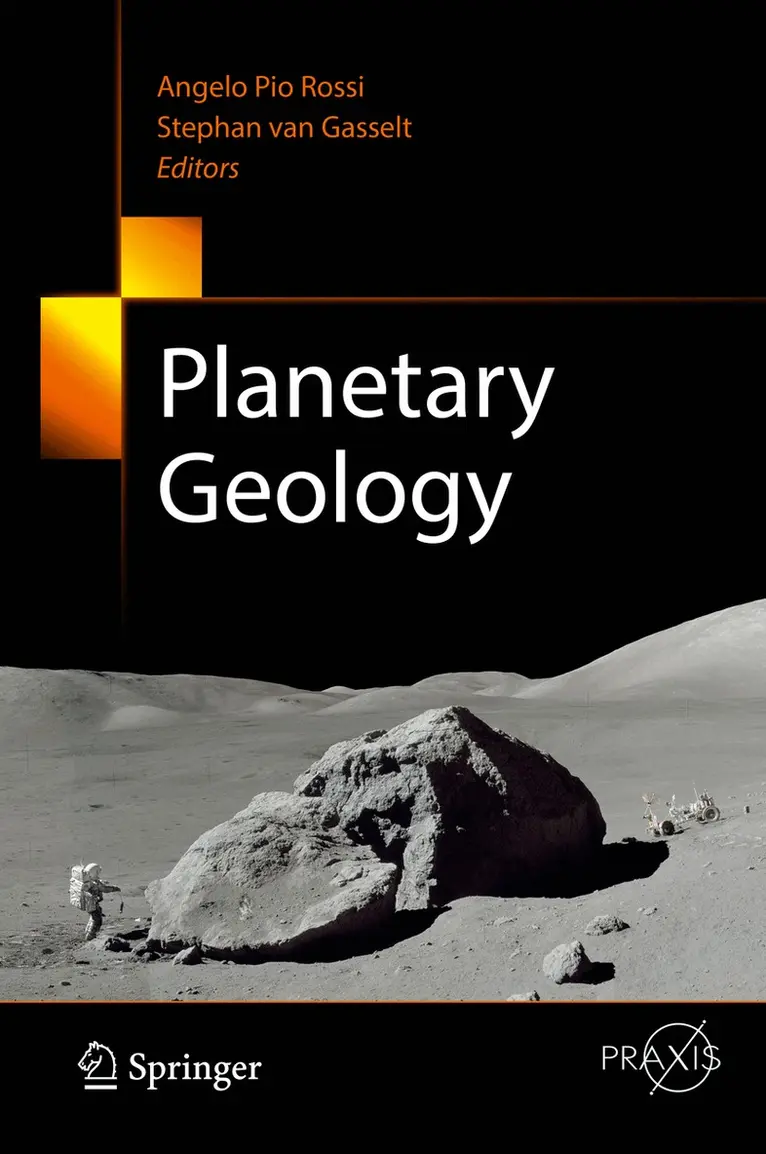
This book provides an up-to-date interdisciplinary geoscience-focused overview of solid solar system bodies and their evolution, based on the comparative description of processes acting on them.Planetary research today is a strongly multidisciplinary endeavor with efforts coming from engineering and natural sciences. Key focal areas of study are the solid surfaces found in our Solar System. Some have a direct interaction with the interplanetary medium and others have dynamic atmospheres. In any of those cases, the geological records of those surfaces (and sub-surfaces) are key to understanding the Solar System as a whole: its evolution and the planetary perspective of our own planet.This book has a modular structure and is divided into 4 sections comprising 15 chapters in total. Each section builds upon the previous one but is also self-standing. The sections are: Methods and toolsProcesses and Sources Integration and Geological SynthesesFrontiersThe latter covers the far-reaching broad topics of exobiology, early life, extreme environments and planetary resources, all areas where major advancements are expected in the forthcoming decades and both key to human exploration of the Solar System.The target readership includes advanced undergraduate students in geoscience-related topics with no specific planetary science knowledge; undergraduates in other natural science domains (e.g. physics, astronomy, biology or chemistry); graduates in engineering and space systems design who want to complement their knowledge in planetary science.The authors’ backgrounds span a broad range of topics and disciplines: rooted in Earth geoscience, their expertise covers remote sensing and cartography, field mapping, impact cratering, volcanology and tectonics, sedimentology and stratigraphy exobiology and life in extreme environments, planetary resources and mining. Several generations of planetary scientists are cooperating to provide a modern view on a discipline developed from Earth during and through Space exploration.
1 064 kr
Skickas inom 10-15 vardagar
This book provides an up-to-date interdisciplinary geoscience-focused overview of solid solar system bodies and their evolution, based on the comparative description of processes acting on them.Planetary research today is a strongly multidisciplinary endeavor with efforts coming from engineering and natural sciences. Key focal areas of study are the solid surfaces found in our Solar System. Some have a direct interaction with the interplanetary medium and others have dynamic atmospheres. In any of those cases, the geological records of those surfaces (and sub-surfaces) are key to understanding the Solar System as a whole: its evolution and the planetary perspective of our own planet.This book has a modular structure and is divided into 4 sections comprising 15 chapters in total. Each section builds upon the previous one but is also self-standing. The sections are: Methods and toolsProcesses and Sources Integration and Geological SynthesesFrontiersThe latter covers the far-reaching broad topics of exobiology, early life, extreme environments and planetary resources, all areas where major advancements are expected in the forthcoming decades and both key to human exploration of the Solar System.The target readership includes advanced undergraduate students in geoscience-related topics with no specific planetary science knowledge; undergraduates in other natural science domains (e.g. physics, astronomy, biology or chemistry); graduates in engineering and space systems design who want to complement their knowledge in planetary science.The authors’ backgrounds span a broad range of topics and disciplines: rooted in Earth geoscience, their expertise covers remote sensing and cartography, field mapping, impact cratering, volcanology and tectonics, sedimentology and stratigraphy exobiology and life in extreme environments, planetary resources and mining. Several generations of planetary scientists are cooperating to provide a modern view on a discipline developed from Earth during and through Space exploration.
1 593 kr
Skickas inom 10-15 vardagar
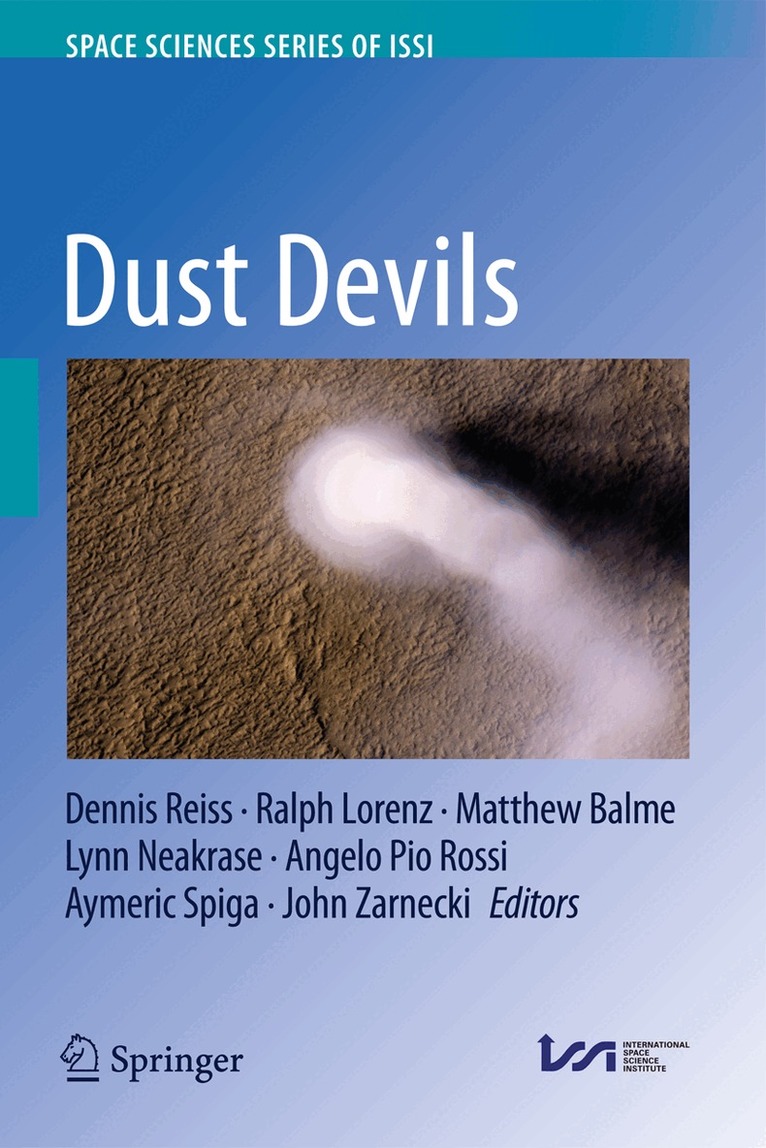
This volume reviews both historical and current studies of desert whirlwinds called dust devils on Earth and Mars. These include field measurements, orbital observations, modelling of dust devil formation and structure, studies of their population and statistics, and their atmospheric and climate impact.Dust devils have captivated humankind since antiquity, and yet also assume importance in that most modern of activities, planetary exploration. The close investigation of the planet Mars by an armada of spacecraft in the last couple of decades has stimulated extensive research on these desert whirlwinds, supported by improvements in field instrumentation on Earth, laboratory experiments and powerful numerical simulations. This convergence of capability and interest stimulated the workshop 'Dust Devils on Mars and Earth', conceived by Dennis Reiss, Ralph Lorenz, Matt Balme, Lynn D. Neakrase, Angelo Pio Rossi, Aymeric Spiga and John Zarnecki, held under the auspicesof the International Space Science Institute in Bern, Switzerland, during the week of February 16–20, 2015. The workshop drew not only planetary scientists, for whom terrestrial dust devils are a convenient proxy for their Martian cousins, but also scientists studying the impact of dust on the terrestrial climate.Originally published in Space Science Reviews, Volume 203, Issue 1-4, November 2016