Angus Britts – författare
Visar alla böcker från författaren . Handla med fri frakt och snabb leverans.
2 produkter
2 produkter
E-bok
Engelska, 2017252 kr
Läs direkt efter köp
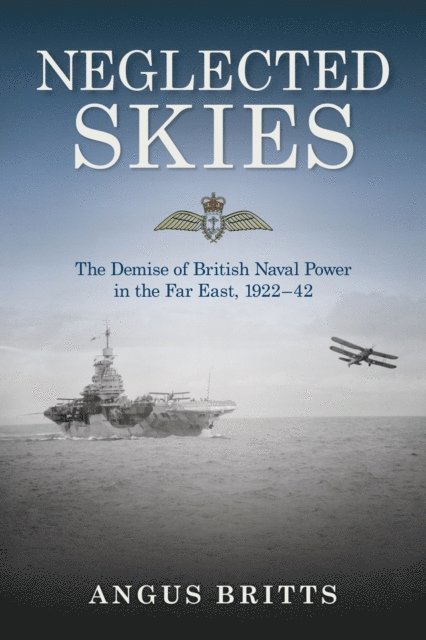
Neglected Skies is a reconsideration of one of the Second World War’s most forgotten naval engagements – the abortive clash between the British Eastern Fleet and the Imperial Japanese Navy’s First Air Fleet (Kido Butai) to the south of Ceylon, over a period of ten days in late March/early April 1942. The focus upon this battle is for the purpose of exploring the surrender of British naval supremacy from the operational perspective, most particularly the inability of the British Admiralty over two decades to develop a first-line, carrier-borne air arm. By primarily analysing the evolution of British naval aviation during the interwar period, as well as the challenges which the peacetime Royal Navy was forced to confront, most especially in the fields of international arms-limitation and domestic fiscal restraint, a picture emerges of a battlefleet which entered war in September 1939 at considerably less that a primary state of combat readiness. Likewise, the publication examines the rise of the instrument which was primarily responsible for toppling the Royal Navy from its paramount position on the battlefield – namely the development of Japan’s lethal first strike instrument known as the Kido Butai. The concentration of the IJN’s six largest aircraft-carriers into a single striking force, equipped with state-of-the-art aircraft manned by elite aviators, represented an enormous quantum leap forward in warfighting at sea, and the evolution of both the concept, and its material components in a domestic atmosphere permeated by aggressive militarism, is a central component in the book. Two essential conclusions are reach by the author. The first is that the demise of British naval supremacy was first and foremost a process that spanned two decades, prior to coming to fruition in the Indian Ocean in April 1942. The second is that the story of British naval and imperial decline did not end with the fall of Singapore on 15 February 1942, but rather reached its climax in the subsequent conduct of Japan’s Operation C, where for the first time in history, a British fleet was compelled to retire from the battlefield in the face of opposition from a force which, though similar in size, possessed a measure of modern aerial firepower which was quite beyond the capability of the British to effectively counter in any form then available to the British Admiralty.
E-bok
Engelska, 2021728 kr
Läs direkt efter köp
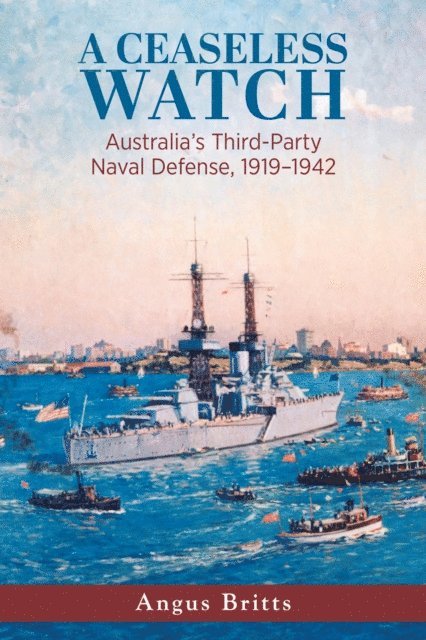
A Ceaseless Watch: Australia’s Third Party Naval Defense, 1919–1942 illustrates how Australia confronted the need to base its post–World War I defense planning around the security provided by a major naval power: in the first instance, Britain, and later the United States. Spanning the period leading up to Australia’s greatest security crisis—the military threat posed by Japan throughout the majority of 1942—the work takes the reader all the way up to the defeat of the Imperial Japanese Navy by the United States Navy in the Solomon Islands campaign. Angus Britts focuses on Anglo-Australian defense relations from 1919–42 when the British were Australia’s primary naval protectors until they were superseded in the Pacific by the United States in May 1942 at the battle of the Coral Sea. Britts traces the process of the alignment or divergence of differing strategic interests between Australia and Britain in particular. Taking place against the backdrop of Imperial Japan’s expansionism debates within Australian political and defense circles during this period, namely the nature of the most likely threat to the continent itself, what became an important subplot to the events then unfolding in the Pacific. Looking at the development of the “Singapore strategy” which utilized the British fleet at Singapore to protect Australia’s interests, Britts lays out how the cornerstone for Australian defense planning was based on the continued assurances from successive British governments that they would honor their naval commitments should Australia itself eventually come under serious threat from Japanese aggression. The Australian-American defense relationship evolved at a later stage within the timeframe in this work, but the varying interactions between both nations throughout the interwar years are likewise addressed, as is the foundation of their wartime relations. Britts illustrates the difficulty in forming a defense relationship between small and great powers, where the needs of the former are not subsumed by the interests of the latter, from the interwar years to the start of World War II. In an era when the entire Pacific region was at war, the inability of a larger power to fulfill its side of a defensive pact with a smaller power shaped the future of the region itself.