Anita Schobel – författare
1 672 kr
Läs direkt efter köp
Customer-Oriented Optimization in Public Transportation develops models, results and algorithms for optimizing public transportation from a customer-oriented point of view. The methods used are based on graph-theoretic approaches and integer programming. The specific topics are all motivated by real-world examples which occurred in practical projects. An appendix summarizes some of the basics of optimization needed to interpret the material in the book.
In detail, the topics the book covers in its three parts are as follows:
1. Stop location. Does it make sense to open new stations along existing bus or railway lines? If yes, in which locations? The problem is modeled as a continuous covering problem. To solve it the author develops a finite dominating set and shows that efficient methods are possible if the special structure of the covering matrix is used.
2. Delay management. Should a train wait for delayed feeder trains or should it depart in time? The author builds up two different integer programming models and a model based on project planning methods. Properties and solution methods are developed.
3. Tariff planning. Part 3 deals with the design of zone tariff systems, in which the fare is determined by the number of zones used by the passengers. The author presents a model for this problem and approaches based on clustering theory.
1 367 kr
Läs direkt efter köp
1 148 kr
Läs direkt efter köp
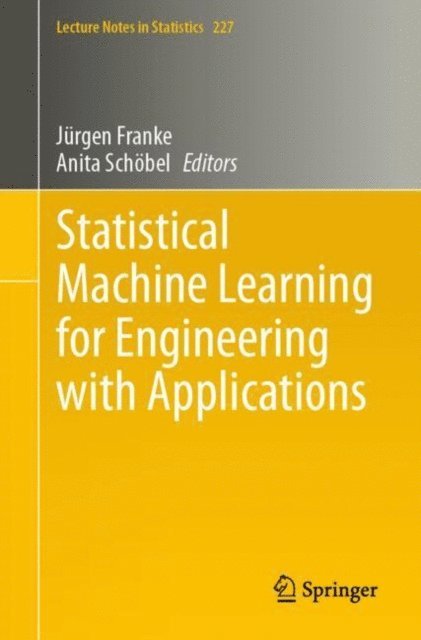
This book offers a leisurely introduction to the concepts and methods of machine learning. Readers will learn about classification trees, Bayesian learning, neural networks and deep learning, the design of experiments, and related methods. For ease of reading, technical details are avoided as far as possible, and there is a particular emphasis on applicability, interpretation, reliability and limitations of the data-analytic methods in practice. To cover the common availability and types of data in engineering, training sets consisting of independent as well as time series data are considered. To cope with the scarceness of data in industrial problems, augmentation of training sets by additional artificial data, generated from physical models, as well as the combination of machine learning and expert knowledge of engineers are discussed.
The methodological exposition is accompanied by several detailed case studies based on industrial projects covering a broad range of engineering applications from vehicle manufacturing, process engineering and design of materials to optimization of production processes based on image analysis.
The focus is on fundamental ideas, applicability and the pitfalls of machine learning in industry and science, where data are often scarce. Requiring only very basic background in statistics, the book is ideal for self-study or short courses for engineering and science students.
693 kr
Läs direkt efter köp
206 kr
Läs direkt efter köp