Ann Nowé – författare
Visar alla böcker från författaren Ann Nowé. Handla med fri frakt och snabb leverans.
5 produkter
ECAI 2023
26th European Conference on Artificial Intelligence, September 30 – October 4, 2023, Kraków, Poland – Including 12th Conference on Prestigious Applications of Intelligent Systems (PAIS 2023)
Häftad, 2023
8134 kr
Lägg i varukorg
Artificial intelligence, or AI, now affects the day-to-day life of almost everyone on the planet, and continues to be a perennial hot topic in the news.This book presents the proceedings of ECAI 2023, the 26th European Conference on Artificial Intelligence, and of PAIS 2023, the 12th Conference on …
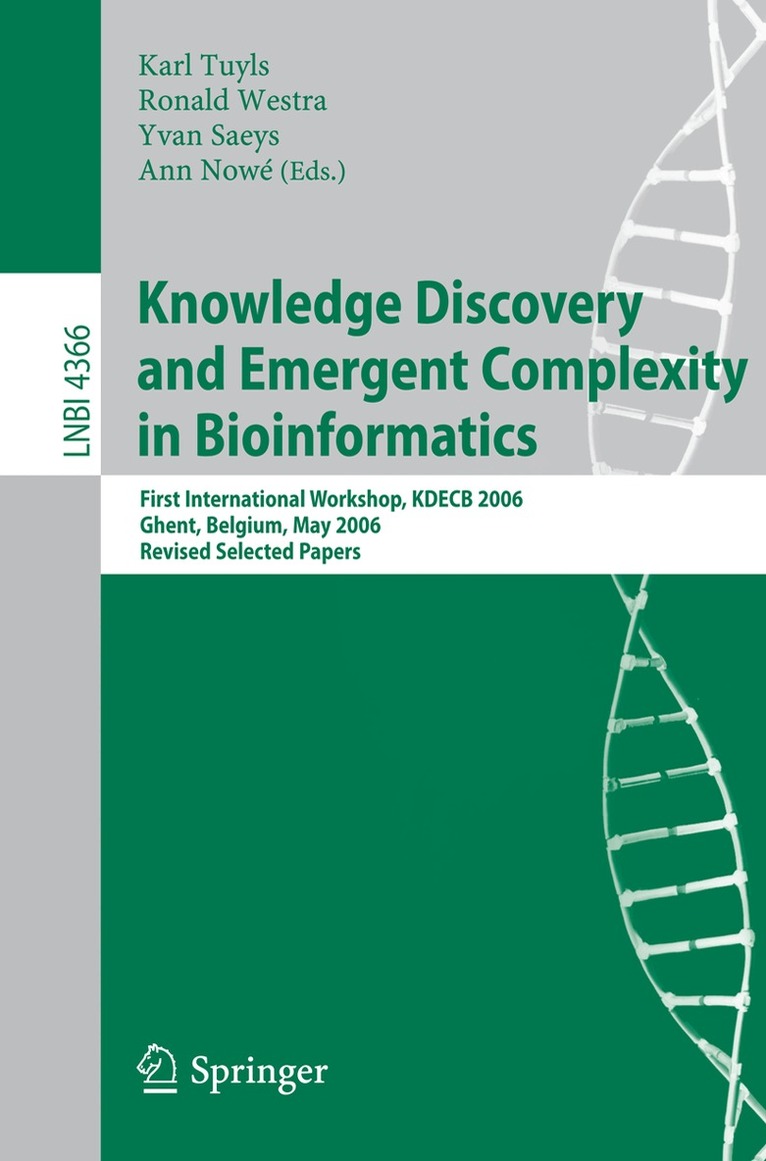
Knowledge Discovery and Emergent Complexity in Bioinformatics
First International Workshop, KDECB 2006, Ghent, Belgium, May 10, 2006, Revised Selected Papers
Av Karl Tuyls, Ronald Westra m. fl.
Häftad, 2007
550 kr
Lägg i varukorg
This book contains selected and revised papers of the International Symposium on Knowledge Discovery and Emergent Complexity in Bioinformatics (KDECB 2006), held at the University of Ghent, Belgium, May 10, 2006. In February 1943, the Austrian physicist Erwin Schrodi ¨ nger, one of the founding …
Knowledge Discovery and Emergent Complexity in Bioinformatics
First International Workshop, KDECB 2006, Ghent, Belgium, May 10, 2006, Revised Selected Papers
Av Ann Nowe, Yvan Saeys m. fl.
E-bok, 2007
734 kr
Lägg i varukorg
This book contains selected and revised papers of the International Symposium on Knowledge Discovery and Emergent Complexity in Bioinformatics (KDECB 2006), held at the University of Ghent, Belgium, May 10, 2006. In February 1943, the Austrian physicist Erwin Schrodi ¨ nger, one of the founding …
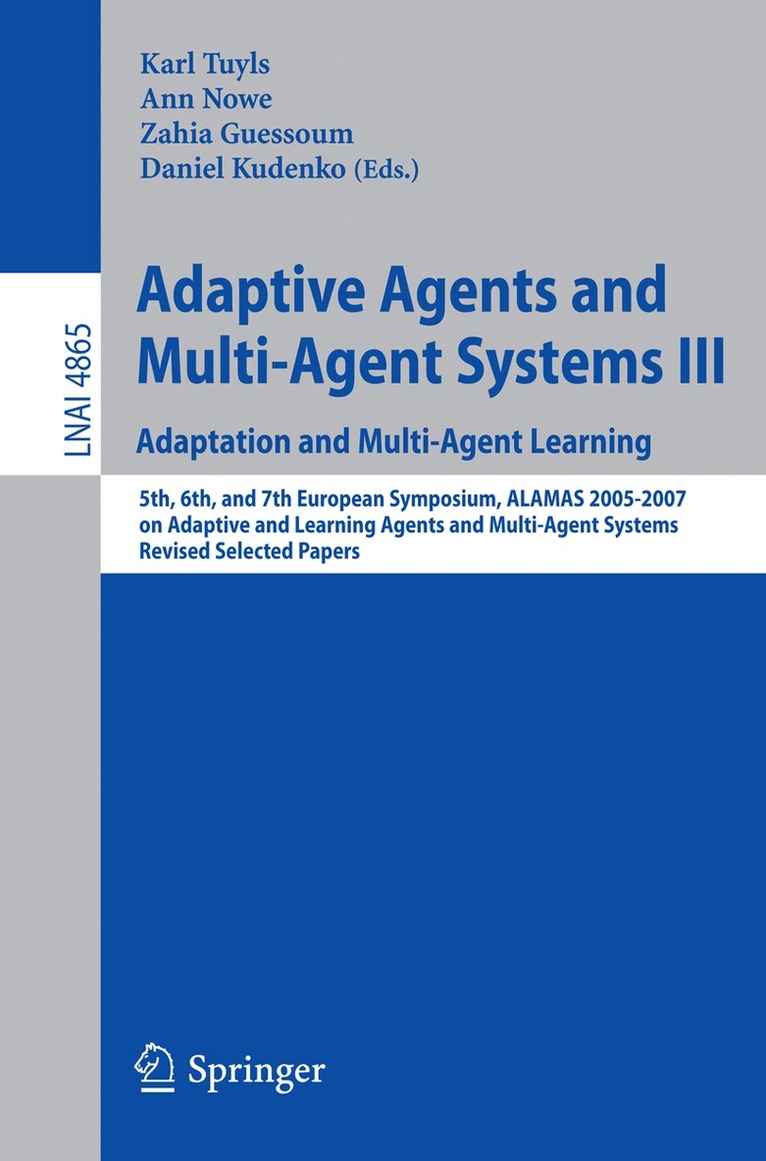
Adaptive Agents and Multi-Agent Systems III. Adaptation and Multi-Agent Learning
Adaptation and Multi-Agent Learning, 5th, 6th, and 7th European Symposium, ALAMAS 2005-2007 on Adaptive and Learning Agents and Multi-Agent Systems, Revised Selected Papers
Av Karl Tuyls, Ann Nowe m. fl.
Häftad, 2008
566 kr
Lägg i varukorg
This book contains selected and revised papers of the European Symposium on Adaptive and Learning Agents and Multi-Agent Systems (ALAMAS), editions 2005, 2006 and 2007, held in Paris, Brussels and Maastricht. The goal of the ALAMAS symposia, and this associated book, is to increase awareness and …
Adaptive Agents and Multi-Agent Systems III. Adaptation and Multi-Agent Learning
Adaptation and Multi-Agent Learning, 5th, 6th, and 7th European Symposium, ALAMAS 2005-2007 on Adaptive and Learning Agents and Multi-Agent Systems, Revised Selected Papers
Av Daniel Kudenko, Zahia Guessoum m. fl.
E-bok, 2008
755 kr
Lägg i varukorg
This book contains selected and revised papers of the European Symposium on Adaptive and Learning Agents and Multi-Agent Systems (ALAMAS), editions 2005, 2006 and 2007, held in Paris, Brussels and Maastricht. The goal of the ALAMAS symposia, and this associated book, is to increase awareness and …