Anna Jacobson Schwartz – författare
Visar alla böcker från författaren Anna Jacobson Schwartz. Handla med fri frakt och snabb leverans.
8 produkter
Great Contraction, 1929-1933
New Edition
Av Milton Friedman, Anna Jacobson Schwartz
Häftad, 2008
403 kr
Lägg i varukorg
Friedman and Schwartz's A Monetary History of the United States, 1867-1960, published in 1963, stands as one of the most influential economics books of the twentieth century. A landmark achievement, the book marshaled massive historical data and sharp analytics to support the claim that monetary …
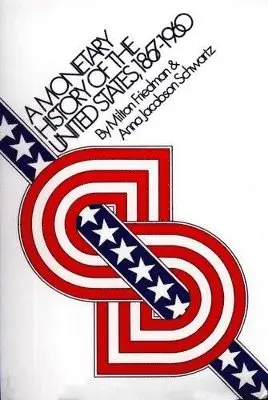
Monetary History of the United States, 1867-1960
Av Milton Friedman, Anna Jacobson Schwartz
Häftad, 1971
668 kr
Lägg i varukorg
Writing in the June 1965 issue of theEconomic Journal, Harry G. Johnson begins with a sentence seemingly calibrated to the scale of the book he set himself to review: "The long-awaited monetary history of the United States by Friedman and Schwartz is in every sense of the term a monumental …
From New Deal Banking Reform to World War II Inflation
Av Milton Friedman, Anna Jacobson Schwartz
Häftad, 2014
368 kr
Lägg i varukorg
This selection from the authors' A Monetary History of the United States, 1867-1960 (Princeton) describes the changes that were made in the banking structure and in the monetary standard following the great contraction of 1929 to 1933, the establishment of monetary policies after the New Deal …
From New Deal Banking Reform to World War II Inflation
Av Milton Friedman, Anna Jacobson Schwartz
Inbunden, 2016
1523 kr
Lägg i varukorg
This selection from the authors' A Monetary History of the United States, 1867-1960 (Princeton) describes the changes that were made in the banking structure and in the monetary standard following the great contraction of 1929 to 1933, the establishment of monetary policies after the New Deal …
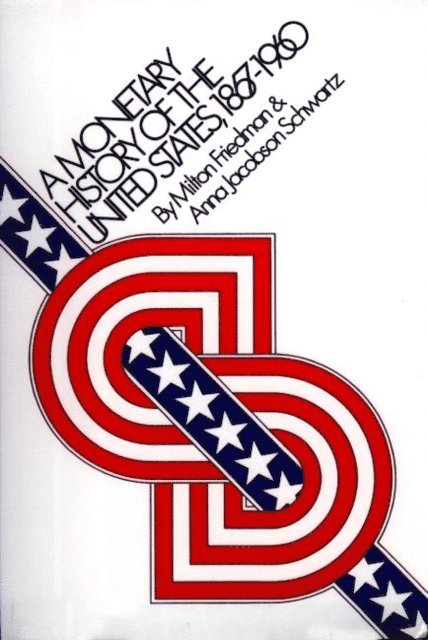
Monetary History of the United States, 1867-1960
Av Anna Jacobson Schwartz, Milton Friedman
E-bok, 2008
884 kr
Lägg i varukorg
“Magisterial. . . . The direct and indirect influence of the Monetary History would be difficult to overstate.”—Ben S. Bernanke, Nobel Prize–winning economist and former chair of the U.S. Federal Reserve From Nobel Prize–winning economist Milton Friedman and his celebrated colleague Anna Jacobson …
Great Contraction, 1929-1933
New Edition
Av Anna Jacobson Schwartz, Milton Friedman
E-bok, 2012
542 kr
Lägg i varukorg
Friedman and Schwartz''s A Monetary History of the United States, 1867-1960 , published in 1963, stands as one of the most influential economics books of the twentieth century. A landmark achievement, the book marshaled massive historical data and sharp analytics to support the claim that monetary …
From New Deal Banking Reform to World War II Inflation
Av Anna Jacobson Schwartz, Milton Friedman
E-bok, 2014
514 kr
Lägg i varukorg
This selection from the authors' A Monetary History of the United States, 1867-1960 (Princeton) describes the changes that were made in the banking structure and in the monetary standard following the great contraction of 1929 to 1933, the establishment of monetary policies after the New Deal …