Anna Rosellini - Böcker
Visar alla böcker från författaren Anna Rosellini. Handla med fri frakt och snabb leverans.
4 produkter
4 produkter
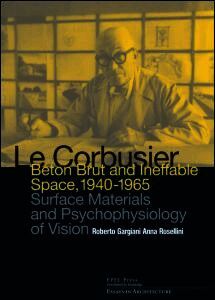
Le Corbusier: Beton Brut and Ineffable Space (1940 – 1965)
Surface Materials and Psychophysiology of Vision
Inbunden, Engelska, 2011
1 383 kr
Skickas inom 7-10 vardagar
This groundbreaking new perspective on Le Corbusier is based on exhaustive archival research and the study of neglected or completely unknown documents. It is innovative in showing the role of materials and construction techniques in the architecture of Le Corbusier and the book also delves into the project management and the construction of several buildings in the period 1940 – 1965. Each worksite, from the Unité d’Habitation (Housing Unit) in Marseille to the city of Chandigarh, and the Tokyo museum, the Carpenter Center in Cambridge and the Unité d'Habitation in Berlin, is analyzed in detail.
606 kr
Kommande
A groundbreaking and interdisciplinary work on architectural collage. Design Strategies in Architecture collects wide-ranging reflections on the use of architectural collage, which has become a popular way of sharing a project’s design because collages can be faster and more approachable than traditional detailed renderings. This book brings together contributions from architectural historians, theoreticians, and architects to look at the role of collage. The essays gathered here reconstruct the role of representation in the evolution of architecture and offer a large selection of relevant case studies in the use of collage, incorporating critical historical analysis of the technical aspects and significance of the case studies within their cultural and political contexts. Together they also provide a critical and historical framework for architectural offices engaged in research related to representation. Groundbreaking and thought-provoking Design Strategies in Architecture is vital reading for understanding architectural collage.
1 261 kr
Skickas inom 7-10 vardagar
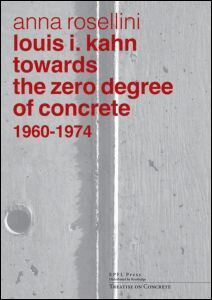
Through sheer determination and courage, Kahn has researched the nature of concrete in the form of precast, cast in place or blocks. Each of his renowned works in exposed concrete, such as the Yale Art Gallery, the Richards Laboratories, the Bath House, the Salk Institute, the National Assembly, the Kimbell Museum, the Exeter Library and the Yale Center for British Art, is itself an important chapter in the history of architecture for the exploration into concrete’s formal expression, beyond the lesson of Le Corbusier.Kahn’s obsession on concrete fabrication processes, on the formwork and the mix-design, is systematically examined in two volumes. The authors illustrate Kahn’s vision with documents that have never been revealed in other essays, drawing heavily from original sketches, plans, specifications, worksite photographs, and correspondences with collaborators, engineers, technicians and contractors.The first volume Exposed Concrete and Hollow Stones focuses on the first ten-year period of Kahn research on concrete. Moving through the many construction systems experienced by Kahn, from the discovery of exposed concrete in the form of béton brut at the Yale Art Gallery, to the precast and poured-in-place techniques, to the values of joint, growth and ornament, the essay culminates in the reconstruction of the artistic and technical characteristics of two great worksite, the Richards Laboratories and the First Unitarian Church and School. The second volume, Towards the Zero Degree of Concrete, covers the following fourteen years and leads the reader along Kahn’s path to the true 'nature of concrete', focusing on his main techniques and poetic discoveries such as the 'liquid stone' of the Salk Institute, the 'smooth finish' at Bryn Mawr and the concept of 'monolithic' at the Yale Center for British Art.
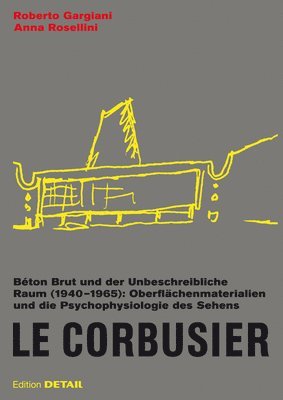
Corbusier. Béton Brut und der Unbeschreibliche Raum (1940 – 1965)
Oberflächenmaterialien und die Psychophysiologie des Sehens
Inbunden, Tyska, 2014
1 088 kr
Skickas inom 5-8 vardagar
„Béton brut“ und „L’Espace Indicible“ – für Le Corbusier waren dies die entscheidenden Theorien in seinem Werk nach dem Zweiten Weltkrieg. Sie bilden den Dialog zwischen dem Realen und dem Abstrakten, zwischen Material und der künstlerischen Sicht seiner Arbeit.Anhand unterschiedlicher Projekte wird Le Corbusiers besonderer Umgang mit Sichtbeton vorgestellt: Von der Herstellung mit einer strengen Auswahl an Bestandteilen über die strukturelle Prägung der Oberfläche durch ein durchdachtes Zusammenfügen der Schalungen bis zur Behandlung der Sichtflächen mit speziellen Anstrichen.Die Entstehung von Raum – Überlegungen zum Einsatz von Baustoffen sowie Fragen der Optik, der Verwendung von Farben und letztlich die Auswirkung ihrer Verbindungen auf die Wahrnehmung – werden in dieser Publikation analysiert und eröffnen so eine neue Sichtweise auf die letzten und wichtigen Arbeiten von Le Corbusier.