Anna Spiegel - Böcker
Visar alla böcker från författaren Anna Spiegel. Handla med fri frakt och snabb leverans.
3 produkter
3 produkter
635 kr
Skickas inom 10-15 vardagar
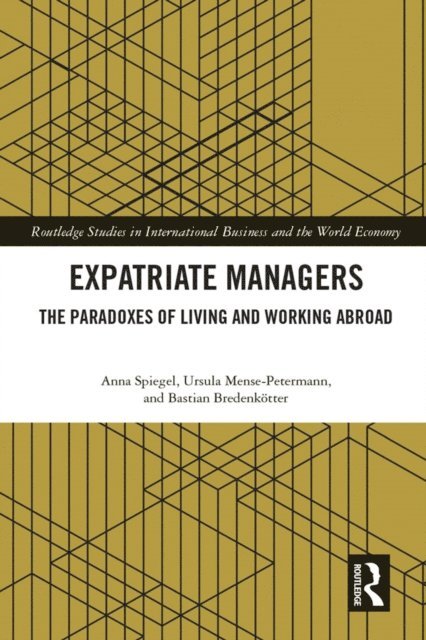
Since the 1990s, economic and cultural globalization has propelled the transnational mobility of managers and fueled cross-border careers. Some scholars have argued for the emergence of a new global business elite with cosmopolitan mind-sets and homogeneous lifestyles, while others have highlighted their disconnection from the local surroundings and their everyday life within national expatriate ‘bubbles’. Thus, the question of whether today’s mobile professionals can be described as interculturally open and competent cosmopolitans, or as pronounced anti-cosmopolitans, is still unanswered. Expatriate Managers and the Paradoxes of Working and Living Abroad considers a core protagonist of economic globalization and the management of MNCs through the lens of a practice-based theoretical approach whilst seeking to address this question by building on intensive ethnographic case studies of expatriate managers, most of them high-ranking executives, from two comparative different home countries, the US and Germany. These managers, together with their families, have been assigned to China, Germany, or the US to perform demanding coordination tasks within their multinational corporations (MNCs). Based on detailed accounts of expatriate managers’ experiences and everyday practices, the book reveals the multiple and sometimes paradoxical ways in which they deal with cultural differences as they build up new forms of working, belonging and dwelling.The findings suggest that the newly emerging mind-sets and lifestyles of expatriate managers transcend the polarized images of mobile elites as either cosmopolitan ‘global managers’ or parochial anti-cosmopolitans. Expatriate Managers and the Paradoxes of Working and Living Abroad examines the global elite from an everyday perspective, showing that understanding the dynamics of a global economy requires probing into the lifeworld’s agency and everyday arrangements of the social actors who are puttin
2 357 kr
Skickas inom 10-15 vardagar
Since the 1990s, economic and cultural globalization has propelled the transnational mobility of managers and fueled cross-border careers. Some scholars have argued for the emergence of a new global business elite with cosmopolitan mind-sets and homogeneous lifestyles, while others have highlighted their disconnection from the local surroundings and their everyday life within national expatriate ‘bubbles’. Thus, the question of whether today’s mobile professionals can be described as interculturally open and competent cosmopolitans, or as pronounced anti-cosmopolitans, is still unanswered. Expatriate Managers and the Paradoxes of Working and Living Abroad considers a core protagonist of economic globalization and the management of MNCs through the lens of a practice-based theoretical approach whilst seeking to address this question by building on intensive ethnographic case studies of expatriate managers, most of them high-ranking executives, from two comparative different home countries, the US and Germany. These managers, together with their families, have been assigned to China, Germany, or the US to perform demanding coordination tasks within their multinational corporations (MNCs). Based on detailed accounts of expatriate managers’ experiences and everyday practices, the book reveals the multiple and sometimes paradoxical ways in which they deal with cultural differences as they build up new forms of working, belonging and dwelling.The findings suggest that the newly emerging mind-sets and lifestyles of expatriate managers transcend the polarized images of mobile elites as either cosmopolitan ‘global managers’ or parochial anti-cosmopolitans. Expatriate Managers and the Paradoxes of Working and Living Abroad examines the global elite from an everyday perspective, showing that understanding the dynamics of a global economy requires probing into the lifeworld’s agency and everyday arrangements of the social actors who are putting globalization into practice.
536 kr
Skickas inom 10-15 vardagar
1. 1 Researching the global everyday of women activists 1. 1 Researching the global everyday of women activists: Experiencing and doing globalisation Going through the broad spectrum of globalisation research and literature, one might be astonished at how much it assumes the force of global change, and how little of this literature demonstrates this force in an empirically grounded way. This study, being based on six months of empirical research in Malaysia in 2004, sets out to counter this lack of thick description of globalisation processes. It takes up the challenge of researching the “global everyday” (Appadurai 2000, 18) of civil society actors in Malaysia and focuses on how social activists belonging to different branches of the women’s movement selectively app- priate, transform and even create global meanings and materialise them in local practices. The methodological endeavour of combining globalisation research and ethnography has been taken up by a diversity of authors. Burawoy and his research team have developed a complex methodological framework by focusing on the experiential dimensions of globalisation. They want to produce a “grounded globalisation” or “perspectives on globalisations from below” (Burawoy 2000b, 338, 341). This perspective is very fruitful, as the notion of experiencing globalisation as “forces, connections, and imaginations” (Burawoy et al. eds. 2000) relocates the global in the local and ties both together in mutual constitution.