
Annika BjA¶rkdahl – författare
723 kr
Läs direkt efter köp
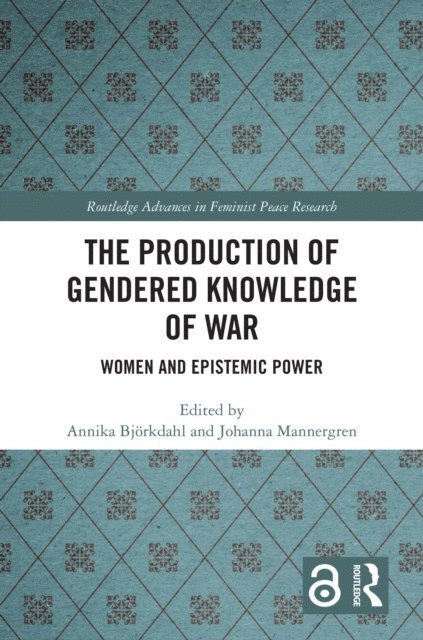
This edited volume critically investigates women’s knowledge about war and explores the epistemic agency of women in a range of contemporary settings across the globe.
Women are deeply affected by war, participate in war and resist war. At the same time, knowledge production often ignores and marginalizes women’s experiences and gendered ways of knowing war. From Colombia to Israel and Palestine, Liberia, Mali, Myanmar, Nepal, North America, Northern Iraq and Ukraine, the chapters in this book illuminate gendered knowledge production in and about different conflict-affected sites. By taking the embodied and narrative epistemic agency of local ‘knowers’ seriously, new insights are thereby presented about the role women play in producing knowledge about war. This book proposes new theoretical vantage points in order to understand how epistemic power and epistemic violence are closely related. Bringing the topic of knowledge production into the so-called ‘Women, Peace and Security’ (WPS) agenda, it analyses how knowledge of the gendered nature of war and security is produced and circulated, and argues that the WPS agenda is a system of knowledge with its own omissions and silences. By theorizing gendered knowledge production and amplifying the voices of women as epistemic agents, this book advances scholarship on gender and war.
This book will be of much interest to students of feminist studies, peace studies, war and conflict studies and International Relations.
The Introduction, Chapter 3, and Chapter 9 of this book is freely available as a downloadable Open Access PDF at http://www.taylorfrancis.com under a Creative Commons Attribution (CC-BY) 4.0 license. Chapter 6 and Chapter 7 of this book is freely available as a downloadable Open Access PDF at http://www.taylorfrancis.com under a Creative Commons Attribution-Non Commercial-No Derivatives (CC-BY-NC-ND) 4.0 license.
723 kr
Läs direkt efter köp
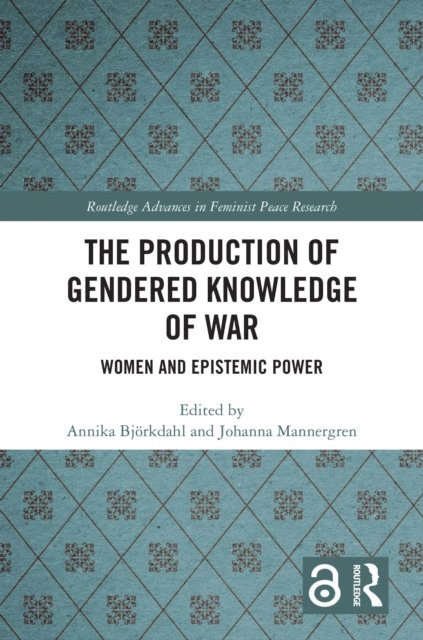
This edited volume critically investigates women’s knowledge about war and explores the epistemic agency of women in a range of contemporary settings across the globe.
Women are deeply affected by war, participate in war and resist war. At the same time, knowledge production often ignores and marginalizes women’s experiences and gendered ways of knowing war. From Colombia to Israel and Palestine, Liberia, Mali, Myanmar, Nepal, North America, Northern Iraq and Ukraine, the chapters in this book illuminate gendered knowledge production in and about different conflict-affected sites. By taking the embodied and narrative epistemic agency of local ‘knowers’ seriously, new insights are thereby presented about the role women play in producing knowledge about war. This book proposes new theoretical vantage points in order to understand how epistemic power and epistemic violence are closely related. Bringing the topic of knowledge production into the so-called ‘Women, Peace and Security’ (WPS) agenda, it analyses how knowledge of the gendered nature of war and security is produced and circulated, and argues that the WPS agenda is a system of knowledge with its own omissions and silences. By theorizing gendered knowledge production and amplifying the voices of women as epistemic agents, this book advances scholarship on gender and war.
This book will be of much interest to students of feminist studies, peace studies, war and conflict studies and International Relations.
The Introduction, Chapter 3, and Chapter 9 of this book is freely available as a downloadable Open Access PDF at http://www.taylorfrancis.com under a Creative Commons Attribution (CC-BY) 4.0 license. Chapter 6 and Chapter 7 of this book is freely available as a downloadable Open Access PDF at http://www.taylorfrancis.com under a Creative Commons Attribution-Non Commercial-No Derivatives (CC-BY-NC-ND) 4.0 license.
925 kr
Läs direkt efter köp
This book presents new theoretical and conceptual perspectives on the problematique of building just and durable peace.
Linking peace and justice has sparked lively debates about the dilemmas and trade-offs in several contemporary peace processes. Despite the fact that justice and peace are commonly referred to there is surprisingly little research and few conceptualizations of the interplay between the two.
This edited volume is the result of three years of collaborative research and draws upon insights from such disciplines as peace and conflict, international law, political science and international relations. It contains policy-relevant knowledge about effective peacebuilding strategies, as well as an in-depth analysis of the contemporary peace processes in the Middle East and the Western Balkans. Using a variety of theoretical perspectives and empirical approaches, the work makes an original contribution to the growing literature on peacebuilding.
This book will be of much interest to students of peacebuilding, peace and conflict studies, Middle Eastern Politics, European Politics and IR/Security Studies.
925 kr
Läs direkt efter köp
This book presents new theoretical and conceptual perspectives on the problematique of building just and durable peace.
Linking peace and justice has sparked lively debates about the dilemmas and trade-offs in several contemporary peace processes. Despite the fact that justice and peace are commonly referred to there is surprisingly little research and few conceptualizations of the interplay between the two.
This edited volume is the result of three years of collaborative research and draws upon insights from such disciplines as peace and conflict, international law, political science and international relations. It contains policy-relevant knowledge about effective peacebuilding strategies, as well as an in-depth analysis of the contemporary peace processes in the Middle East and the Western Balkans. Using a variety of theoretical perspectives and empirical approaches, the work makes an original contribution to the growing literature on peacebuilding.
This book will be of much interest to students of peacebuilding, peace and conflict studies, Middle Eastern Politics, European Politics and IR/Security Studies.
824 kr
Läs direkt efter köp
This book aims to understand the processes and outcomes that arise from frictional encounters in peacebuilding, when global and local forces meet.
Building a sustainable peace after violent conflict is a process that entails competing ideas, political contestation and transformation of power relations. This volume develops the concept of ‘friction’ to better analyse the interplay between global ideas, actors, and practices, and their local counterparts. The chapters examine efforts undertaken to promote sustainable peace in a variety of locations, such as Cambodia, Sri Lanka, Afghanistan, and Sierra Leone. These case analyses provide a nuanced understanding not simply of local processes, or of the hybrid or mixed agencies, ideas, and processes that are generated, but of the complex interactions that unfold between all of these elements in the context of peacebuilding intervention. The analyses demonstrate how the ambivalent relationship between global and local actors leads to unintended and sometimes counterproductive results of peacebuilding interventions. The approach of this book, with its focus on friction as a conceptual tool, advances the peacebuilding research agenda and adds to two ongoing debates in the peacebuilding field; the debate on hybridity, and the debate on local agency and local ownership. In analysing frictional encounters this volume prepares the ground for a better understanding of the mixed impact peace initiatives have on post-conflict societies.
This book will be of much interest to students of peacebuilding, conflict resolution, security studies, and international relations in general.
824 kr
Läs direkt efter köp
This book aims to understand the processes and outcomes that arise from frictional encounters in peacebuilding, when global and local forces meet.
Building a sustainable peace after violent conflict is a process that entails competing ideas, political contestation and transformation of power relations. This volume develops the concept of ‘friction’ to better analyse the interplay between global ideas, actors, and practices, and their local counterparts. The chapters examine efforts undertaken to promote sustainable peace in a variety of locations, such as Cambodia, Sri Lanka, Afghanistan, and Sierra Leone. These case analyses provide a nuanced understanding not simply of local processes, or of the hybrid or mixed agencies, ideas, and processes that are generated, but of the complex interactions that unfold between all of these elements in the context of peacebuilding intervention. The analyses demonstrate how the ambivalent relationship between global and local actors leads to unintended and sometimes counterproductive results of peacebuilding interventions. The approach of this book, with its focus on friction as a conceptual tool, advances the peacebuilding research agenda and adds to two ongoing debates in the peacebuilding field; the debate on hybridity, and the debate on local agency and local ownership. In analysing frictional encounters this volume prepares the ground for a better understanding of the mixed impact peace initiatives have on post-conflict societies.
This book will be of much interest to students of peacebuilding, conflict resolution, security studies, and international relations in general.