Anthony Hesketh - Böcker
Visar alla böcker från författaren Anthony Hesketh. Handla med fri frakt och snabb leverans.
5 produkter
5 produkter
1 372 kr
Skickas inom 3-6 vardagar
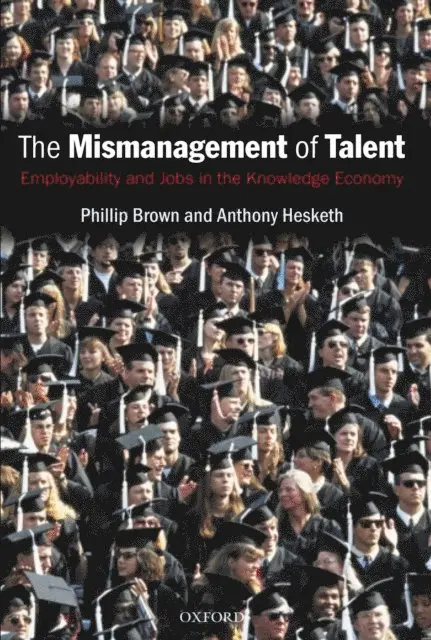
The knowledge economy conjures a world of smart people, in smart jobs, doing smart things, in smart ways, for smart money, a world increasingly open to all rather than a few. Glossy corporate brochures present a future in challenging, exciting and financially rewarding jobs for the winners in the competition for fast track management appointments. They also convey an image of enlightened employers actively seeking to diversify their talent pool, reflected in their approach to identifying, hiring and retaining outstanding talent. We are told that the challenge confronting governments around the world is to enhance the employability of the workforce. Every effort must be made to expand access to higher education, dismantle barriers to talent regardless of social circumstances, gender, or skin colour, and to harness human creativity and enterprise to meet the demands of the new economy.The Mismanagement of Talent comes to a different conclusion. Those leaving the world of mass higher education find themselves in a scramble for jobs with rising stakes for the winners and losers. The Mismanagement of Talent examines what determines the outcome of this race when a degree loses its badge of distinction. It shows how some graduates are playing 'the game' to win a competitive advantage and what really happens in the selection events of leading-edge employers. It also argues that talent is being mismanaged by employers that have yet to come to terms with the realities and possibilities of mass higher education. The Mismanagement of Talent will be thought-provoking and controversial reading for those involved in the recruitment of graduates, and those concerned with the way knowledge-based firms recruit and the impact of higher education policy: Professionals working in university careers services, HRM, training, or recruitment generally; Researchers, academics, or students of Business and Management, Human Resource Management, Public Policy, Education, or Sociology; and Job candidates themselves - the 'players' and 'purists' described in the book.
816 kr
Skickas inom 5-8 vardagar
The knowledge economy conjures a world of smart people, in smart jobs, doing smart things, in smart ways, for smart money, a world increasingly open to all rather than a few. Glossy corporate brochures present a future in challenging, exciting and financially rewarding jobs for the winners in the competition for fast track management appointments. They also convey an image of enlightened employers actively seeking to diversify their talent pool, reflected in their approach to identifying, hiring and retaining outstanding talent. We are told that the challenge confronting governments around the world is to enhance the employability of the workforce. Every effort must be made to expand access to higher education, dismantle barriers to talent regardless of social circumstances, gender, or skin colour, and to harness human creativity and enterprise to meet the demands of the new economy.The Mismanagement of Talent comes to a different conclusion. Those leaving the world of mass higher education find themselves in a scramble for jobs with rising stakes for the winners and losers. The Mismanagement of Talent examines what determines the outcome of this race when a degree loses its badge of distinction. It shows how some graduates are playing 'the game' to win a competitive advantage and what really happens in the selection events of leading-edge employers. It also argues that talent is being mismanaged by employers that have yet to come to terms with the realities and possibilities of mass higher education. The Mismanagement of Talent will be thought-provoking and controversial reading for those involved in the recruitment of graduates, and those concerned with the way knowledge-based firms recruit and the impact of higher education policy: Professionals working in university careers services, HRM, training, or recruitment generally; Researchers, academics, or students of Business and Management, Human Resource Management, Public Policy, Education, or Sociology; and Job candidates themselves - the 'players' and 'purists' described in the book.
97 kr
Skickas
552 kr
Skickas inom 7-10 vardagar
Human resource departments increasingly use the statistical analysis of performance indicators as a way of demonstrating their contribution to organizational performance. In this book, Steve Fleetwood and Anthony Hesketh take issue with this 'scientific' approach by arguing that its preoccupation with statistical analysis is misplaced because it fails to take account of the complexities of organizations and the full range of issues that influence individual performance. The book is split into three parts. Part I deconstructs research into the alleged link between people and business performance by showing that it cannot explain the associations it alleges. Part II attributes these shortcomings to the importation of spurious 'scientific' methods, before going on to suggest more appropriate methods that might be used in future. Finally, Part III explores how HR executives and professionals understand their work and shows how a critical realist stance adds value to this understanding through enhanced explanation.
807 kr
Skickas inom 7-10 vardagar
Human resource departments increasingly use the statistical analysis of performance indicators as a way of demonstrating their contribution to organizational performance. In this book, Steve Fleetwood and Anthony Hesketh take issue with this 'scientific' approach by arguing that its preoccupation with statistical analysis is misplaced because it fails to take account of the complexities of organizations and the full range of issues that influence individual performance. The book is split into three parts. Part I deconstructs research into the alleged link between people and business performance by showing that it cannot explain the associations it alleges. Part II attributes these shortcomings to the importation of spurious 'scientific' methods, before going on to suggest more appropriate methods that might be used in future. Finally, Part III explores how HR executives and professionals understand their work and shows how a critical realist stance adds value to this understanding through enhanced explanation.