Anthony W. Marx – författare
Visar alla böcker från författaren Anthony W. Marx. Handla med fri frakt och snabb leverans.
6 produkter
6 produkter
E-bok
Engelska, 2005382 kr
Läs direkt efter köp
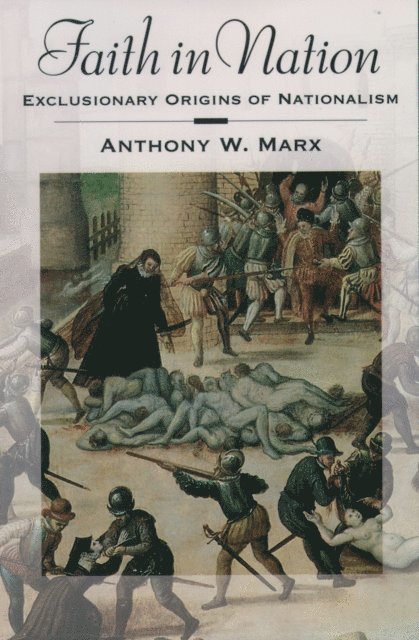
Common wisdom has long held that the ascent of the modern nation coincided with the flowering of Enlightenment democracy and the decline of religion, ringing in an age of tolerant, inclusive, liberal states. Not so, demonstrates Anthony W. Marx in this landmark work of revisionist political history and analysis. In a startling departure from a historical consensus that has dominated views of nationalism for the past quarter century, Marx argues that European nationalism emerged two centuries earlier, in the early modern era, as a form of mass political engagement based on religious conflict, intolerance, and exclusion. Challenging the self-congratulatory geneaology of civic Western nationalism, Marx shows how state-builders attempted to create a sense of national solidarity to support their burgeoning authority. Key to this process was the transfer of power from local to central rulers; the most suitable vehicle for effecting this transfer was religion and fanatical passions. Religious intolerance--specifically the exclusion of religious minorities from the nascent state--provided the glue that bonded the remaining populations together. Out of this often violent religious intolerance grew popular nationalist sentiment. Only after a core and exclusive nationality was formed in England and France, and less successfully in Spain, did these countries move into the "enlightened" 19th century, all the while continuing to export intolerance and exclusion to overseas colonies. Providing an explicitly political theory of early nation-building, rather than an account emphasizing economic imperatives or literary imaginings, Marx reveals that liberal, secular Western political traditions were founded on the basis of illiberal, intolerant origins. His provocative account also suggests that present-day exclusive and violent nation-building, or efforts to form solidarity through cultural or religious antagonisms, are not fundamentally different from the West''s own earlier experiences.
E-bok
PDF, Engelska, 2005382 kr
Läs direkt efter köp
Common wisdom has long held that the ascent of the modern nation coincided with the flowering of Enlightenment democracy and the decline of religion, ringing in an age of tolerant, inclusive, liberal states. Not so, demonstrates Anthony W. Marx in this landmark work of revisionist political history and analysis. In a startling departure from a historical consensus that has dominated views of nationalism for the past quarter century, Marx argues that European nationalism emerged two centuries earlier, in the early modern era, as a form of mass political engagement based on religious conflict, intolerance, and exclusion. Challenging the self-congratulatory geneaology of civic Western nationalism, Marx shows how state-builders attempted to create a sense of national solidarity to support their burgeoning authority. Key to this process was the transfer of power from local to central rulers; the most suitable vehicle for effecting this transfer was religion and fanatical passions. Religious intolerance--specifically the exclusion of religious minorities from the nascent state--provided the glue that bonded the remaining populations together. Out of this often violent religious intolerance grew popular nationalist sentiment. Only after a core and exclusive nationality was formed in England and France, and less successfully in Spain, did these countries move into the "enlightened" 19th century, all the while continuing to export intolerance and exclusion to overseas colonies. Providing an explicitly political theory of early nation-building, rather than an account emphasizing economic imperatives or literary imaginings, Marx reveals that liberal, secular Western political traditions were founded on the basis of illiberal, intolerant origins. His provocative account also suggests that present-day exclusive and violent nation-building, or efforts to form solidarity through cultural or religious antagonisms, are not fundamentally different from the West''s own earlier experiences.
E-bok
PDF, Engelska, 1997447 kr
Läs direkt efter köp
Why and how has race become a central aspect of politics during this century? This book addresses this pressing question by comparing South African apartheid and resistance to it, the United States Jim Crow law and protests against it, and the myth of racial democracy in Brazil. Anthony Marx argues that these divergent experiences had roots in the history of slavery, colonialism, miscegenation and culture, but were fundamentally shaped by impediments and efforts to build national unity. In South Africa and the United States, ethnic or regional conflicts among whites were resolved by unifying whites and excluding blacks, while Brazil''s longer established national unity required no such legal racial crutch. Race was thus central to projects of nation-building, and nationalism shaped uses of race. Professor Marx extends this argument to explain popular protest and the current salience of issues of race.
Inbunden, Engelska, 1997
708 kr
Skickas inom 7-10 vardagar
Why and how has race become a central aspect of politics during this century? This book addresses this pressing question by comparing South African apartheid and resistance to it, the United States Jim Crow law and protests against it, and the myth of racial democracy in Brazil. Anthony Marx argues that these divergent experiences had roots in the history of slavery, colonialism, miscegenation and culture, but were fundamentally shaped by impediments and efforts to build national unity. In South Africa and the United States, ethnic or regional conflicts among whites were resolved by unifying whites and excluding blacks, while Brazil's longer established national unity required no such legal racial crutch. Race was thus central to projects of nation-building, and nationalism shaped uses of race. Professor Marx extends this argument to explain popular protest and the current salience of issues of race.
Häftad, Engelska, 1998
367 kr
Skickas inom 7-10 vardagar
Why and how has race become a central aspect of politics during this century? This book addresses this pressing question by comparing South African apartheid and resistance to it, the United States Jim Crow law and protests against it, and the myth of racial democracy in Brazil. Anthony Marx argues that these divergent experiences had roots in the history of slavery, colonialism, miscegenation and culture, but were fundamentally shaped by impediments and efforts to build national unity. In South Africa and the United States, ethnic or regional conflicts among whites were resolved by unifying whites and excluding blacks, while Brazil's longer established national unity required no such legal racial crutch. Race was thus central to projects of nation-building, and nationalism shaped uses of race. Professor Marx extends this argument to explain popular protest and the current salience of issues of race.
E-bok
Engelska, 1997443 kr
Läs direkt efter köp
Why and how has race become a central aspect of politics during this century? This book addresses this pressing question by comparing South African apartheid and resistance to it, the United States Jim Crow law and protests against it, and the myth of racial democracy in Brazil. Anthony Marx argues that these divergent experiences had roots in the history of slavery, colonialism, miscegenation and culture, but were fundamentally shaped by impediments and efforts to build national unity. In South Africa and the United States, ethnic or regional conflicts among whites were resolved by unifying whites and excluding blacks, while Brazil''s longer established national unity required no such legal racial crutch. Race was thus central to projects of nation-building, and nationalism shaped uses of race. Professor Marx extends this argument to explain popular protest and the current salience of issues of race.