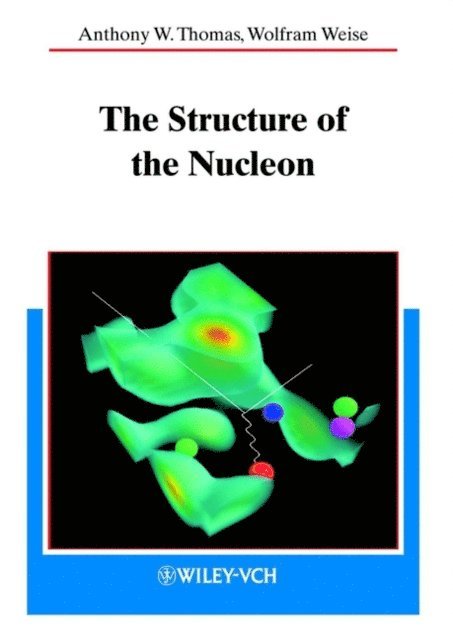
As the only stable baryon, the nucleon is of crucial importance in particle physics. Since the nucleon is a building block for all atomic nuclei, there is a need to analyse the its structure in order to fully understand the essential properties of all atomic nuclei. After more than forty years of research on the nucleon, both the experimental and theoretical situations have matured to a point where a synthesis of the results becomes indispensable. Here, A.W. Thomas and W. Weise present a unique report on the extensive empirical studies, theoretical foundations and the different models of the nucleon. The appendices provide an extensive summary of formulae needed in practical calculations. From the contents: electromagnetic structure of the nucleon, weak probes of nucleon structure, deep inelastic lepton scattering on the nucleon; elements of QCD, aspects of non-perturbative QCD, Chiral Symmetry and nucleon structure, models of the nucleon
As the only stable baryon, the nucleon is of crucial importance in particle physics. Since the nucleon is a building block for all atomic nuclei, there is a need to analyse the its structure in order to fully understand the essential properties of all atomic nuclei.After more than forty years of research on the nucleon, both the experimental and theoretical situations have matured to a point where a synthesis of the results becomes indispensable. Here, A.W. Thomas and W. Weise present a unique report on the extensive empirical studies, theoretical foundations and the different models of the nucleon. The appendices provide an extensive summary of formulae needed in practical calculations. From the contents: electromagnetic structure of the nucleon, weak probes of nucleon structure, deep inelastic lepton scattering on the nucleon; elements of QCD, aspects of non-perturbative QCD, Chiral Symmetry and nucleon structure, models of the nucleon
One of the most fundamental questions in understanding strong interaction is whether or not quarks and gluons play a significant role in nuclear systems. At high densities we need to explore the existence and nature of a deconfinement phase transition. At lower densities we wish to study the changes in the properties of a hadron particle as mass and electroweak form factors, when it is immersed in nuclear matter. Finally, we may even ask whether the internal structure of the nucleon plays a role in the binding and properties of finite nuclei.On the theoretical side the issues raised here are of concern to a very broad community, from those working in traditional many-body physics, to those building effective field theories, to those working in lattice QCD. Experimentally, there are many accelerators, mature, new and planned, which can offer insight into this field — from SLAC to HERA, COSY, CELSIUS and TJNAF. This workshop brought together key figures from all areas of theoretical and experimental physics concerned with this fundamental problem.
As the only stable baryon, the nucleon is of crucial importance in particle physics. Since the nucleon is a building block for all atomic nuclei, there is a need to analyse the its structure in order to fully understand the essential properties of all atomic nuclei. After more than forty years of research on the nucleon, both the experimental and theoretical situations have matured to a point where a synthesis of the results becomes indispensable. Here, A.W. Thomas and W. Weise present a unique report on the extensive empirical studies, theoretical foundations and the different models of the nucleon. The appendices provide an extensive summary of formulae needed in practical calculations. From the contents: electromagnetic structure of the nucleon, weak probes of nucleon structure, deep inelastic lepton scattering on the nucleon; elements of QCD, aspects of non-perturbative QCD, Chiral Symmetry and nucleon structure, models of the nucleon
As the only stable baryon, the nucleon is of crucial importance in particle physics. Since the nucleon is a building block for all atomic nuclei, there is a need to analyse the its structure in order to fully understand the essential properties of all atomic nuclei.After more than forty years of research on the nucleon, both the experimental and theoretical situations have matured to a point where a synthesis of the results becomes indispensable. Here, A.W. Thomas and W. Weise present a unique report on the extensive empirical studies, theoretical foundations and the different models of the nucleon. The appendices provide an extensive summary of formulae needed in practical calculations. From the contents: electromagnetic structure of the nucleon, weak probes of nucleon structure, deep inelastic lepton scattering on the nucleon; elements of QCD, aspects of non-perturbative QCD, Chiral Symmetry and nucleon structure, models of the nucleon
One of the most fundamental questions in understanding strong interaction is whether or not quarks and gluons play a significant role in nuclear systems. At high densities we need to explore the existence and nature of a deconfinement phase transition. At lower densities we wish to study the changes in the properties of a hadron particle as mass and electroweak form factors, when it is immersed in nuclear matter. Finally, we may even ask whether the internal structure of the nucleon plays a role in the binding and properties of finite nuclei.On the theoretical side the issues raised here are of concern to a very broad community, from those working in traditional many-body physics, to those building effective field theories, to those working in lattice QCD. Experimentally, there are many accelerators, mature, new and planned, which can offer insight into this field — from SLAC to HERA, COSY, CELSIUS and TJNAF. This workshop brought together key figures from all areas of theoretical and experimental physics concerned with this fundamental problem.