Anton Jager – författare
412 kr
Läs direkt efter köp
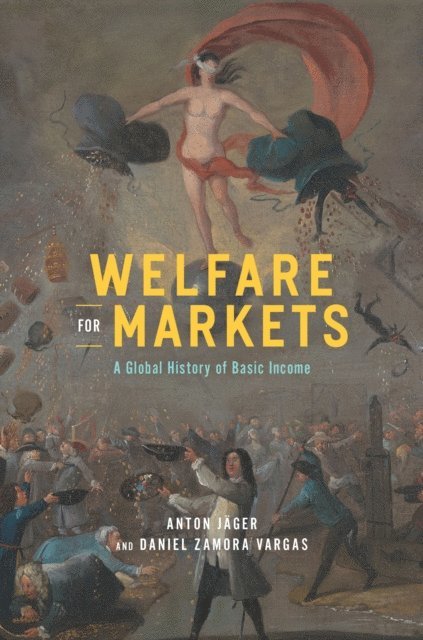
A sweeping intellectual history of the welfare state’s policy-in-waiting. The idea of a government paying its citizens to keep them out of poverty—now known as basic income—is hardly new. Often dated as far back as ancient Rome, basic income’s modern conception truly emerged in the late nineteenth century. Yet as one of today’s most controversial proposals, it draws supporters from across the political spectrum.
In this eye-opening work, Anton Jäger and Daniel Zamora Vargas trace basic income from its rise in American and British policy debates following periods of economic tumult to its modern relationship with technopopulist figures in Silicon Valley. They chronicle how the idea first arose in the United States and Europe as a market-friendly alternative to the postwar welfare state and how interest in the policy has grown in the wake of the 2008 credit crisis and COVID-19 crash.
An incisive, comprehensive history, Welfare for Markets tells the story of how a fringe idea conceived in economics seminars went global, revealing the most significant shift in political culture since the end of the Cold War.
752 kr
Läs direkt efter köp
This volume takes a fresh approach to the issue of ‘space’ in intellectual history and puts forward novel ways of rendering conceptions of space useful for historians of political thought.
Notions of ‘space’ have become increasingly important to the practice of intellectual historians in recent years. This is evidenced by emerging locutions such as ‘the international turn’, ‘global intellectual history’, and ‘political space’. Thus far, however, it is still unclear what it actually means to take ‘space’ seriously in intellectual history, and what we might gain from doing so. Ranging from the early modern period to the twentieth century, the contributions to this volume span a variety of diverse topics and showcase the rewards of a spatial focus in intellectual history, both as a kind of place and as an organising principle. The book reconstructs the role of the modern territorial state in grounding reflection on political legitimacy; the interface between oceans and empires as a source of political reflection; and the curious antecedents of today’s spatial turn in German and Indian visions of geopolitics in the interwar years. In doing so, it makes a contribution to an ever-growing field.
This book was originally published as a special issue of Global Intellectual History.
752 kr
Läs direkt efter köp
This volume takes a fresh approach to the issue of ‘space’ in intellectual history and puts forward novel ways of rendering conceptions of space useful for historians of political thought.
Notions of ‘space’ have become increasingly important to the practice of intellectual historians in recent years. This is evidenced by emerging locutions such as ‘the international turn’, ‘global intellectual history’, and ‘political space’. Thus far, however, it is still unclear what it actually means to take ‘space’ seriously in intellectual history, and what we might gain from doing so. Ranging from the early modern period to the twentieth century, the contributions to this volume span a variety of diverse topics and showcase the rewards of a spatial focus in intellectual history, both as a kind of place and as an organising principle. The book reconstructs the role of the modern territorial state in grounding reflection on political legitimacy; the interface between oceans and empires as a source of political reflection; and the curious antecedents of today’s spatial turn in German and Indian visions of geopolitics in the interwar years. In doing so, it makes a contribution to an ever-growing field.
This book was originally published as a special issue of Global Intellectual History.
258 kr
Skickas inom 5-8 vardagar