Antoni Rogalski – författare
Visar alla böcker från författaren Antoni Rogalski. Handla med fri frakt och snabb leverans.
8 produkter
8 produkter
2 311 kr
Skickas inom 10-15 vardagar
2D Materials for Infrared and Terahertz Detectors provides an overview of the performance of emerging detector materials, while also offering, for the first time, a comparison with traditional materials used in the fabrication of infrared and terahertz detectors. Since the discovery of graphene, its applications to electronic and optoelectronic devices have been intensively researched. The extraordinary electronic and optical properties allow graphene and other 2D materials to be promising candidates for infrared (IR) and terahertz (THz) photodetectors, and yet it appears that the development of new detectors using these materials is still secondary to those using traditional materials. This book explores this phenomenon, as well as the advantages and disadvantages of using 2D materials. Special attention is directed toward the identification of the most-effective hybrid 2D materials in infrared and terahertz detectors, as well as future trends. Written by one of the world’s leading researchers in the field of IR optoelectronics, this book will be a must-read for researchers and graduate students in photodetectors and related fields.Features• Offers a comprehensive overview of the different types of 2D materials used in fabrication of IR and THz detectors, and includes their advantages/disadvantages • The first book to compare new detectors to a wide family of common, commercially available detectors that use traditional materials.

698 kr
Skickas inom 10-15 vardagar
2D Materials for Infrared and Terahertz Detectors provides an overview of the performance of emerging detector materials, while also offering, for the first time, a comparison with traditional materials used in the fabrication of infrared and terahertz detectors. Since the discovery of graphene, its applications to electronic and optoelectronic devices have been intensively researched. The extraordinary electronic and optical properties allow graphene and other 2D materials to be promising candidates for infrared (IR) and terahertz (THz) photodetectors, and yet it appears that the development of new detectors using these materials is still secondary to those using traditional materials. This book explores this phenomenon, as well as the advantages and disadvantages of using 2D materials. Special attention is directed toward the identification of the most-effective hybrid 2D materials in infrared and terahertz detectors, as well as future trends. Written by one of the world’s leading researchers in the field of IR optoelectronics, this book will be a must-read for researchers and graduate students in photodetectors and related fields.Features• Offers a comprehensive overview of the different types of 2D materials used in fabrication of IR and THz detectors, and includes their advantages/disadvantages • The first book to compare new detectors to a wide family of common, commercially available detectors that use traditional materials.

2 108 kr
Skickas inom 10-15 vardagar
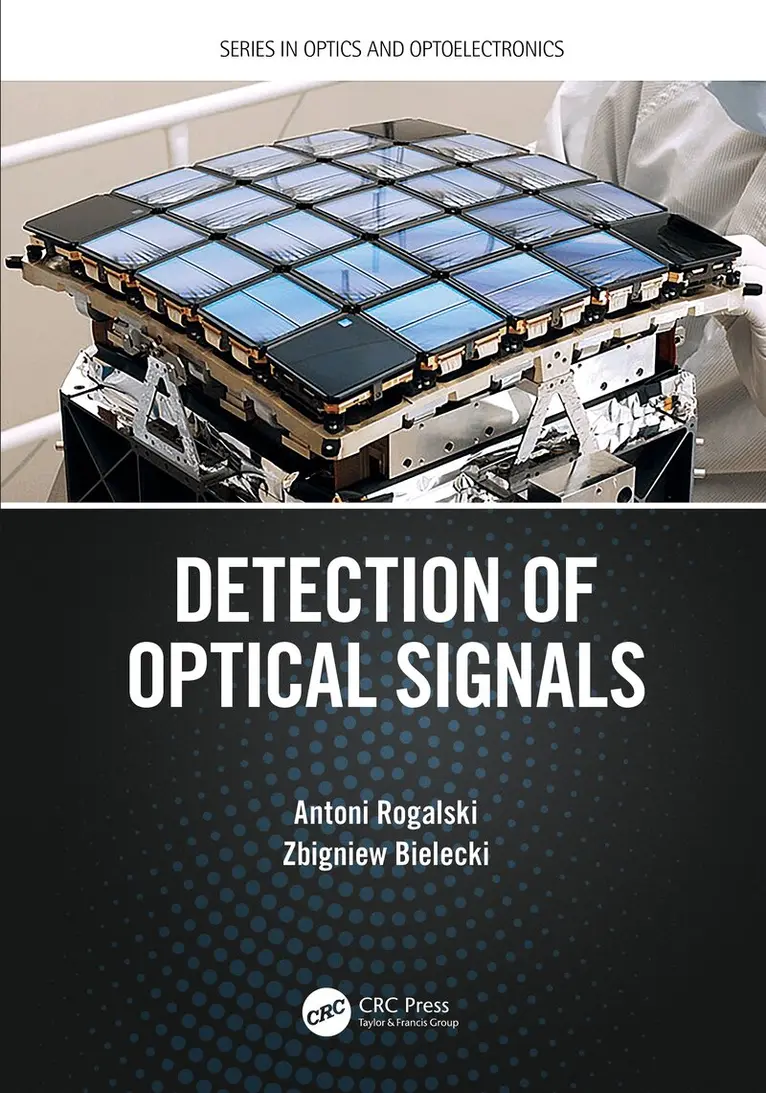
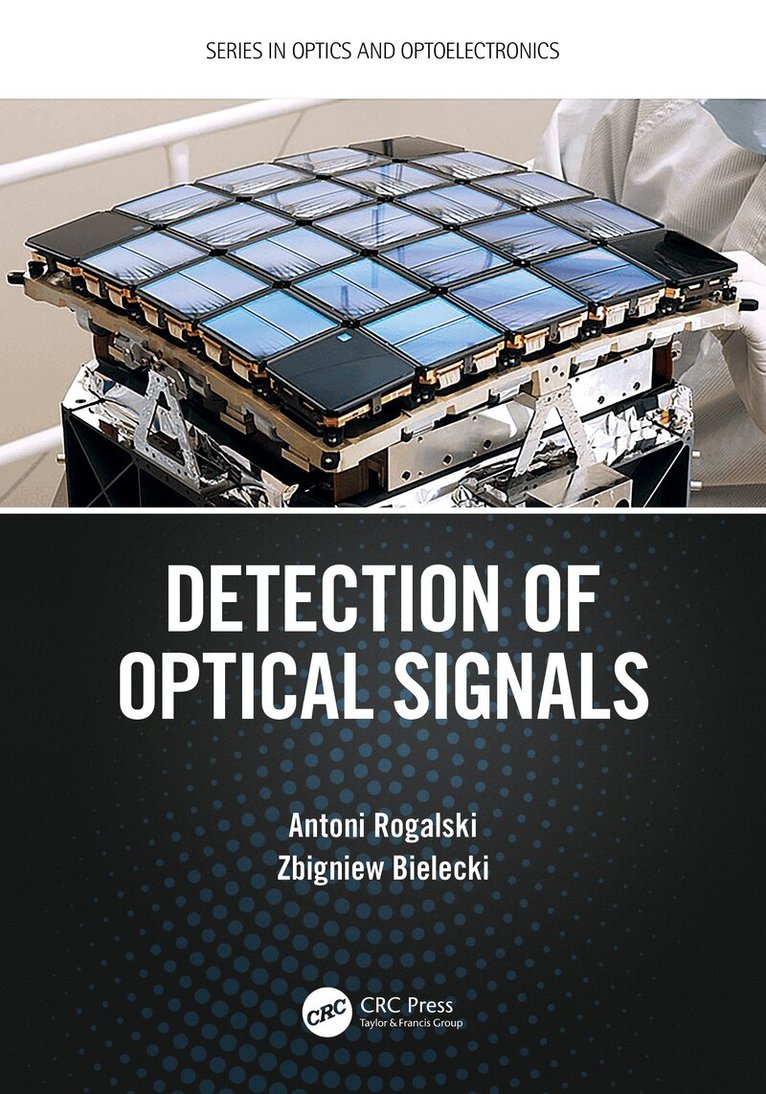
Detection of Optical Signals provides a comprehensive overview of important technologies for photon detection, from the X-ray through ultraviolet, visible, infrared to far-infrared spectral regions. It uniquely combines perspectives from many disciplines, particularly within physics and electronics, which are necessary to have a complete understanding of optical receivers.This interdisciplinary textbook aims to:Guide readers into more detailed and technical treatments of readout optical signalsGive a broad overview of optical signal detection including terahertz region and two-dimensional materialHelp readers further their studies by offering chapter-end problems and recommended reading.This is an invaluable resource for graduate students in physics and engineering, as well as a helpful refresher for those already working with aerospace sensors and systems, remote sensing, thermal imaging, military imaging, optical telecommunications, infrared spectroscopy, and light detection.
671 kr
Skickas inom 10-15 vardagar
Detection of Optical Signals provides a comprehensive overview of important technologies for photon detection, from the X-ray through ultraviolet, visible, infrared to far-infrared spectral regions. It uniquely combines perspectives from many disciplines, particularly within physics and electronics, which are necessary to have a complete understanding of optical receivers.This interdisciplinary textbook aims to:Guide readers into more detailed and technical treatments of readout optical signalsGive a broad overview of optical signal detection including terahertz region and two-dimensional materialHelp readers further their studies by offering chapter-end problems and recommended reading.This is an invaluable resource for graduate students in physics and engineering, as well as a helpful refresher for those already working with aerospace sensors and systems, remote sensing, thermal imaging, military imaging, optical telecommunications, infrared spectroscopy, and light detection.
698 kr
Skickas inom 10-15 vardagar
This new edition of Infrared and Terahertz Detectors provides a comprehensive overview of infrared and terahertz detector technology, from fundamental science to materials and fabrication techniques. It contains a complete overhaul of the contents including several new chapters and a new section on terahertz detectors and systems. It includes a new tutorial introduction to technical aspects that are fundamental for basic understanding. The other dedicated sections focus on thermal detectors, photon detectors, and focal plane arrays.
2 786 kr
Skickas inom 10-15 vardagar
Room Temperature Photon Detectors provides an overview of the performance of emerging new generation of room temperature photodetectors generally called low-dimensional solid (LDS) photodetectors among which the most important are two-dimensional (2D) materials, perovskites, and quantum dots (QDs)/nanowires (NWs) operating in a wide spectral range from the ultraviolet (UV), visible (VIS), far infrared (FIR) to terahertz (THz). The LDS reported performance at room temperature is even better than that presented for standard commercial photodetectors.This book describes the peculiarities of the physical properties of LDS materials and their impact on the photodetectors’ performance. It also undertakes a comprehensive analysis of these performances when confronted with the standard photodetectors dominating the global market.Currently, intensive efforts are being made to reduce the cost of imaging systems and, in particular in the infrared (IR) range, to increase their operating temperature by reducing size, weight and power consumption (SWaP). This raises the question of whether the emergence of a new generation of LDS photodetectors will result in their rapid commercialization and serious competition for the standardized bulk photodetectors. This book attempts to answer those issues/questions.Features• Defines the importance of LDS photodetectors in the broad group of standard UV, VIS, IR, and THz photodetectors, and includes their advantages/disadvantages• Covers different types of photodetectors, including the relevant aspects of theory, types of materials, their physical properties, and detector fabrication• Provides invaluable resource for graduate students in physics and engineering, as well as a guide for those already working with sensors and systems, thermal imaging, remote sensing, optical telecommunications, and light detection.
3 870 kr
Skickas inom 10-15 vardagar
This new edition of Infrared and Terahertz Detectors provides a comprehensive overview of infrared and terahertz detector technology, from fundamental science to materials and fabrication techniques. It contains a complete overhaul of the contents including several new chapters and a new section on terahertz detectors and systems. It includes a new tutorial introduction to technical aspects that are fundamental for basic understanding. The other dedicated sections focus on thermal detectors, photon detectors, and focal plane arrays.
860 kr
Skickas inom 5-8 vardagar
Currently, III-V antimonide-based detector technology is under strong development as a possible alternative to HgCdTe material systems. The apparent rapid success of a broken-gap type-II superlattice (T2SL) depends not only on the previous five decades of development of III-V materials, but mainly on recent ideas in the design of infrared photodetectors. The ability to tune the positions of the conduction and valence band edges independently in the T2SL is especially helpful in the design of unipolar barriers. Unipolar barriers are used to implement the barrier detector architecture for increasing the collection efficiency of photogenerated carriers and reducing dark current originating within the depletion region without inhibiting photocurrent flow. During the last decade, antimonide-based focal plane array technology has achieved a level close to HgCdTe. However, the modern version of the technology is still in its infancy. The advent of bandgap engineering has given III-Vs a new lease on life. This book describes current concepts of antimonide-based IR detectors, focusing on designs having the largest impact on the mainstream of IR detector technologies. It is suitable for graduate students in physics and engineering who have knowledge of modern solid-state physics and electronic circuits, and will be of interest to those working with aerospace sensors and systems, remote sensing, thermal imaging, military imaging, optical telecommunications, infrared spectroscopy, and lidar.