Antonio Greco – författare
Visar alla böcker från författaren Antonio Greco. Handla med fri frakt och snabb leverans.
7 produkter
7 produkter
Inbunden, Engelska, 2026
2 955 kr
Kommande
This comprehensive guide to cardiovascular pharmacotherapy provides a clinically oriented overview of drugs in the field of cardiology. Written for healthcare professionals, it integrates latest evidence with clinical decision-making. The book emphasizes practical, evidence-based approaches to drug use, featuring step-by-step therapeutic algorithms to support everyday clinical practice.Key Features:Summarizes current cardiovascular therapies, integrating pharmacological mechanisms with clinical evidence.Bridges science and practice, offering practical guidance for real-world clinical decision-making.Delivers comprehensive disease-oriented pharmacological approaches, guiding clinicians on how to use and combine drugs effectively for each cardiovascular condition.
Häftad, Engelska, 2026
892 kr
Kommande
This comprehensive guide to cardiovascular pharmacotherapy provides a clinically oriented overview of drugs in the field of cardiology. Written for healthcare professionals, it integrates latest evidence with clinical decision-making. The book emphasizes practical, evidence-based approaches to drug use, featuring step-by-step therapeutic algorithms to support everyday clinical practice.Key Features:Summarizes current cardiovascular therapies, integrating pharmacological mechanisms with clinical evidence.Bridges science and practice, offering practical guidance for real-world clinical decision-making.Delivers comprehensive disease-oriented pharmacological approaches, guiding clinicians on how to use and combine drugs effectively for each cardiovascular condition.
Inbunden, Engelska, 2018
1 559 kr
Skickas inom 5-8 vardagar
Inbunden, Engelska, 2002
1 634 kr
Skickas inom 10-15 vardagar
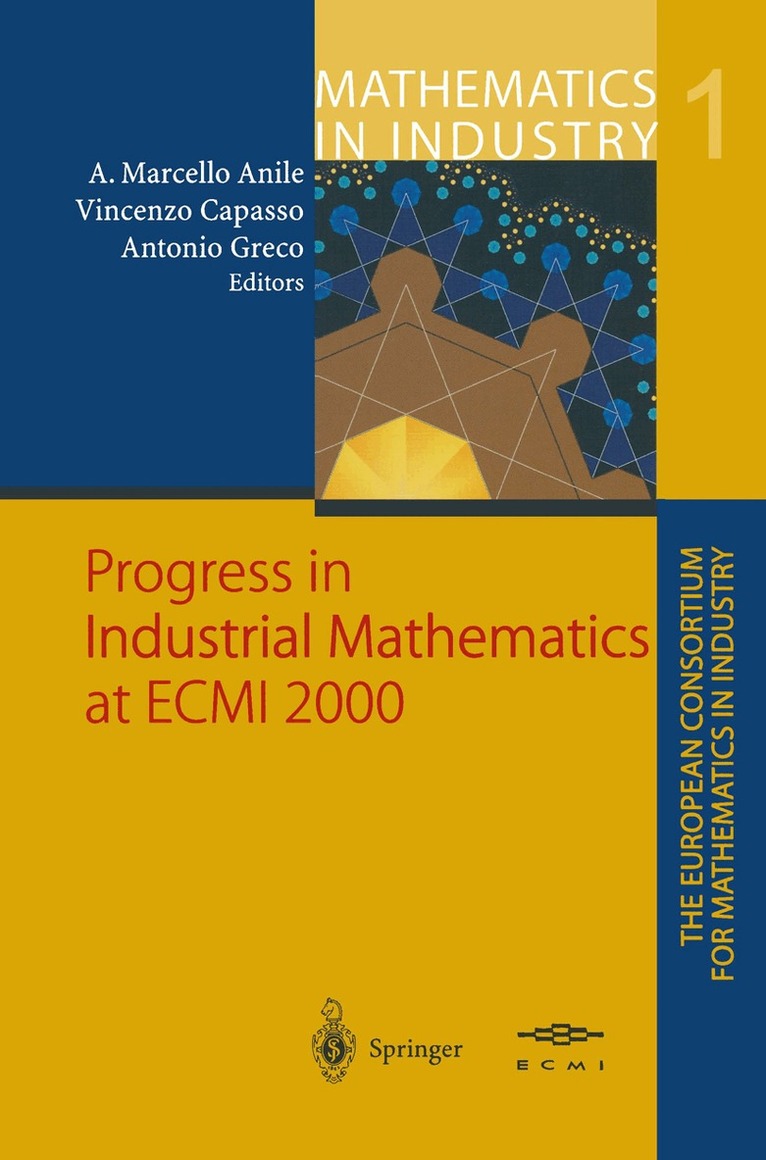
The European Consortium for Mathematics in Industry (ECMI) was founded in 1986 by leading groups of mathematicians in Europe for the following scopes: i) direct involvement of mathematicians in R&D activities;ii) international cooperation at a European scale;iii) education of industrial mathematicians to meet the growing demand for such experts.ECMI 2000 shows that ECMI has offered a unique example of effective international cooperation thanks to the financial support of the European Framework programmes. In particular they have helped ECMI establishing a set of Special Interest Groups to favour interaction with industry. This volume includes minisymposia about their activities, in particular microelectronics, glass, polymers, finance, traffic, and textiles. Applied mathematicians and other professionals working in academia or industry will find the book to be a useful and stimulating source of mathematical applications related to industrial problems.
Del 1 - Mathematics in Industry
Progress in Industrial Mathematics at ECMI 2000
Häftad, Engelska, 2010
1 634 kr
Skickas inom 10-15 vardagar
Realizing the need of interaction between universities and research groups in industry, the European Consortium for Mathematics in Industry (ECMI) was founded in 1986 by mathematicians from ten European universities. Since then it has been continuously extending and now it involves about all Euro pean countries. The aims of ECMI are • To promote the use of mathematical models in industry. • To educate industrial mathematicians to meet the growing demand for such experts. • To operate on a European Scale. Mathematics, as the language of the sciences, has always played an im portant role in technology, and now is applied also to a variety of problems in commerce and the environment. European industry is increasingly becoming dependent on high technology and the need for mathematical expertise in both research and development can only grow. These new demands on mathematics have stimulated academic interest in Industrial Mathematics and many mathematical groups world-wide are committed to interaction with industry as part of their research activities. ECMI was founded with the intention of offering its collective knowledge and expertise to European Industry. The experience of ECMI members is that similar technical problems are encountered by different companies in different countries. It is also true that the same mathematical expertise may often be used in differing industrial applications.
E-bok
PDF, Engelska, 20132 036 kr
Läs direkt efter köp
Realizing the need of interaction between universities and research groups in industry, the European Consortium for Mathematics in Industry (ECMI) was founded in 1986 by mathematicians from ten European universities. Since then it has been continuously extending and now it involves about all Euro pean countries. The aims of ECMI are • To promote the use of mathematical models in industry. • To educate industrial mathematicians to meet the growing demand for such experts. • To operate on a European Scale. Mathematics, as the language of the sciences, has always played an im portant role in technology, and now is applied also to a variety of problems in commerce and the environment. European industry is increasingly becoming dependent on high technology and the need for mathematical expertise in both research and development can only grow. These new demands on mathematics have stimulated academic interest in Industrial Mathematics and many mathematical groups world-wide are committed to interaction with industry as part of their research activities. ECMI was founded with the intention of offering its collective knowledge and expertise to European Industry. The experience of ECMI members is that similar technical problems are encountered by different companies in different countries. It is also true that the same mathematical expertise may often be used in differing industrial applications.
E-bok
PDF, Engelska, 20263 066 kr
Läs direkt efter köp
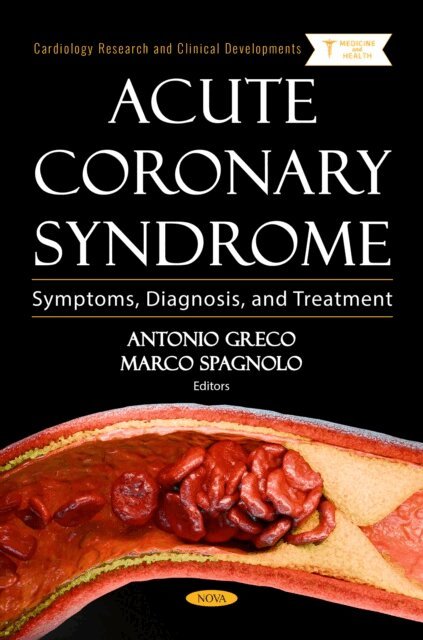
Acute coronary syndromes (ACS) remain a leading cause of morbidity and mortality worldwide, encompassing a broad spectrum of clinical entities surrounded by distinct pathophysiological mechanisms, clinical presentations, treatment strategies and outcomes. A rapid recognition of these conditions and a thorough patient risk stratification are pivotal elements for tailoring diagnostic and therapeutic approaches with the final goal to improve survival. Over the past decades, advances in interventional cardiology have revolutionized the acute treatment of ACS, enabling prompt and safe revascularization. Following the acute phase, pharmacological regimens aimed at minimizing recurrent ischemic events and mitigating bleeding risk become central in the long-term management. Within this broad spectrum of ACS, certain complex scenarios, including critical presentations such as cardiogenic shock, and the management of high-risk subgroups such as frail individuals or those with multiple comorbidities, require personalized strategies and specialized care. This book bridges current evidence with emerging frontiers in the management of ACS, providing clinicians, interventional cardiologists and cardiovascular researchers with a comprehensive resource on the latest standards and innovations in the field.