Antonio Trincone – författare
3 812 kr
Läs direkt efter köp
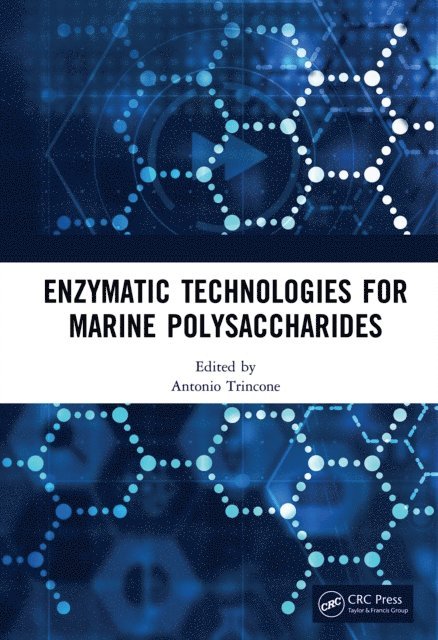
The bioactivity potential of marine polysaccharides has long been considered an underexploited aspect. These molecules found in seaweed, microalgae, bacteria, and animal fish (shellfish, mollusks, etc.) and the derived oligosaccharides need to be explored thoroughly with an interdisciplinary approach. They are an extraordinary source of chemical diversity, and the literature highlights many applicative fields, including the food industry, cosmetics, biomedicine, agriculture, environmental protection, wastewater management, etc. More recently, a new challenge has emerged: the exploitation of marine biomass as the source of sustainable energy to participate in the future replacement of fossil resources. Enzymatic Technologies for Marine Polysaccharides provides insight into the recent research developments of marine polysaccharides and their current and potential applications.
The first section of the book explores the diversity of marine polysaccharides from various angles, including a description of the chemical complexity and current applications and new perspectives in food, pharmaceutical, cosmetics, and biomaterials offered by recent research. Efficient valorization of the marine polysaccharide biomass requires a rigorous analysis of the polysaccharides structure and their biological properties. The second section of the book concerns the development of extraction techniques and the improvement of the methods aimed at the characterization of their structure and function. Finally, the third and last section of the book articulates the enzymatic technologies from the discovery of novel enzymes to their production pipelines related to the fields of biorefinery, food, pharmaceutics, and other fine chemicals.
Presents the latest research in marine oligosaccharides and polysaccharides
Written by world-class researchers in marine enzyme technology
Discusses the latest developments in extraction methods
Presents a detailed overview of enzymatic routes for modification, production, and synthesis of marine oligosaccharides
Contains extensive references at the end of each chapter to enhance further study
3 812 kr
Läs direkt efter köp
The bioactivity potential of marine polysaccharides has long been considered an underexploited aspect. These molecules found in seaweed, microalgae, bacteria, and animal fish (shellfish, mollusks, etc.) and the derived oligosaccharides need to be explored thoroughly with an interdisciplinary approach. They are an extraordinary source of chemical diversity, and the literature highlights many applicative fields, including the food industry, cosmetics, biomedicine, agriculture, environmental protection, wastewater management, etc. More recently, a new challenge has emerged: the exploitation of marine biomass as the source of sustainable energy to participate in the future replacement of fossil resources. Enzymatic Technologies for Marine Polysaccharides provides insight into the recent research developments of marine polysaccharides and their current and potential applications.
The first section of the book explores the diversity of marine polysaccharides from various angles, including a description of the chemical complexity and current applications and new perspectives in food, pharmaceutical, cosmetics, and biomaterials offered by recent research. Efficient valorization of the marine polysaccharide biomass requires a rigorous analysis of the polysaccharides structure and their biological properties. The second section of the book concerns the development of extraction techniques and the improvement of the methods aimed at the characterization of their structure and function. Finally, the third and last section of the book articulates the enzymatic technologies from the discovery of novel enzymes to their production pipelines related to the fields of biorefinery, food, pharmaceutics, and other fine chemicals.
Presents the latest research in marine oligosaccharides and polysaccharides
Written by world-class researchers in marine enzyme technology
Discusses the latest developments in extraction methods
Presents a detailed overview of enzymatic routes for modification, production, and synthesis of marine oligosaccharides
Contains extensive references at the end of each chapter to enhance further study
3 299 kr
Skickas inom 10-15 vardagar
2 519 kr
Läs direkt efter köp
1 631 kr
Skickas inom 10-15 vardagar
1 631 kr
Skickas inom 10-15 vardagar
1 995 kr
Läs direkt efter köp
This book serves as essential reading for research scientists and biotechnologists from both academia and industry working in marine biotechnology and related disciplines. The book discusses recent advances and challenges in terms of science, technology, innovation, and policy for the development of the field; and how marine biotechnology may provide new solutions to some of the grand challenges faced by our society. Written in an accessible language, the book is also recommended as a reference text for decision-makers in government and non-governmental organizations in their efforts to foster the development of a global blue economy.
With less than 5 % of the vast and rich marine environment explored, our seas and oceans represent a virtually unexplored resource for the discovery of novel product, processes, and development of bio-inspired synthetic drugs with biotechnological potential. As such, the marine environment has been considered Earth''s last frontier of exploration. Recent advances in molecular techniques are providing the necessary tools to access on a larger scale the still-untapped ocean resources and, consequently, unveil the promise of the blue biotechnology. Governments are recognizing the potential of marine biotechnology to provide solutions to some of the Grand Challenges of the 21st Century such as sustainable energy and food sources, identification of novel drugs for improved health treatments, and providing new industrial materials and processes. For this reason, advances in marine biotechnology may foster the much-needed source of innovation and economic growth in many countries, and pave the way towards the development of a global blue economy, i.e. a new economic model based on the sustainable exploration of our ocean ecosystems.