Antonios Fytopoulos - Böcker
Visar alla böcker från författaren Antonios Fytopoulos. Handla med fri frakt och snabb leverans.
5 produkter
5 produkter
Del 189 - Springer Optimization and Its Applications
Optimization of Pharmaceutical Processes
Inbunden, Engelska, 2022
797 kr
Skickas inom 5-8 vardagar
Optimization of Pharmaceutical Processes presents contributions from leading authorities in the fields of optimization and pharmaceutical manufacturing.
Del 189 - Springer Optimization and Its Applications
Optimization of Pharmaceutical Processes
Häftad, Engelska, 2023
589 kr
Skickas inom 5-8 vardagar
Optimization of Pharmaceutical Processes presents contributions from leading authorities in the fields of optimization and pharmaceutical manufacturing.
Del 205 - Springer Optimization and Its Applications
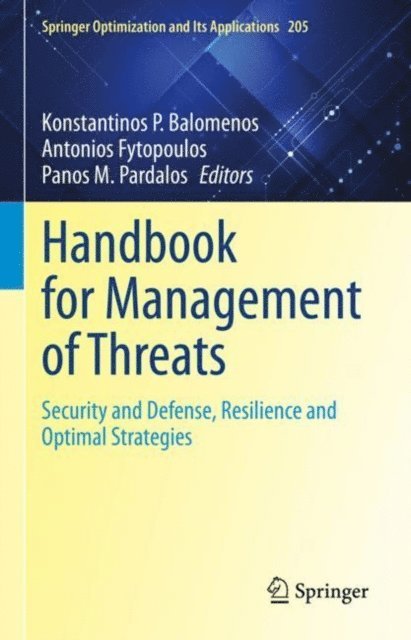
Handbook for Management of Threats
Security and Defense, Resilience and Optimal Strategies
Inbunden, Engelska, 2023
1 891 kr
Skickas inom 10-15 vardagar
In answer to the unprecedented challenges and threats that face today’s globalized world, the primary goal of this Handbook is to identify the most probable threats that have affected humanity in recent years and our world in years to come. The Handbook comprises mostly expository chapters that discuss tested methods/algorithms, case studies, as well as policy decision-making techniques surrounding threats and unnatural disasters, to evaluate their effects on people and to propose ways to mitigate these effects. In several chapters, new approaches and suggested policies supplement algorithms that are already in practice. The curated content brings together key experts from the academic and policy worlds to formulate a guide of principal techniques employed to gain better control over selected types of threats.This Handbook explores a wide range of technologies and theories and their impact on countering threats. These include artificial intelligence, machinelearning, variational inequality theory, game theory, data envelopment analysis, and data-driven risk analysis. These tools play a vital role in decision-making processes and aid in finding optimal solutions. Additionally, a variety of optimization techniques are employed. These include (mixed) integer linear programming models for identifying critical nodes in complex systems, heuristics, approximation algorithms, and bilevel mixed integer programming for determining the most impactful links in dynamic networks. Furthermore, simulation tools are described that enable the quantification of societal resilience. These techniques collectively provide a mathematical framework capable of quantifying fundamental aspects of threats. They equip policymakers with the necessary tools and knowledge to minimize the impact of unnatural threats. The expected readership is wide and includes officials working in technical and policy roles in various ministries such as the Ministry of Defense, Civil Protection, Ministry of Public Order and Citizen Protection, United Nations, European Institutions for Threat Management, NATO, Intelligence Agencies, Centers of Excellence for Countering Threats, Think Tanks, Centers for Policy Studies, Political Leaders, the European Commission, National Institutes, International Organizations, Strategic Consulting Experts, Policymakers, and Foreign Affairs personnel. Some of these national or international organizations employ algorithms to measure resilience and enhance security. Quantification is challenging but crucial in the scenarios discussed in the book. This Handbook will also prove valuable to various universities (non-practitioners), studying systems engineering, leadership, management, strategy, foreign affairs, politics, and related disciplines.Chapter "Risk Assessment and Identification Methodology for the Defense Industry in Times of Crisis: Decision-Making" is available open access under a Creative Commons Attribution 4.0 International License via Springerlink.
Del 205 - Springer Optimization and Its Applications
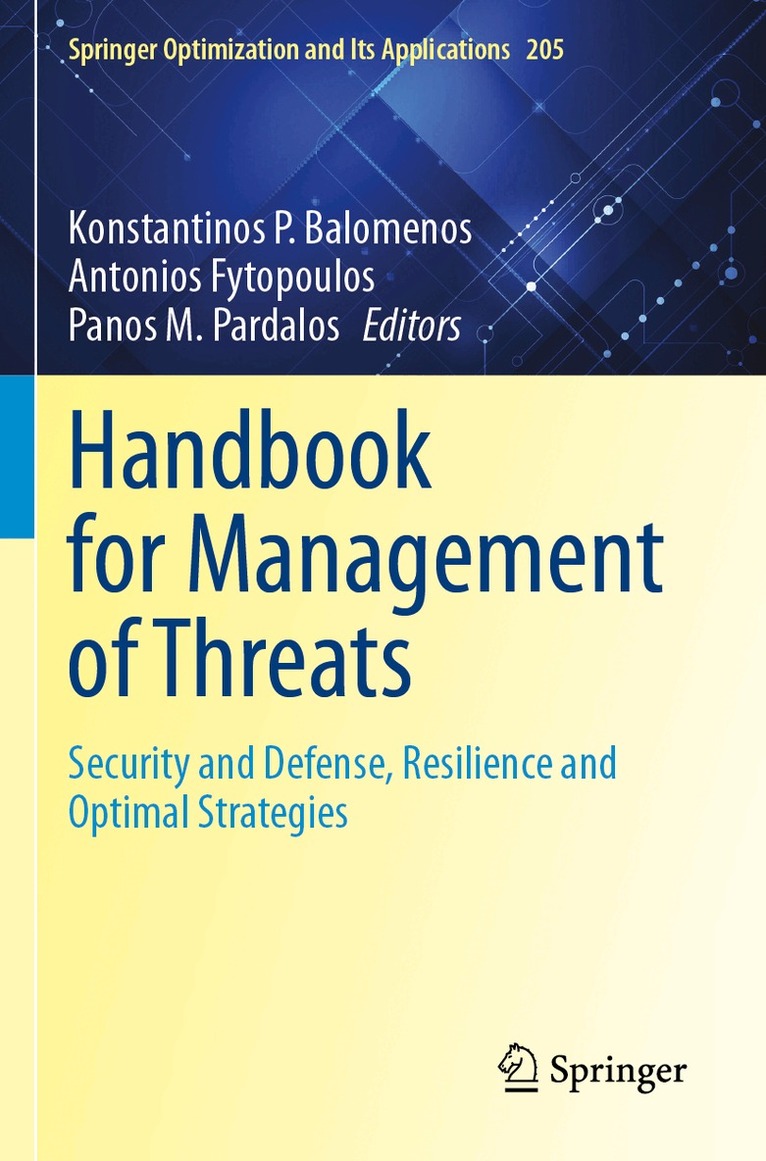
Handbook for Management of Threats
Security and Defense, Resilience and Optimal Strategies
Häftad, Engelska, 2024
1 387 kr
Skickas inom 10-15 vardagar
In answer to the unprecedented challenges and threats that face today’s globalized world, the primary goal of this Handbook is to identify the most probable threats that have affected humanity in recent years and our world in years to come. The Handbook comprises mostly expository chapters that discuss tested methods/algorithms, case studies, as well as policy decision-making techniques surrounding threats and unnatural disasters, to evaluate their effects on people and to propose ways to mitigate these effects. In several chapters, new approaches and suggested policies supplement algorithms that are already in practice. The curated content brings together key experts from the academic and policy worlds to formulate a guide of principal techniques employed to gain better control over selected types of threats.This Handbook explores a wide range of technologies and theories and their impact on countering threats. These include artificial intelligence, machinelearning, variational inequality theory, game theory, data envelopment analysis, and data-driven risk analysis. These tools play a vital role in decision-making processes and aid in finding optimal solutions. Additionally, a variety of optimization techniques are employed. These include (mixed) integer linear programming models for identifying critical nodes in complex systems, heuristics, approximation algorithms, and bilevel mixed integer programming for determining the most impactful links in dynamic networks. Furthermore, simulation tools are described that enable the quantification of societal resilience. These techniques collectively provide a mathematical framework capable of quantifying fundamental aspects of threats. They equip policymakers with the necessary tools and knowledge to minimize the impact of unnatural threats. The expected readership is wide and includes officials working in technical and policy roles in various ministries such as the Ministry of Defense, Civil Protection, Ministry of Public Order and Citizen Protection, United Nations, European Institutions for Threat Management, NATO, Intelligence Agencies, Centers of Excellence for Countering Threats, Think Tanks, Centers for Policy Studies, Political Leaders, the European Commission, National Institutes, International Organizations, Strategic Consulting Experts, Policymakers, and Foreign Affairs personnel. Some of these national or international organizations employ algorithms to measure resilience and enhance security. Quantification is challenging but crucial in the scenarios discussed in the book. This Handbook will also prove valuable to various universities (non-practitioners), studying systems engineering, leadership, management, strategy, foreign affairs, politics, and related disciplines.Chapter "Risk Assessment and Identification Methodology for the Defense Industry in Times of Crisis: Decision-Making" is available open access under a Creative Commons Attribution 4.0 International License via Springerlink.
2 712 kr
Kommande
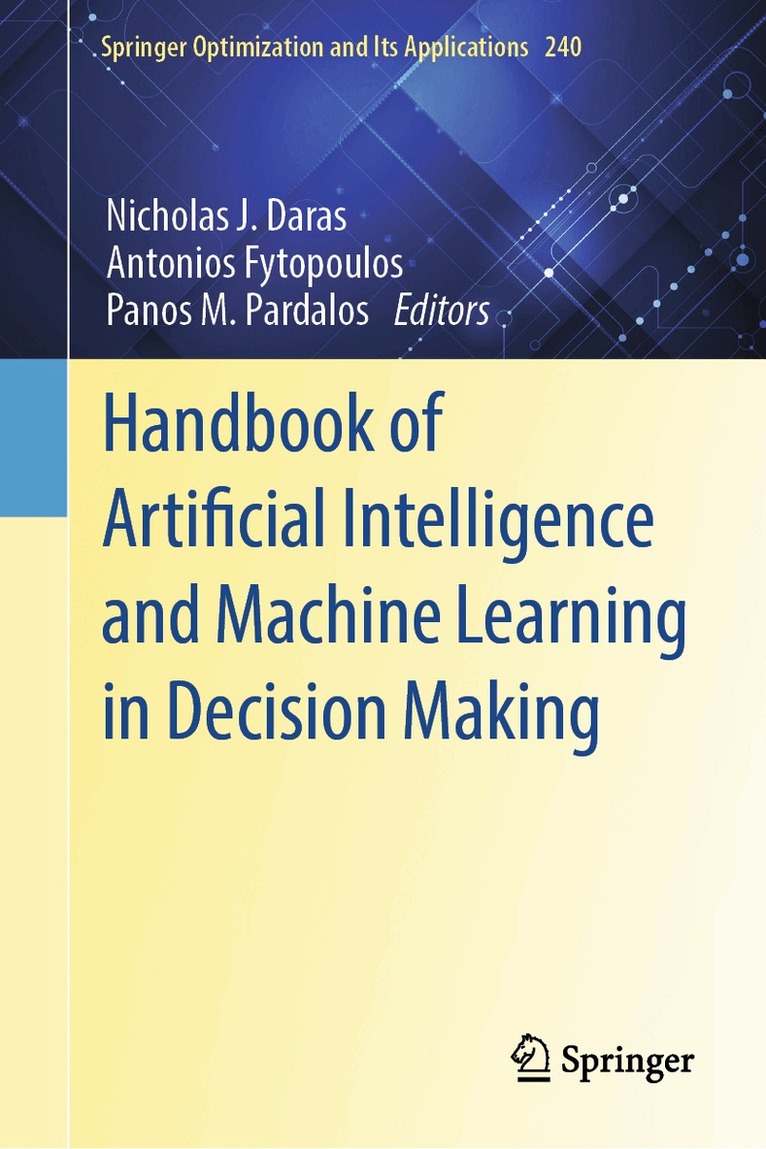
This volume presents a collection of invited chapters covering a broad range of perspectives on AI and decision-making. The scope is broad, and the potential impact is expected to be broader. Therefore, this volume represents only the beginning of a timely exploration of decision-making processes across thousands of applications that AI is expected to influence, including engineering, healthcare, management, human behavior, and business. This handbook includes several applications of decision-making based on artificial intelligence and machine learning techniques. This book also explores both new methods and well-established techniques in several topics related to AI and decision-making. This book is suitable for practitioners and researchers interested in artificial intelligence, machine learning, decision-making, and related topics.