Ardath W. Burks – författare
Visar alla böcker från författaren Ardath W. Burks. Handla med fri frakt och snabb leverans.
5 produkter
5 produkter
1 009 kr
Skickas inom 10-15 vardagar
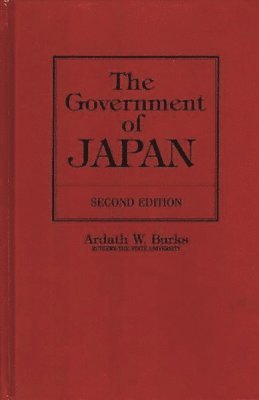
This book describes the government of Japan, with emphasis on the period of readjustment since the peace treaty of 1952.
2 113 kr
Skickas inom 10-15 vardagar
Japan has been among the first of the handful of countries to move "beyond modern," and in this third edition of a much-praised book, Ardath Burks brings the blur of the nation's rapid change into focus. In his newly revised and updated Japan, Professor Burks also traces the history of the Japanese, exploring their traditions, their continuity, and their cultural heritage. He devotes a chapter to the remarkable "introspection boom" (Nihonron): the Japanese asking, "Who are we Japanese?" In discussing the country's swift modernization, the author looks not only at the initial transition from primary agriculture to an industrial economy but also at the current evolution into a service-centered society. On both domestic and international levels, the book evaluates the maturing of Japanese industry and its growing investment abroad, as well as the global tensions fueled by Japan's enormous trade surpluses. In response to the intense trade pressure it feels, the country is beginning to shift from export-driven growth to a consumer-oriented economy, a shift that will demand the building of a heretofore neglected, yet essential, infrastructure of housing and transportation. The author analyzes domestic political developments including the regime of Nakasone Yasuhiro and the fall of Takeshita Noboru and Uno Sousuke, precipitated by financial scandal within the majority Liberal Democratic Party (LDP). Burks assesses the formidable tasks facing the revamped ruling LDP as its new generation of younger leaders grapples with an evolving economy, an expanding regional role, and the dissatisfaction of women and young people who have begun to rebel against the growth ethic and their marginalized role in society. In his well-drawn, lucid portrait of this complex country, Professor Burks reflects on Japan as a nation in historical transition, envisioning a postindustrial future filled with friction and promise. As he writes in his introduction, "Americans and Japanese too often look
618 kr
Skickas inom 10-15 vardagar
This book traces the history of the Japanese, exploring their traditions, continuity, and cultural heritage. It reflects on Japan as a nation in historical transition, envisioning a postindustrial future filled with friction and promise.
2 113 kr
Skickas inom 10-15 vardagar
This volume of essays by Japanese and Western scholars sheds light on the process of modernization in nineteenth-century Japan, focusing on two significant aspects of Japan's transition to a modern society: the decision to live for a time with the necessary evil of relying on the skill and advice of foreign employees (oyatio gaikokujin) and the decision to dispatch Japanese students overseas (Pyugakusei). The. essays make clear that the success of both these programs went beyond aiding Japan's modernization goals; their indirect effects often extended much further than planned, influencing even today the fields of education, science, and history and affecting other countries' knowledge about Japan.
618 kr
Skickas inom 10-15 vardagar
This volume of essays by Japanese and Western scholars sheds light on the process of modernization in nineteenth-century Japan, focusing on two significant aspects of Japan's transition to a modern society: the decision to live for a time with the necessary evil of relying on the skill and advice of foreign employees (oyatio gaikokujin) and the decision to dispatch Japanese students overseas (Pyugakusei). The. essays make clear that the success of both these programs went beyond aiding Japan's modernization goals; their indirect effects often extended much further than planned, influencing even today the fields of education, science, and history and affecting other countries' knowledge about Japan.