Ari Heljakka – författare
Visar alla böcker från författaren Ari Heljakka. Handla med fri frakt och snabb leverans.
3 produkter
3 produkter
Inbunden, Engelska, 2008
1 619 kr
Skickas inom 10-15 vardagar
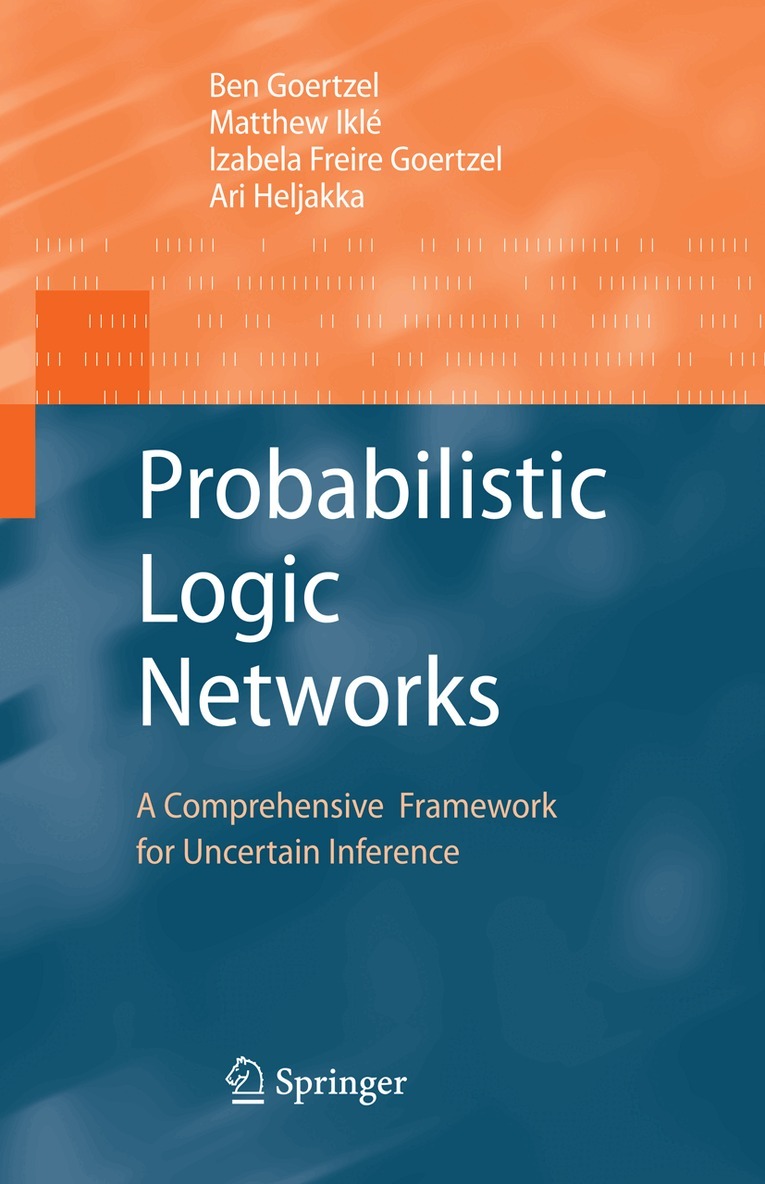
Abstract In this chapter we provide an overview of probabilistic logic networks (PLN), including our motivations for developing PLN and the guiding principles underlying PLN. We discuss foundational choices we made, introduce PLN knowledge representation, and briefly introduce inference rules and truth-values. We also place PLN in context with other approaches to uncertain inference. 1.1 Motivations This book presents Probabilistic Logic Networks (PLN), a systematic and pragmatic framework for computationally carrying out uncertain reasoning – r- soning about uncertain data, and/or reasoning involving uncertain conclusions. We begin with a few comments about why we believe this is such an interesting and important domain of investigation. First of all, we hold to a philosophical perspective in which “reasoning” – properly understood – plays a central role in cognitive activity. We realize that other perspectives exist; in particular, logical reasoning is sometimes construed as a special kind of cognition that humans carry out only occasionally, as a deviation from their usual (intuitive, emotional, pragmatic, sensorimotor, etc.) modes of thought. However, we consider this alternative view to be valid only according to a very limited definition of “logic.” Construed properly, we suggest, logical reasoning may be understood as the basic framework underlying all forms of cognition, including those conventionally thought of as illogical and irrational.
E-bok
PDF, Engelska, 20082 036 kr
Läs direkt efter köp
Abstract In this chapter we provide an overview of probabilistic logic networks (PLN), including our motivations for developing PLN and the guiding principles underlying PLN. We discuss foundational choices we made, introduce PLN knowledge representation, and briefly introduce inference rules and truth-values. We also place PLN in context with other approaches to uncertain inference. 1.1 Motivations This book presents Probabilistic Logic Networks (PLN), a systematic and pragmatic framework for computationally carrying out uncertain reasoning – r- soning about uncertain data, and/or reasoning involving uncertain conclusions. We begin with a few comments about why we believe this is such an interesting and important domain of investigation. First of all, we hold to a philosophical perspective in which “reasoning” – properly understood – plays a central role in cognitive activity. We realize that other perspectives exist; in particular, logical reasoning is sometimes construed as a special kind of cognition that humans carry out only occasionally, as a deviation from their usual (intuitive, emotional, pragmatic, sensorimotor, etc.) modes of thought. However, we consider this alternative view to be valid only according to a very limited definition of “logic.” Construed properly, we suggest, logical reasoning may be understood as the basic framework underlying all forms of cognition, including those conventionally thought of as illogical and irrational.
Häftad, Engelska, 2010
1 667 kr
Skickas inom 10-15 vardagar
Abstract In this chapter we provide an overview of probabilistic logic networks (PLN), including our motivations for developing PLN and the guiding principles underlying PLN. We discuss foundational choices we made, introduce PLN knowledge representation, and briefly introduce inference rules and truth-values. We also place PLN in context with other approaches to uncertain inference. 1.1 Motivations This book presents Probabilistic Logic Networks (PLN), a systematic and pragmatic framework for computationally carrying out uncertain reasoning – r- soning about uncertain data, and/or reasoning involving uncertain conclusions. We begin with a few comments about why we believe this is such an interesting and important domain of investigation. First of all, we hold to a philosophical perspective in which “reasoning” – properly understood – plays a central role in cognitive activity. We realize that other perspectives exist; in particular, logical reasoning is sometimes construed as a special kind of cognition that humans carry out only occasionally, as a deviation from their usual (intuitive, emotional, pragmatic, sensorimotor, etc.) modes of thought. However, we consider this alternative view to be valid only according to a very limited definition of “logic.” Construed properly, we suggest, logical reasoning may be understood as the basic framework underlying all forms of cognition, including those conventionally thought of as illogical and irrational.