Arno F. Wittig – författare
293 kr
Läs direkt efter köp
Tough Test Questions? Missed Lectures? Not Enough Time?
Fortunately for you, there''s Schaum''s Outlines. More than 40 million students have trusted Schaum''s to help them succeed in the classroom and on exams. Schaum''s is the key to faster learning and higher grades in every subject. Each Outline presents all the essential course information in an easy-to-follow, topic-by-topic format. You also get hundreds of examples, solved problems, and practice exercises to test your skills.
This Schaum''s Outline gives you
Practice problems with full explanations that reinforce knowledgeCoverage of the most up-to-date developments in your course fieldIn-depth review of practices and applicationsFully compatible with your classroom text, Schaum''s highlights all the important facts you need to know. Use Schaum''s to shorten your study time-and get your best test scores!
670 kr
Skickas inom 10-15 vardagar
768 kr
Läs direkt efter köp
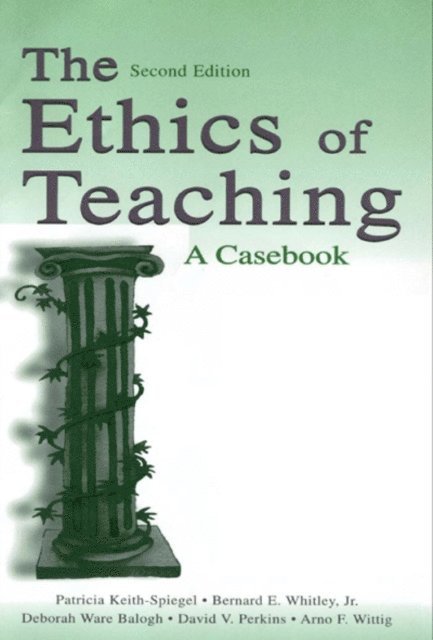
The Ethics of Teaching provides a frank discussion of the most frequently encountered ethical dilemmas that can arise in educational settings, as well as tips on how to avoid these predicaments and how to deal with them when they do occur. The goal is to stimulate discussion and raise faculties'' consciousness about ethical issues. Ethical dilemmas are presented as short, engaging case scenarios, most of which are based on actual situations, so as to furnish more realistic and interesting stimuli for individual reflection and group discussion. These scenarios offer the opportunity to consider the subtle complexities inherent in the social and psychological contexts in which educator-student interactions occur and the effects of those complexities on ethical decision making. Each case is followed by a detailed analysis and advice. The book''s 195 cases are grouped into 22 chapters representing topics, such as the controversial classroom presentations and assignments, debatable testing and grading practices, problematic student-faculty interactions, dual-role relationships with students, collegial conflicts, managing very difficult students, and confidentiality dilemmas. The Ethics of Teaching: A Casebook, Second Edition: *focuses on commonly encountered ethical "gray areas" that have no clear solution; *includes questions to stimulate discussion of related ethical issues; *concludes with a chapter on prevention, peer mentoring, and intervention; and *serves as excellent "assigned reading" to stimulate group discussion in teaching workshops and faculty development programs. The first edition of this book evolved by collecting a variety of teaching situations that commonly occur in college and university settings. The authors then created responses to the situations and circulated both the cases and the responses to reviewers from a number of departments across the country. As a result, the vast majority of the cases are "discipline free." The second edition features many new cases to reflect recent trends and events related to academic ethics. Questions were added to stimulate discussion and to further elaborate the issues. The Ethics of Teaching: A Casebook is ideal for college and university faculty, graduate assistants, and administrators involved in workshops, graduate teaching assistant courses, and faculty development and new faculty orientation programs. As a result of the book''s cross-disciplinary development, it will be beneficial to faculty from a broad spectrum of disciplines.
768 kr
Läs direkt efter köp
The Ethics of Teaching provides a frank discussion of the most frequently encountered ethical dilemmas that can arise in educational settings, as well as tips on how to avoid these predicaments and how to deal with them when they do occur. The goal is to stimulate discussion and raise faculties'' consciousness about ethical issues. Ethical dilemmas are presented as short, engaging case scenarios, most of which are based on actual situations, so as to furnish more realistic and interesting stimuli for individual reflection and group discussion. These scenarios offer the opportunity to consider the subtle complexities inherent in the social and psychological contexts in which educator-student interactions occur and the effects of those complexities on ethical decision making. Each case is followed by a detailed analysis and advice. The book''s 195 cases are grouped into 22 chapters representing topics, such as the controversial classroom presentations and assignments, debatable testing and grading practices, problematic student-faculty interactions, dual-role relationships with students, collegial conflicts, managing very difficult students, and confidentiality dilemmas. The Ethics of Teaching: A Casebook, Second Edition: *focuses on commonly encountered ethical "gray areas" that have no clear solution; *includes questions to stimulate discussion of related ethical issues; *concludes with a chapter on prevention, peer mentoring, and intervention; and *serves as excellent "assigned reading" to stimulate group discussion in teaching workshops and faculty development programs. The first edition of this book evolved by collecting a variety of teaching situations that commonly occur in college and university settings. The authors then created responses to the situations and circulated both the cases and the responses to reviewers from a number of departments across the country. As a result, the vast majority of the cases are "discipline free." The second edition features many new cases to reflect recent trends and events related to academic ethics. Questions were added to stimulate discussion and to further elaborate the issues. The Ethics of Teaching: A Casebook is ideal for college and university faculty, graduate assistants, and administrators involved in workshops, graduate teaching assistant courses, and faculty development and new faculty orientation programs. As a result of the book''s cross-disciplinary development, it will be beneficial to faculty from a broad spectrum of disciplines.