Arnold Koslow - Böcker
Visar alla böcker från författaren Arnold Koslow. Handla med fri frakt och snabb leverans.
6 produkter
6 produkter
850 kr
Skickas inom 7-10 vardagar
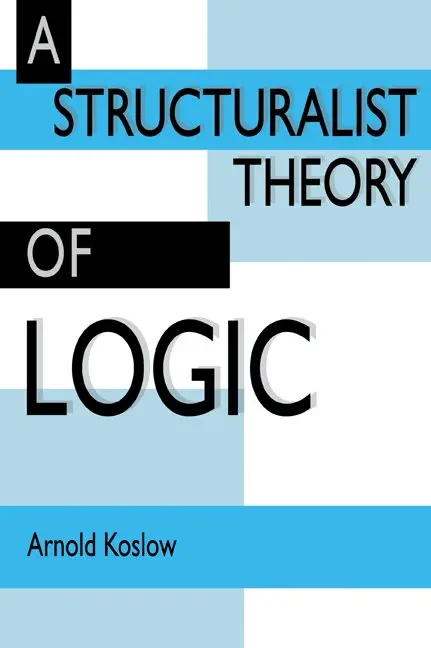
In this 1992 book, Professor Koslow advances an account of the basic concepts of logic. A central feature of the theory is that it does not require the elements of logic to be based on a formal language. Rather, it uses a general notion of implication as a way of organizing the formal results of various systems of logic in a simple, but insightful way. The study has four parts. In the first two parts the various sources of the general concept of an implication structure and its forms are illustrated and explained. Part 3 defines the various logical operations and systematically explores their properties. A generalized account of extensionality and dual implication is given, and the extensionality of each of the operators, as well as the relation of negation and its dual, are given substantial treatment because of the novel results they yield. Part 4 considers modal operators and studies their interaction with logical operators. By obtaining the usual results without the usual assumptions this new approach allows one to give a very simple account of modal logic minus the excess baggage of possible world semantics.
1 429 kr
Skickas inom 7-10 vardagar
In this 1992 book, Professor Koslow advances an account of the basic concepts of logic. A central feature of the theory is that it does not require the elements of logic to be based on a formal language. Rather, it uses a general notion of implication as a way of organizing the formal results of various systems of logic in a simple, but insightful way. The study has four parts. In the first two parts the various sources of the general concept of an implication structure and its forms are illustrated and explained. Part 3 defines the various logical operations and systematically explores their properties. A generalized account of extensionality and dual implication is given, and the extensionality of each of the operators, as well as the relation of negation and its dual, are given substantial treatment because of the novel results they yield. Part 4 considers modal operators and studies their interaction with logical operators. By obtaining the usual results without the usual assumptions this new approach allows one to give a very simple account of modal logic minus the excess baggage of possible world semantics.
906 kr
Skickas inom 10-15 vardagar
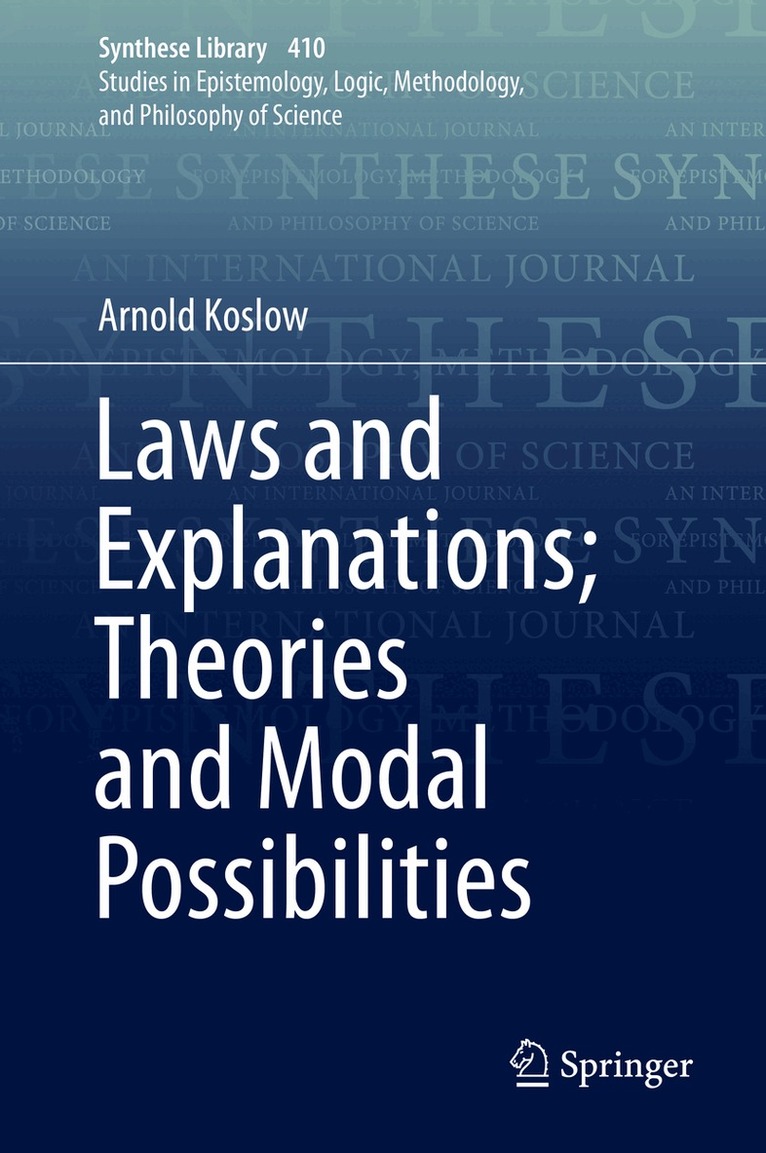
The book has two parts: In the first, after a review of some seminal classical accounts of laws and explanations, a new account is proposed for distinguishing between laws and accidental generalizations (LAG). Among the new consequences of this proposal it is proved that any explanation of a contingent generalization shows that the generalization is not accidental. The second part involves physical theories, their modality, and their explanatory power. In particular, it is shown that (1) Each theory has a theoretical implication structure associated with it, such that there are new physical modal operators on these structures and also special modal entities that are in these structures. A special subset of the physical modals, the nomic modals are associated with the laws of theories. (2) The familiar idea that theories always explain laws by deduction of them has to be seriously modified in light of the fact that there are a host of physical theories (including for example, Newtonian Classical mechanics, Hamiltonian, and Lagrangian theory, and probability theory) that we believe are schematic (they do not have any truth value). Nevertheless, we think that there is a kind of non-deductive explanation and generality that they achieve by subsumtion under a schema.
641 kr
Skickas inom 10-15 vardagar
The book has two parts: In the first, after a review of some seminal classical accounts of laws and explanations, a new account is proposed for distinguishing between laws and accidental generalizations (LAG). Among the new consequences of this proposal it is proved that any explanation of a contingent generalization shows that the generalization is not accidental. The second part involves physical theories, their modality, and their explanatory power. In particular, it is shown that (1) Each theory has a theoretical implication structure associated with it, such that there are new physical modal operators on these structures and also special modal entities that are in these structures. A special subset of the physical modals, the nomic modals are associated with the laws of theories. (2) The familiar idea that theories always explain laws by deduction of them has to be seriously modified in light of the fact that there are a host of physical theories (including for example, Newtonian Classical mechanics, Hamiltonian, and Lagrangian theory, and probability theory) that we believe are schematic (they do not have any truth value). Nevertheless, we think that there is a kind of non-deductive explanation and generality that they achieve by subsumtion under a schema.
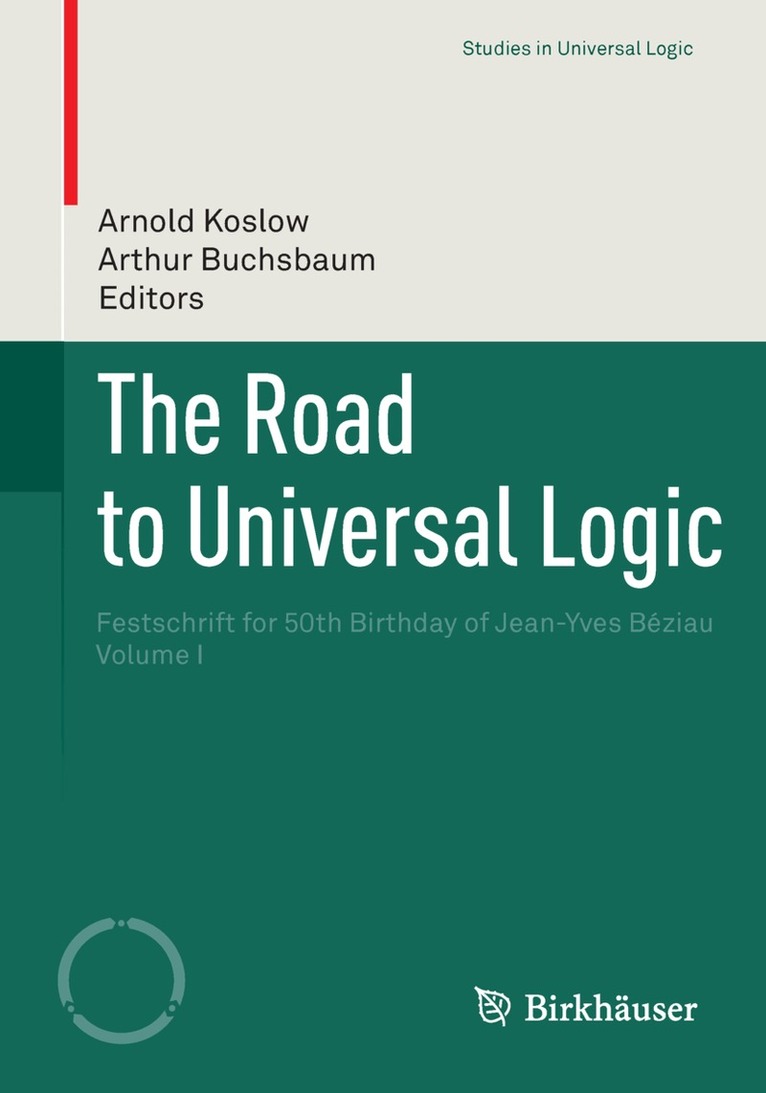
Road to Universal Logic
Festschrift for 50th Birthday of Jean-Yves Béziau Volume I
Häftad, Engelska, 2014
536 kr
Skickas inom 10-15 vardagar
The Road to Universal Logic
Road to Universal Logic
Festschrift for the 50th Birthday of Jean-Yves Béziau Volume II
Häftad, Engelska, 2015
536 kr
Skickas inom 10-15 vardagar
This second volume of a collection of papers offers new perspectives and challenges in the study of logic. It is presented in honor of the fiftieth birthday of Jean-Yves Béziau. The papers touch upon a wide range of topics including paraconsistent logic, quantum logic, geometry of oppositions, categorical logic, computational logic, fundamental logic notions (identity, rule, quantification) and history of logic (Leibniz, Peirce, Hilbert).The volume gathers personal recollections about Jean-Yves Béziau and an autobiography, followed by 25 papers written by internationally distinguished logicians, mathematicians, computer scientists, linguists and philosophers, including Irving Anellis, Dov Gabbay, Ivor Grattan-Guinness, Istvan Németi, Henri Prade.These essays will be of interest to all students and researchers interested in the nature and future of logic.