Arpan K. Banerjee – författare
Visar alla böcker från författaren Arpan K. Banerjee. Handla med fri frakt och snabb leverans.
6 produkter
6 produkter
E-bok
PDF, Engelska, 20131 027 kr
Läs direkt efter köp
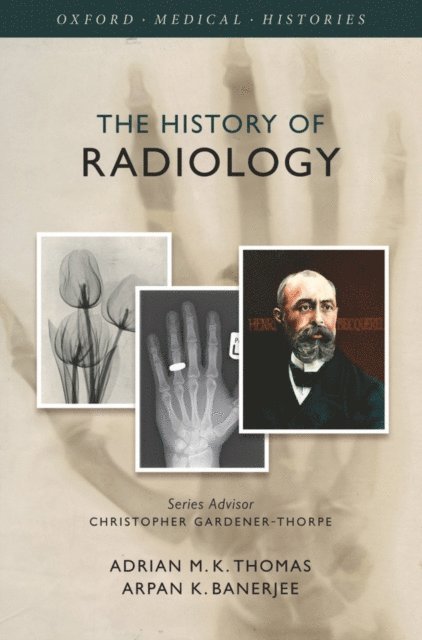
In 1890, Professor Arthur Willis Goodspeed, a professor of physics at Pennsylvania USA was working with an English born photographer, William N Jennings, when they accidentally produced a Röntgen Ray picture. Unfortunately, the significance of their findings were overlooked, and the formal discovery of X-rays was credited to Wilhelm Roentgen in 1895.The discovery has since transformed the practice of medicine, and over the course of the past 130 years, the development of new radiological techniques has continued to grow. The impact has been seen in virtually every hospital in the world, from the routine use of ultrasound for pregnancy scans, through to the diagnosis of complex medical issues such as brain tumours. More subtly, X-rays were also used in the discovery of DNA and in military combat, and their social influence through popularculture can be seen in cartoons, books, movies and art.Written by two radiologists who have a passion for the history of their field, The History of Radiology is a beautifully illustrated review of the remarkable developments within radiology and the scientists and pioneers who were involved. This engaging and authoritative history will appeal to a wide audience including medical students studying for the Diploma in the History of Medicine of the Society of Apothecaries (DHMSA), doctors, medical physicists, medical historians andradiographers.
E-bok
Engelska, 2013991 kr
Läs direkt efter köp
In 1890, Professor Arthur Willis Goodspeed, a professor of physics at Pennsylvania USA was working with an English born photographer, William N Jennings, when they accidentally produced a Röntgen Ray picture. Unfortunately, the significance of their findings were overlooked, and the formal discovery of X-rays was credited to Wilhelm Roentgen in 1895.The discovery has since transformed the practice of medicine, and over the course of the past 130 years, the development of new radiological techniques has continued to grow. The impact has been seen in virtually every hospital in the world, from the routine use of ultrasound for pregnancy scans, through to the diagnosis of complex medical issues such as brain tumours. More subtly, X-rays were also used in the discovery of DNA and in military combat, and their social influence through popularculture can be seen in cartoons, books, movies and art.Written by two radiologists who have a passion for the history of their field, The History of Radiology is a beautifully illustrated review of the remarkable developments within radiology and the scientists and pioneers who were involved. This engaging and authoritative history will appeal to a wide audience including medical students studying for the Diploma in the History of Medicine of the Society of Apothecaries (DHMSA), doctors, medical physicists, medical historians andradiographers.
Inbunden, Engelska, 2013
1 619 kr
Skickas inom 7-10 vardagar
In 1890, Professor Arthur Willis Goodspeed, a professor of physics at Pennsylvania USA was working with an English born photographer, William N Jennings, when they accidentally produced a Röntgen Ray picture. Unfortunately, the significance of their findings were overlooked, and the formal discovery of X-rays was credited to Wilhelm Roentgen in 1895. The discovery has since transformed the practice of medicine, and over the course of the past 130 years, the development of new radiological techniques has continued to grow. The impact has been seen in virtually every hospital in the world, from the routine use of ultrasound for pregnancy scans, through to the diagnosis of complex medical issues such as brain tumours. More subtly, X-rays were also used in the discovery of DNA and in military combat, and their social influence through popular culture can be seen in cartoons, books, movies and art.Written by two radiologists who have a passion for the history of their field, The History of Radiology is a beautifully illustrated review of the remarkable developments within radiology and the scientists and pioneers who were involved. This engaging and authoritative history will appeal to a wide audience including medical students studying for the Diploma in the History of Medicine of the Society of Apothecaries (DHMSA), doctors, medical physicists, medical historians and radiographers.
Häftad, Engelska, 2006
838 kr
Skickas inom 7-10 vardagar
Radiology plays a central role in diagnosis, management and even treatment of a patient's condition. The increasing importance of radiology in clinical medicine has led to the inclusion of the subject in medical school curricula worldwide. Most radiology teaching for medical students is conducted around films of real patients on the ward or in tutorial groups within the radiology department itself and, by reflecting this method of learning, the approach of this book will be familiar to students studying radiology at undergraduate level. The book adopts a systemic approach to cover the commonest clinical problems that are encountered on the wards, in tutorials and in examinations. Clear radiographs are each presented with brief reports and an accompanying discussion of the diagnosis, differential diagnosis and potential further investigations. This new edition is enhanced with many new images, and all are now clearly labelled and arrowed to highlight significant diagnostic features.
Häftad, Engelska, 1993
199 kr
Skickas inom 11-20 vardagar
The Radiology of AIDS is aimed at candidates for postgraduate examinations in all specialities and especially those doctors with some training in HIV disease who need to assess their knowledge of the subject. This book is particularly applicable to candidates for postgraduate examinations in radiology.
E-bok
PDF, Engelska, 20051 931 kr
Läs direkt efter köp
I am very pleased to have been asked to write the foreword to this book. The technical advances in diagnostic radiology in the last few decades have transformed clinical practice and have been nothing short of astonishing. The subject of diagnostic radiology is now very large and radiology depa- ments are involved in all areas of modern patient care.The defining event in m- ern radiology,and arguably the most significant development in radiology since Wilhelm Röntgen discovered X-rays, was the invention of the CT scanner in the 1970s.The CT scanner introduced modern cross-sectional imaging and also di- tal imaging.We now have MRI and ultrasound and these techniques are replacing many traditional X-ray procedures.The developments in radiology have been the result of a fruitful interaction between the basic sciences, clinical medicine and the manufacturers. This can be seen by looking at the various sources of these publications. Change is produced by the interactions between the variousdis- plines. The editors have had a very difficult task in selecting the key discoveries and descriptions.The radiological literature is very large.Medical imaging continues to develop rapidly and these papers are the foundations of our current practice.