Arthur Charpentier - Böcker
Visar alla böcker från författaren Arthur Charpentier. Handla med fri frakt och snabb leverans.
4 produkter
4 produkter
766 kr
Skickas inom 10-15 vardagar
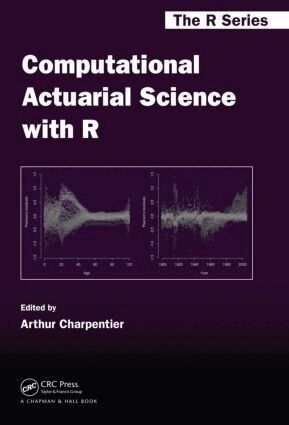
A Hands-On Approach to Understanding and Using Actuarial ModelsComputational Actuarial Science with R provides an introduction to the computational aspects of actuarial science. Using simple R code, the book helps you understand the algorithms involved in actuarial computations. It also covers more advanced topics, such as parallel computing and C/C++ embedded codes.After an introduction to the R language, the book is divided into four parts. The first one addresses methodology and statistical modeling issues. The second part discusses the computational facets of life insurance, including life contingencies calculations and prospective life tables. Focusing on finance from an actuarial perspective, the next part presents techniques for modeling stock prices, nonlinear time series, yield curves, interest rates, and portfolio optimization. The last part explains how to use R to deal with computational issues of nonlife insurance.Taking a do-it-yourself approach to understanding algorithms, this book demystifies the computational aspects of actuarial science. It shows that even complex computations can usually be done without too much trouble. Datasets used in the text are available in an R package (CASdatasets).
2 088 kr
Skickas inom 10-15 vardagar
A Hands-On Approach to Understanding and Using Actuarial ModelsComputational Actuarial Science with R provides an introduction to the computational aspects of actuarial science. Using simple R code, the book helps you understand the algorithms involved in actuarial computations. It also covers more advanced topics, such as parallel computing and C/C++ embedded codes.After an introduction to the R language, the book is divided into four parts. The first one addresses methodology and statistical modeling issues. The second part discusses the computational facets of life insurance, including life contingencies calculations and prospective life tables. Focusing on finance from an actuarial perspective, the next part presents techniques for modeling stock prices, nonlinear time series, yield curves, interest rates, and portfolio optimization. The last part explains how to use R to deal with computational issues of nonlife insurance.Taking a do-it-yourself approach to understanding algorithms, this book demystifies the computational aspects of actuarial science. It shows that even complex computations can usually be done without too much trouble. Datasets used in the text are available in an R package (CASdatasets).
1 578 kr
Skickas inom 10-15 vardagar
This book offers an introduction to the technical foundations of discrimination and equity issues in insurance models, catering to undergraduates, postgraduates, and practitioners. It is a self-contained resource, accessible to those with a basic understanding of probability and statistics. Designed as both a reference guide and a means to develop fairer models, the book acknowledges the complexity and ambiguity surrounding the question of discrimination in insurance. In insurance, proposing differentiated premiums that accurately reflect policyholders' true risk—termed "actuarial fairness" or "legitimate discrimination"—is economically and ethically motivated. However, such segmentation can appear discriminatory from a legal perspective. By intertwining real-life examples with academic models, the book incorporates diverse perspectives from philosophy, social sciences, economics, mathematics, and computer science. Although discrimination has long been a subject of inquiry in economics and philosophy, it has gained renewed prominence in the context of "big data," with an abundance of proxy variables capturing sensitive attributes, and "artificial intelligence" or specifically "machine learning" techniques, which often involve less interpretable black box algorithms.The book distinguishes between models and data to enhance our comprehension of why a model may appear unfair. It reminds us that while a model may not be inherently good or bad, it is never neutral and often represents a formalization of a world seen through potentially biased data. Furthermore, the book equips actuaries with technical tools to quantify and mitigate potential discrimination, featuring dedicated chapters that delve into these methods.
1 578 kr
Skickas inom 10-15 vardagar
This book offers an introduction to the technical foundations of discrimination and equity issues in insurance models, catering to undergraduates, postgraduates, and practitioners. It is a self-contained resource, accessible to those with a basic understanding of probability and statistics. Designed as both a reference guide and a means to develop fairer models, the book acknowledges the complexity and ambiguity surrounding the question of discrimination in insurance. In insurance, proposing differentiated premiums that accurately reflect policyholders' true risk—termed "actuarial fairness" or "legitimate discrimination"—is economically and ethically motivated. However, such segmentation can appear discriminatory from a legal perspective. By intertwining real-life examples with academic models, the book incorporates diverse perspectives from philosophy, social sciences, economics, mathematics, and computer science. Although discrimination has long been a subject of inquiry in economics and philosophy, it has gained renewed prominence in the context of "big data," with an abundance of proxy variables capturing sensitive attributes, and "artificial intelligence" or specifically "machine learning" techniques, which often involve less interpretable black box algorithms.The book distinguishes between models and data to enhance our comprehension of why a model may appear unfair. It reminds us that while a model may not be inherently good or bad, it is never neutral and often represents a formalization of a world seen through potentially biased data. Furthermore, the book equips actuaries with technical tools to quantify and mitigate potential discrimination, featuring dedicated chapters that delve into these methods.