Arthur J. Robson – författare
Visar alla böcker från författaren . Handla med fri frakt och snabb leverans.
2 produkter
2 produkter
Häftad, Engelska, 2026
526 kr
Kommande
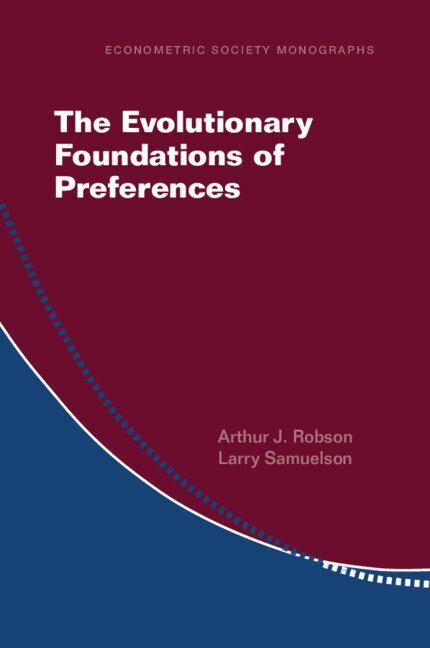
Preferences are the point of departure for economic analysis. Despite myriad experiments designed to characterize preferences, no consensus has been reached. In The Evolutionary Foundation of Preferences, Arthur J. Robson and Larry Samuelson examine how economic preferences might be shaped by biological evolution. They theorize that each of us is descended from a line of ancestors who were able to survive and reproduce, and they analyze how this may have affected modern preferences. Drawing on demographic models, they explain how different preferences induce different behaviors which lead to different growth rates among respective subpopulations. People whose preferences induce the highest growth rate eventually comprise the overwhelming proportion of the population. Examining neuroscientific evidence that points to a cardinal, or hedonic, interpretation of utility, the authors discuss the implications of these interpretations and the challenges raised for welfare economics.
Inbunden, Engelska, 2026
1 512 kr
Kommande
Preferences are the point of departure for economic analysis. Despite myriad experiments designed to characterize preferences, no consensus has been reached. In The Evolutionary Foundation of Preferences, Arthur J. Robson and Larry Samuelson examine how economic preferences might be shaped by biological evolution. They theorize that each of us is descended from a line of ancestors who were able to survive and reproduce, and they analyze how this may have affected modern preferences. Drawing on demographic models, they explain how different preferences induce different behaviors which lead to different growth rates among respective subpopulations. People whose preferences induce the highest growth rate eventually comprise the overwhelming proportion of the population. Examining neuroscientific evidence that points to a cardinal, or hedonic, interpretation of utility, the authors discuss the implications of these interpretations and the challenges raised for welfare economics.