Arthur Kroker - Böcker
Visar alla böcker från författaren Arthur Kroker. Handla med fri frakt och snabb leverans.
9 produkter
9 produkter
250 kr
Skickas inom 3-6 vardagar
716 kr
Skickas inom 7-10 vardagar
Exits to the Posthuman Future is media theory for a global digital society which thrives, and sometimes perishes, at the intersection of technologies of speed, distant ethics and a pervasive cultural anxiety. Arthur Kroker’s incisive and insightful text presents the emerging pattern of a posthuman future: life at the tip of technologies of acceleration, drift and crash. Kroker links key concepts such as “Guardian Liberalism” and Obama’s vision of the “Just War” with a striking account of “culture drift” as the essence of real world technoculture. He argues that contemporary society displays growing uncertainty about the ultimate ends of technological innovation and the intelligibility of the digital future. The posthuman future is elusive: is it a gathering storm of cynical abandonment, inertia, disappearance and substitution? Or else the development of a new form of critical consciousness - the posthuman imagination - as a means of comprehending the full complexity of life? Depending on which exit to the posthuman future we choose or, perhaps, which exit chooses us, Kroker argues that a very different posthuman future will likely ensue.
251 kr
Skickas inom 11-20 vardagar
Exits to the Posthuman Future is media theory for a global digital society which thrives, and sometimes perishes, at the intersection of technologies of speed, distant ethics and a pervasive cultural anxiety. Arthur Kroker’s incisive and insightful text presents the emerging pattern of a posthuman future: life at the tip of technologies of acceleration, drift and crash. Kroker links key concepts such as “Guardian Liberalism” and Obama’s vision of the “Just War” with a striking account of “culture drift” as the essence of real world technoculture. He argues that contemporary society displays growing uncertainty about the ultimate ends of technological innovation and the intelligibility of the digital future. The posthuman future is elusive: is it a gathering storm of cynical abandonment, inertia, disappearance and substitution? Or else the development of a new form of critical consciousness - the posthuman imagination - as a means of comprehending the full complexity of life? Depending on which exit to the posthuman future we choose or, perhaps, which exit chooses us, Kroker argues that a very different posthuman future will likely ensue.
774 kr
Skickas inom 3-6 vardagar
In The Will to Technology and the Culture of Nihilism, Arthur Kroker explores the future of the 21st century in the language of technological destiny. Presenting Martin Heidegger, Karl Marx, and Friedrich Nietzsche as prophets of technological nihilism, Kroker argues that every aspect of contemporary culture, society, and politics is coded by the dynamic unfolding of the 'will to technology.'Moving between cultural history, our digital present, and the biotic future, Kroker theorizes on the relationship between human bodies and posthuman technology, and more specifically, wonders if the body of work offered by thinkers like Heidegger, Marx, and Nietzsche is a part of our past or a harbinger of our technological future. Heidegger, Marx, and Nietzsche intensify our understanding of the contemporary cultural climate. Heidegger's vision posits an increasingly technical society before which we have become 'objectless objects'– driftworks in a 'culture of boredom.' In Marx, the disciplining of capital itself by the will to technology is a code of globalization, first announced as streamed capitalism. Nietzsche mediates between them, envisioning in the gathering shadows of technological society the emergent signs of a culture of nihilism. Like Marx, he insists on thinking of the question of technology in terms of its material signs.In The Will to Technology and the Culture of Nihilism, Kroker consistently enacts an invigorating and innovative vision, bringing together critical theory, art, and politics to reveal the philosophic apparatus of technoculture.
348 kr
Skickas inom 10-15 vardagar
As exemplary representatives of a form of critical feminism, the writings of Judith Butler, Katherine Hayles, and Donna Haraway offer entry into the great crises of contemporary society, politics, and culture. Butler leads readers to rethink the boundaries of the human in a time of perpetual war. Hayles turns herself into a “writing machine” in order to find a dwelling place for the digital humanities within the austere landscape of the culture of the code. Haraway is the one contemporary thinker to have begun the necessary ethical project of creating a new language of potential reconciliation among previously warring species.According to Arthur Kroker, the postmodernism of Judith Butler, the posthumanism of Katherine Hayles, and the companionism of Donna Haraway are possible pathways to the posthuman future that is captured by the specter of body drift. Body drift refers to the fact that individuals no longer inhabit a body, in any meaningful sense of the term, but rather occupy a multiplicity of bodies: gendered, sexualized, laboring, disciplined, imagined, and technologically augmented.Body drift is constituted by the blast of information culture envisioned by artists, communicated by social networking, and signified by its signs. It is lived daily by remixing, resplicing, and redesigning the codes: codes of gender, sexuality, class, ideology, and identity. The writings of Butler, Hayles, and Haraway, Kroker reveals, provide the critical vocabulary and political context for understanding the deep complexities of body drift and challenging the current emphasis on the material body.
494 kr
Skickas inom 7-10 vardagar
Since its initial publication, Critical Digital Studies has proven an indispensable guide to understanding digitally mediated culture. Bringing together the leading scholars in this growing field, internationally renowned scholars Arthur and Marilouise Kroker present an innovative and interdisciplinary survey of the relationship between humanity and technology. The reader offers a study of our digital future, a means of understanding the world with new analytic tools and means of communication that are defining the twenty-first century.The second edition includes new essays on the impact of social networking technologies and new media. A new section – “New Digital Media” – presents important, new articles on topics including hacktivism in the age of digital power and the relationship between gaming and capitalism. The extraordinary range and depth of the first edition has been maintained in this new edition. Critical Digital Studies will continue to provide the leading edge to readers wanting to understand the complex intersection of digital culture and human knowledge.
257 kr
Skickas inom 7-10 vardagar
With astonishing speed, we have been projected into a new reality where interactions with drones, robotic bodies, and high-level surveillance are increasingly mainstream. In this age of groundbreaking developments in robotic technologies, synthetic biology is merging with artificial intelligence, forming a newly blended reality of machines, bodies, and affect.Technologies of the New Real draws from critical intersections of technology and society – including drones, surveillance, DIY bodies, and innovations in robotic technology – to explore what these advances can tell us about our present reality, or what authors Arthur and Marilouise Kroker deem the "new real" of digital culture in the twenty-first century.Technologies of the New Real explores the many technologies of our present reality as they infiltrate the social, political, and economic static of our everyday lives, seemingly eroding traditionally conceived boundaries between humans and machines, and rendering fully ambivalent borders between the human mind and simulated data.
684 kr
Skickas inom 7-10 vardagar
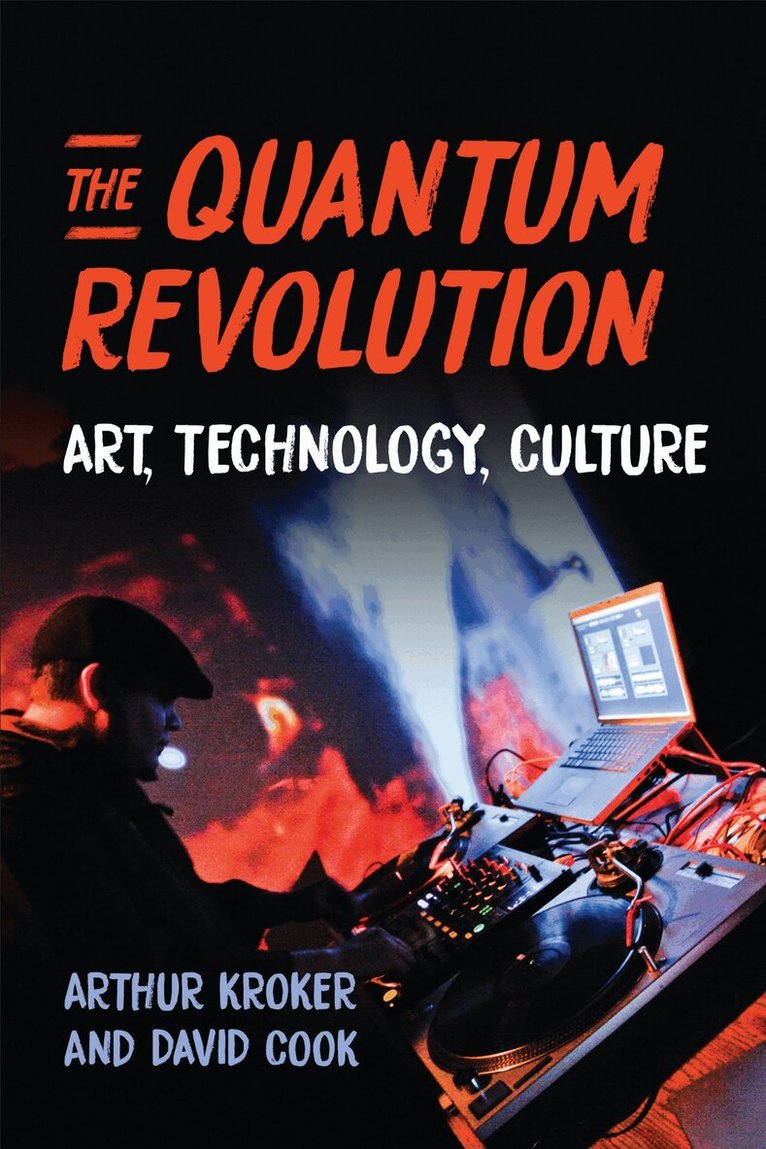
Focusing on the entanglement of art, technology, and culture, The Quantum Revolution illuminates the contemporary scientific imagination as a new way of understanding everyday life.
336 kr
Skickas inom 7-10 vardagar
We are currently riders of the information storm. AI fascinates us, images mesmerize us, data defines us, algorithms remember us, news bombards us, devices connect us, isolation saddens us. Deeply embedded in digital technology, we are the very first inhabitants of life in the quantum zone. The Quantum Revolution is about life today – its entanglements, creativity, politics, and artistic vision.Arthur Kroker and David Cook explore a new way of thinking drawn directly from the quantum imaginary itself. They explain the quantum revolution as everyday life, where technology moves fast, and where, under cover of the digital devices that connect us, the most sophisticated concepts of technology and science originating in mathematics, astrophysics, and biogenetics have swiftly flooded human consciousness, shaped social behavior, and crafted individual identity. The book discusses the concept of the quantum zone as a new way of understanding digital culture, and presents stories about art, technology, and society, as well as a series of reflections on art as a gateway to understanding the quantum imaginary. Richly illustrated with sixty images of critically engaged photos and artwork, The Quantum Revolution privileges a new way of understanding and seeing politics, society, and culture through the lens of the duality that is the essence of the quantum imaginary.