Arthur M. Jacobs - Böcker
Visar alla böcker från författaren Arthur M. Jacobs. Handla med fri frakt och snabb leverans.
7 produkter
7 produkter
2 039 kr
Skickas inom 10-15 vardagar
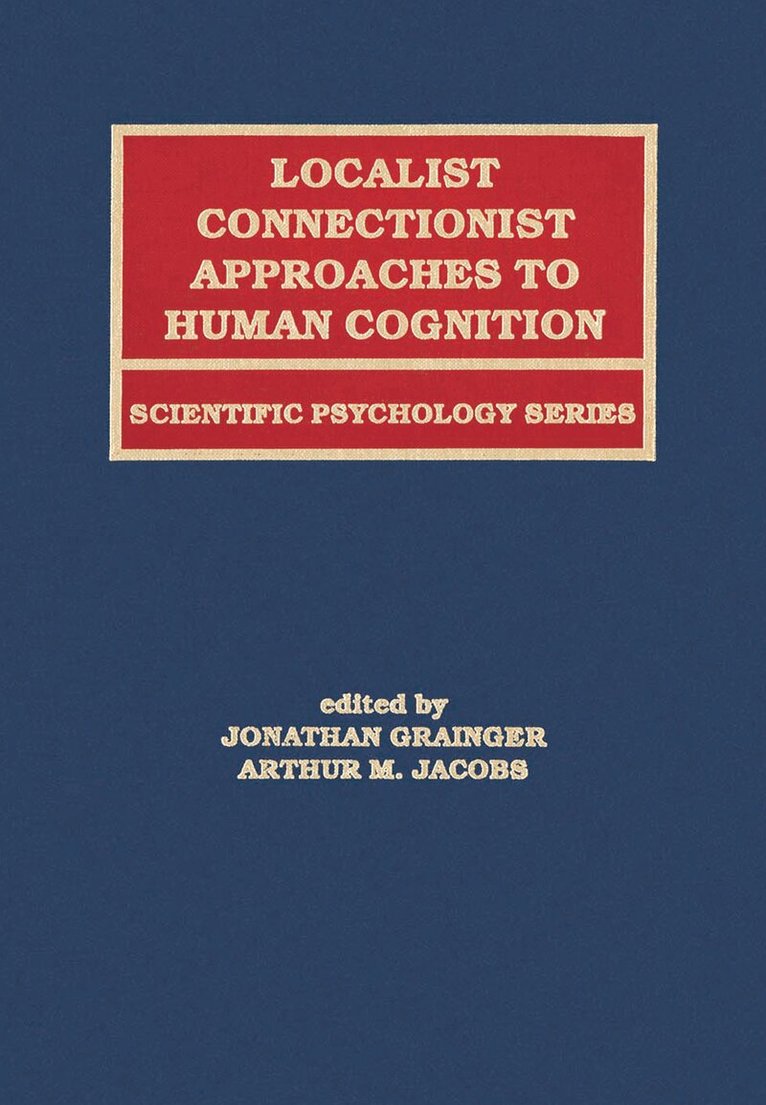
This volume provides an overview of a relatively neglected branch of connectionism known as localist connectionism. The singling out of localist connectionism is motivated by the fact that some critical modeling strategies have been more readily applied in the development and testing of localist as opposed to distributed connectionist models (models using distributed hidden-unit representations and trained with a particular learning algorithm, typically back-propagation). One major theme emerging from this book is that localist connectionism currently provides an interesting means of evolving from verbal-boxological models of human cognition to computer-implemented algorithmic models. The other central messages conveyed are that the highly delicate issue of model testing, evaluation, and selection must be taken seriously, and that model-builders of the localist connectionist family have already shown exemplary steps in this direction.
784 kr
Skickas inom 10-15 vardagar
This volume provides an overview of a relatively neglected branch of connectionism known as localist connectionism. The singling out of localist connectionism is motivated by the fact that some critical modeling strategies have been more readily applied in the development and testing of localist as opposed to distributed connectionist models (models using distributed hidden-unit representations and trained with a particular learning algorithm, typically back-propagation). One major theme emerging from this book is that localist connectionism currently provides an interesting means of evolving from verbal-boxological models of human cognition to computer-implemented algorithmic models. The other central messages conveyed are that the highly delicate issue of model testing, evaluation, and selection must be taken seriously, and that model-builders of the localist connectionist family have already shown exemplary steps in this direction.
1 219 kr
Skickas inom 5-8 vardagar
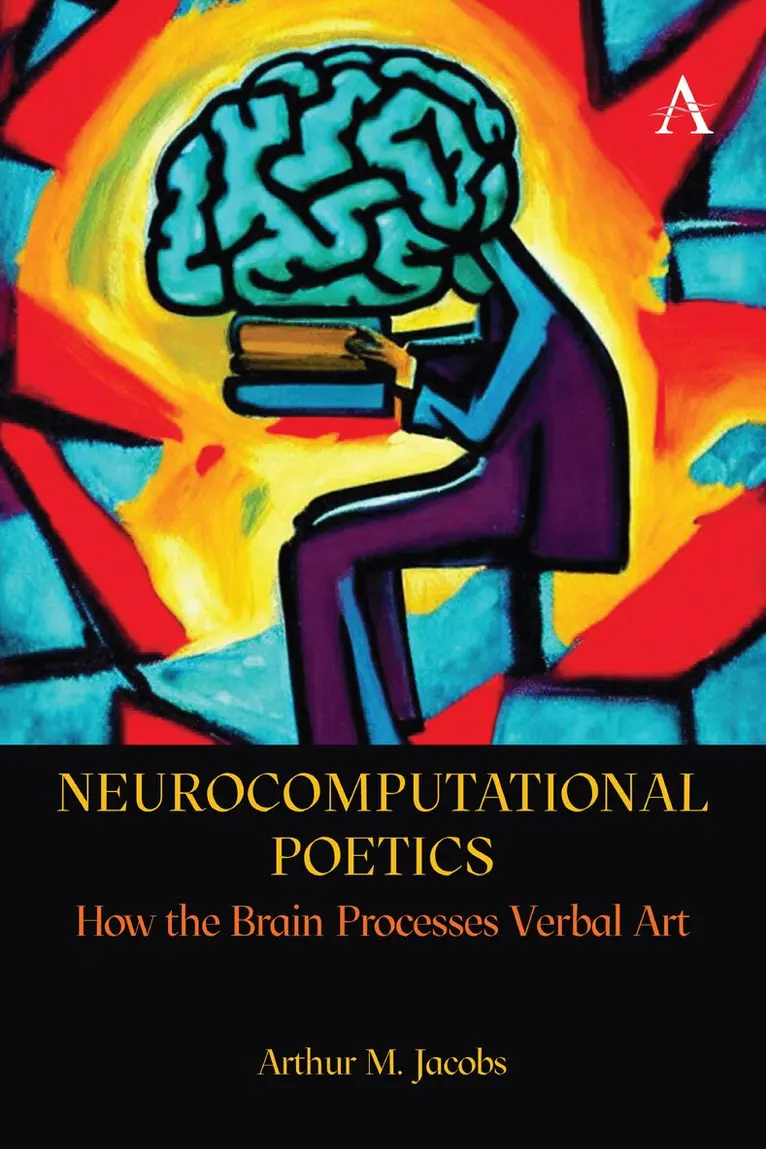
This book introduces a new thrilling field: Neurocomputational Poetics, the scientific ‘marriage’ between cognitive poetics, data science and neuroscience. Its goal is to uncover the secrets of verbal art reception and to explain how readers come to understand and like literary texts. For centuries, verbal art reception has been considered too subjective for quantitative scientific studies and till date many scholars in the humanities and neurosciences alike view literary reading as too complex for accurate computational prediction of the neuronal, experiential and behavioural aspects of reader responses to texts. This book sets out to change this view.
433 kr
Tillfälligt slut
433 kr
Tillfälligt slut
391 kr
Skickas inom 5-8 vardagar
This book introduces a new thrilling field: Neurocomputational Poetics, the scientific ‘marriage’ between cognitive poetics, data science and neuroscience. Its goal is to uncover the secrets of verbal art reception and to explain how readers come to understand and like literary texts. For centuries, verbal art reception has been considered too subjective for quantitative scientific studies and till date many scholars in the humanities and neurosciences alike view literary reading as too complex for accurate computational prediction of the neuronal, experiential and behavioural aspects of reader responses to texts. This book sets out to change this view.
2 298 kr
Skickas inom 5-8 vardagar
This handbook reviews efforts to increase the use of empirical methods in studies of the aesthetic and social effects of literary reading. The reviewed research is expansive, including extension of familiar theoretical models to novel domains (e.g., educational settings); enlarging empirical efforts within under-represented research areas (e.g., child development); and broadening the range of applicable quantitative and qualitative methods (e.g., computational stylistics; phenomenological methods). Especially challenging is articulation of the subtle aesthetic and social effects of literary artefacts (e.g., poetry, film). Increasingly, the complexity of these effects is addressed in multi-variate studies, including confirmatory factor analysis and structural equation modeling. While each chapter touches upon the historical background of a specific research topic, two chapters address the area’s historical background and guiding philosophical assumptions. Taken together, the material in this volume provides a systematic introduction to the area for early career professionals, while challenging active researchers to develop theoretical frameworks and empirical procedures that match the complexity of their research objectives.