Artyom M. Grigoryan - Böcker
Visar alla böcker från författaren Artyom M. Grigoryan. Handla med fri frakt och snabb leverans.
6 produkter
6 produkter
Multidimensional Discrete Unitary Transforms
Representation: Partitioning, and Algorithms
Inbunden, Engelska, 2003
5 155 kr
Skickas inom 5-8 vardagar
This reference presents a more efficient, flexible, and manageable approach to unitary transform calculation and examines novel concepts in the design, classification, and management of fast algorithms for different transforms in one-, two-, and multidimensional cases. Illustrating methods to construct new unitary transforms for best algorithm selection and development in real-world applications, the book contains a wide range of examples to compare the efficacy of different algorithms in a variety of one-, two-, and three-dimensional cases. Multidimensional Discrete Unitary Transforms builds progressively from simple representative cases to higher levels of generalization.
1 138 kr
Skickas inom 10-15 vardagar
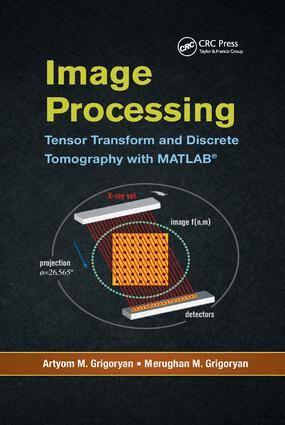
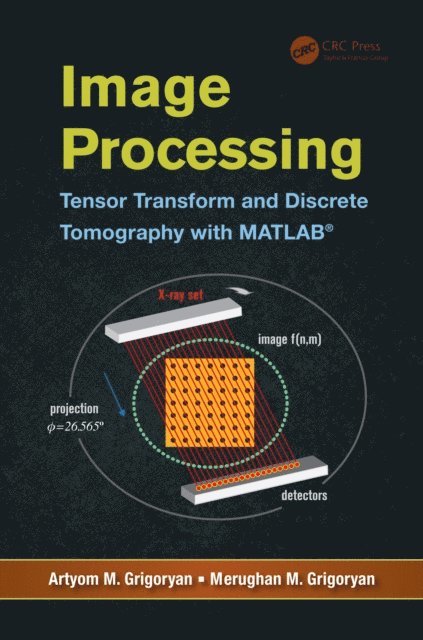
Focusing on mathematical methods in computer tomography, Image Processing: Tensor Transform and Discrete Tomography with MATLAB® introduces novel approaches to help in solving the problem of image reconstruction on the Cartesian lattice. Specifically, it discusses methods of image processing along parallel rays to more quickly and accurately reconstruct images from a finite number of projections, thereby avoiding overradiation of the body during a computed tomography (CT) scan.The book presents several new ideas, concepts, and methods, many of which have not been published elsewhere. New concepts include methods of transferring the geometry of rays from the plane to the Cartesian lattice, the point map of projections, the particle and its field function, and the statistical model of averaging. The authors supply numerous examples, MATLAB®-based programs, end-of-chapter problems, and experimental results of implementation.The main approach for image reconstruction proposed by the authors differs from existing methods of back-projection, iterative reconstruction, and Fourier and Radon filtering. In this book, the authors explain how to process each projection by a system of linear equations, or linear convolutions, to calculate the corresponding part of the 2-D tensor or paired transform of the discrete image. They then describe how to calculate the inverse transform to obtain the reconstruction. The proposed models for image reconstruction from projections are simple and result in more accurate reconstructions.Introducing a new theory and methods of image reconstruction, this book provides a solid grounding for those interested in further research and in obtaining new results. It encourages readers to develop effective applications of these methods in CT.
725 kr
Skickas inom 10-15 vardagar
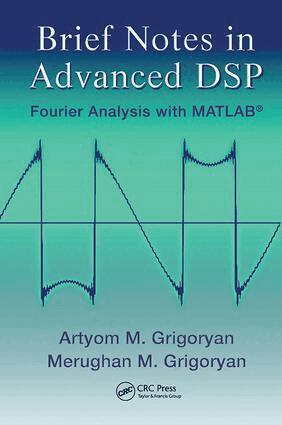
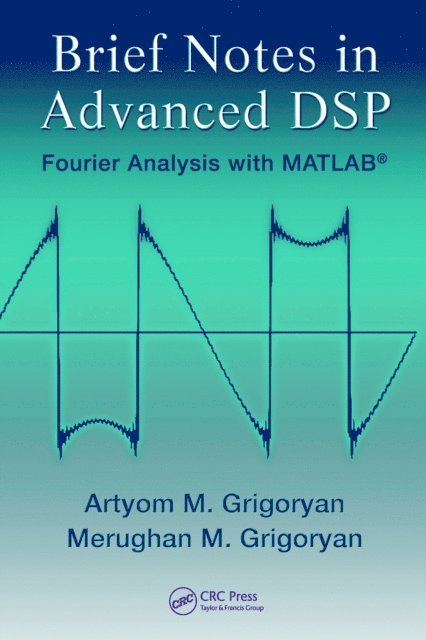
Based on the authors’ research in Fourier analysis, Brief Notes in Advanced DSP: Fourier Analysis with MATLAB® addresses many concepts and applications of digital signal processing (DSP). The included MATLAB® codes illustrate how to apply the ideas in practice.The book begins with the basic concept of the discrete Fourier transformation and its properties. It then describes lifting schemes, integer transformations, the discrete cosine transform, and the paired transform method for calculating the discrete Hadamard transform. The text also examines the decomposition of the 1D signal by so-called section basis signals as well as new forms of 2D signal/image representation and decomposition by direction signals/images. Focusing on Fourier transform wavelets and Givens–Haar transforms, the last chapter discusses the problem of signal multiresolution.This book presents numerous interesting problems and concepts of unitary transformations, such as the Fourier, Hadamard, Hartley, Haar, paired, cosine, and new signal-induced transformations. It aids readers in using new forms and methods of signals and images in the frequency and frequency-and-time domains.
1 454 kr
Skickas inom 7-10 vardagar
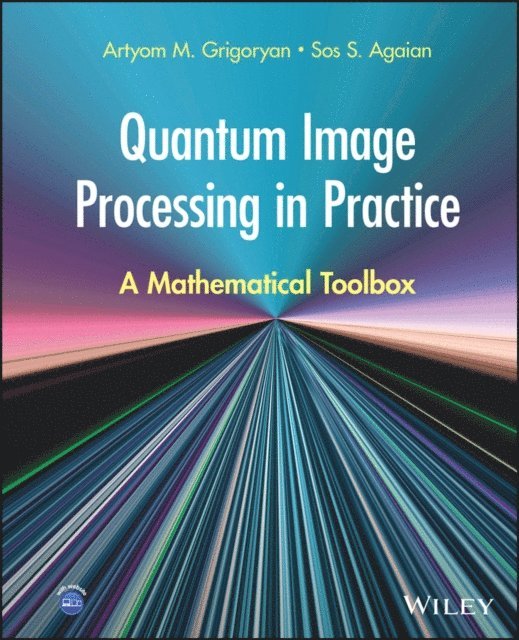
Comprehensive resource addressing the need for a quantum image processing machine learning model that can outperform classical neural networks Quantum Image Processing in Practice explores the transformative potential of quantum color image processing across various domains, including biomedicine, entertainment, economics, and industry. The rapid growth of image data, especially in facial recognition and autonomous vehicles, demands more efficient processing techniques. Quantum computing promises to accelerate digital image processing (DIP) to meet this demand. This book covers the role of quantum image processing (QIP) in quantum information processing, including mathematical foundations, quantum operations, image processing using quantum filters, quantum image representation, and quantum neural networks. It aims to inspire practical applications and foster innovation in this promising field. Topics include: Qubits and Quantum Logic Gates: Introduces qubits, the fundamental data unit in quantum computing, and their manipulation using quantum logic gates like Pauli matrices, rotations, the CNOT gate, and Hadamard matrices. The concept of entanglement, where qubits become interconnected, is also explored, highlighting its importance for applications like quantum teleportation and cryptography.Two and Multiple Qubit Systems: Demonstrates the importance of using two qubits to process color images, enabling image enhancement, noise reduction, edge detection, and feature extraction. Covers the tensor product, Kronecker sum, SWAP gate, and local and controlled gates. Extends to multi-qubit superpositions, exploring local and control gates for three qubits, such as the Toffoli and Fredkin gates, and describes the measurement of superpositions using projection operators.Transforms and Quantum Image Representations: Covers the Hadamard, Fourier, and Heap transforms and their circuits in quantum computation, highlighting their applications in signal and image processing. Introduces the quantum signal-induced heap transform for image enhancement, classification, compression, and filtration. Explores quantum representations and operations for images using the RGB, XYZ, CMY, HSI, and HSV color models, providing numerous examples.Fourier Transform Qubit Representation: Introduces a new model of quantum image representation, the Fourier transform qubit representation. Describes the algorithm and circuit for calculating the 2-D quantum Fourier transform, enabling advancements in quantum imaging techniques.New Operations and Hypercomplex Algebra: Presents new operations on qubits and quantum representations, including multiplication, division, and inverse operations. Explores hypercomplex algebra, specifically quaternion algebra, for its potential in color image processing.Quantum Neural Networks (QNNs): Discusses QNNs and their circuit implementation as advancements in machine learning driven by quantum mechanics. Summarizes various applications of QNNs and current trends and future developments in this rapidly evolving field.The book also addresses challenges and opportunities in QIP research, aiming to inspire practical applications and innovation. It is a valuable resource for researchers, students, and professionals interested in the intersection of quantum computing and color image processing applications, as well as those in visual communications, multimedia systems, computer vision, entertainment, and biomedical applications.
2 088 kr
Skickas inom 7-10 vardagar
Based on the authors’ research in Fourier analysis, Brief Notes in Advanced DSP: Fourier Analysis with MATLAB® addresses many concepts and applications of digital signal processing (DSP). The included MATLAB® codes illustrate how to apply the ideas in practice.The book begins with the basic concept of the discrete Fourier transformation and its properties. It then describes lifting schemes, integer transformations, the discrete cosine transform, and the paired transform method for calculating the discrete Hadamard transform. The text also examines the decomposition of the 1D signal by so-called section basis signals as well as new forms of 2D signal/image representation and decomposition by direction signals/images. Focusing on Fourier transform wavelets and Givens–Haar transforms, the last chapter discusses the problem of signal multiresolution.This book presents numerous interesting problems and concepts of unitary transformations, such as the Fourier, Hadamard, Hartley, Haar, paired, cosine, and new signal-induced transformations. It aids readers in using new forms and methods of signals and images in the frequency and frequency-and-time domains.
3 048 kr
Skickas inom 10-15 vardagar
Focusing on mathematical methods in computer tomography, Image Processing: Tensor Transform and Discrete Tomography with MATLAB® introduces novel approaches to help in solving the problem of image reconstruction on the Cartesian lattice. Specifically, it discusses methods of image processing along parallel rays to more quickly and accurately reconstruct images from a finite number of projections, thereby avoiding overradiation of the body during a computed tomography (CT) scan.The book presents several new ideas, concepts, and methods, many of which have not been published elsewhere. New concepts include methods of transferring the geometry of rays from the plane to the Cartesian lattice, the point map of projections, the particle and its field function, and the statistical model of averaging. The authors supply numerous examples, MATLAB®-based programs, end-of-chapter problems, and experimental results of implementation.The main approach for image reconstruction proposed by the authors differs from existing methods of back-projection, iterative reconstruction, and Fourier and Radon filtering. In this book, the authors explain how to process each projection by a system of linear equations, or linear convolutions, to calculate the corresponding part of the 2-D tensor or paired transform of the discrete image. They then describe how to calculate the inverse transform to obtain the reconstruction. The proposed models for image reconstruction from projections are simple and result in more accurate reconstructions.Introducing a new theory and methods of image reconstruction, this book provides a solid grounding for those interested in further research and in obtaining new results. It encourages readers to develop effective applications of these methods in CT.