Ashby William J. Ashby – författare
Visar alla böcker från författaren Ashby William J. Ashby. Handla med fri frakt och snabb leverans.
3 produkter
3 produkter
E-bok
Engelska, 20231 447 kr
Läs direkt efter köp
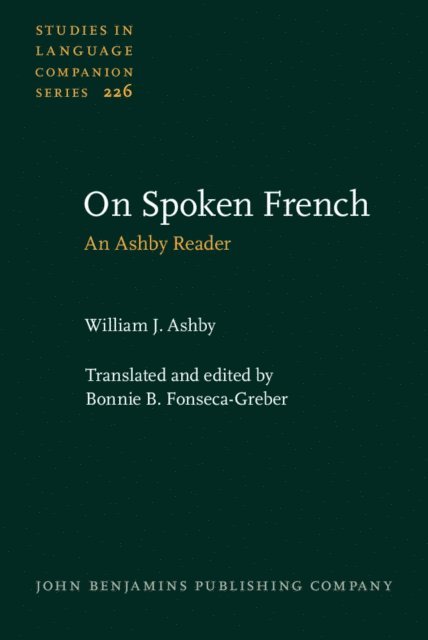
This scholarly edition invites us to reconsider our assumptions about the French language, by showcasing the oeuvre of one of the pioneers of diachronic Spoken French corpus linguistics, William J. Ashby, and the ground-breaking findings to come out of his influential Tours corpora (1976 & 1995), including two real-time studies appearing for the first time in English translation. To help readers visualize just how radically different the morphosyntax, morphophonology, and semantics of Spoken French are from French-on-the-page, the editor has developed a glossing framework, designed to capture the systemic, radically-prefixal morphology of Spoken French and the variability of change-in-progress. The model, presented here and used to gloss the examples from the Tours corpus, is also suitable for corpus-tagging. The volume is organized into sections preceded by an Editor’s note and followed by suggestions for further reading, and closes with an appendix of French corpora. This scholarly edition was written for advanced undergraduates, graduate students, and scholars in the field.
E-bok
PDF, Engelska, 19931 714 kr
Läs direkt efter köp
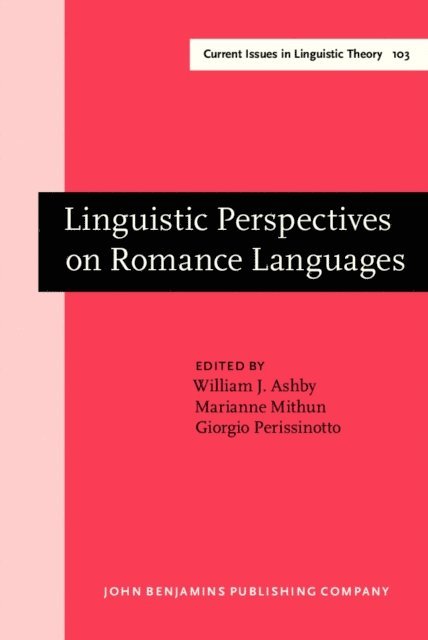
This volume presents a selection of the best papers from the 1991 Linguistic Symposium on Romance Languages, held in Santa Barbara. In addition, the volume contains revised versions of three of the keynote papers. A welcome aspect of this collection, reflective of the conference itself, is the recurrent incorporation of historical and social factors into explanations of linguistic form.
E-bok
PDF, Engelska, 20031 714 kr
Läs direkt efter köp
Preferred Argument Structure offers a profound insight into the relationship between language use and grammatical structure. In his original publication on Preferred Argument Structure, Du Bois (1987) demonstrated the power of this perspective by using it to explain the origins of ergativity and ergative marking systems. Since this work, the general applicability of Preferred Argument Structure has been demonstrated in studies of language after language. In this collection, the authors move beyond verifying Preferred Argument Structure as a property of a given language. They use the methodology to reveal more subtle aspects of the patterns, for example, to look across languages, diachronically or synchronically, to examine particular grammatical relations, and to examine special populations or particular genres. This volume will appeal to linguists interested in the relationship of pragmatics and grammar generally, in the typology of grammatical relations, and in explanations derived from data- and corpus-based approaches to analysis.