Assaf Pinkus – författare
Visar alla böcker från författaren Assaf Pinkus. Handla med fri frakt och snabb leverans.
5 produkter
5 produkter
484 kr
Skickas inom 5-8 vardagar
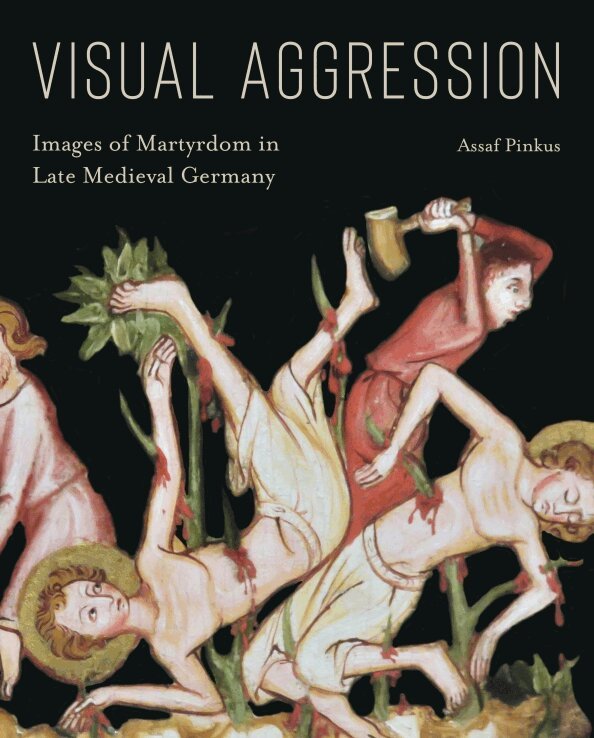
Why does a society seek out images of violence? What can the consumption of violent imagery teach us about the history of violence and the ways in which it has been represented and understood? Assaf Pinkus considers these questions within the context of what he calls galleries of violence, the torment imagery that flourished in German-speaking regions during the fourteenth and fifteenth centuries. Exploring these images and the visceral bodily responses that they produced in their viewers, Pinkus argues that the new visual discourse on violence was a watershed in premodern conceptualizations of selfhood.Images of martyrdom in late medieval Germany reveal a strikingly brutal parade of passion: severed heads, split skulls, mutilated organs, extracted fingernails and teeth, and myriad other torments. Stripped from their devotional context and presented simply as brutal acts, these portrayals assailed viewers’ bodies and minds so violently that they amounted to what Pinkus describes as “visual aggressions.” Addressing contemporary discourses on violence and cruelty, the aesthetics of violence, and the eroticism of the tortured body, Pinkus ties these galleries of violence to larger cultural concerns about the ethics of violence and bodily integrity in the conceptualization of early modern personhood.Innovative and convincing, this study heralds a fundamental shift in the scholarly conversation about premodern violence, moving from a focus on the imitatio Christi and the liturgy of punishment to the notion of violence as a moral problem in an ethical system. Scholars of medieval and early modern art, history, and literature will welcome and engage with Pinkus’s research for years to come.
711 kr
Skickas inom 10-15 vardagar
Engaging with the imaginative, nonreligious response to Gothic sculpture in German-speaking lands and tracing high and late medieval notions of the ’living statue’ and the simulacrum in religious, lay, and travel literature, this study explores the subjective and intuitive potential inherent in thirteenth- and fourteenth-century sculpture. It addresses a range of works, from the oeuvre of the so-called Naumburg Master through Freiburg-im-Breisgau to the imperial art of Vienna and Prague. As living simulacra, the sculptures offer themselves to the imaginative horizons of their viewers as factual presences that substitute for the real. In perceiving Gothic sculpture as a conscious alternative to the sacred imago, the book offers a new understanding of the function, production, and use of three-dimensional images in late medieval Germany. By blurring the boundaries between viewers and works of art, between the imaginary and the real, the sculptures invite the speculations of their viewers and in this way produce an unstable meaning, perpetually mutable and alive. The book constitutes the first art-historical attempt to theorize the idiosyncratic character of German Gothic sculpture - much of which has never been fully documented - and provides the first English-language survey of the historiography of these works.
2 189 kr
Skickas inom 10-15 vardagar
Engaging with the imaginative, nonreligious response to Gothic sculpture in German-speaking lands and tracing high and late medieval notions of the ’living statue’ and the simulacrum in religious, lay, and travel literature, this study explores the subjective and intuitive potential inherent in thirteenth- and fourteenth-century sculpture. It addresses a range of works, from the oeuvre of the so-called Naumburg Master through Freiburg-im-Breisgau to the imperial art of Vienna and Prague. As living simulacra, the sculptures offer themselves to the imaginative horizons of their viewers as factual presences that substitute for the real. In perceiving Gothic sculpture as a conscious alternative to the sacred imago, the book offers a new understanding of the function, production, and use of three-dimensional images in late medieval Germany. By blurring the boundaries between viewers and works of art, between the imaginary and the real, the sculptures invite the speculations of their viewers and in this way produce an unstable meaning, perpetually mutable and alive. The book constitutes the first art-historical attempt to theorize the idiosyncratic character of German Gothic sculpture - much of which has never been fully documented - and provides the first English-language survey of the historiography of these works.
1 515 kr
Skickas inom 5-8 vardagar
Del 20 - Studies in the Visual Cultures of the Middle Ages
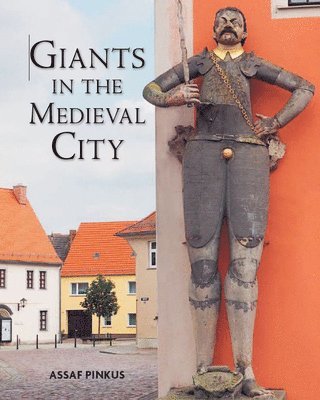
Giants in the Medieval City
Inbunden, Engelska, 2024
2 265 kr
Skickas inom 5-8 vardagar